7/26/16 Show feat. Dr. Andrea Graham on the immune system, cytokine storms, and sheep + ice algae

Graham_strongyle_nematode_400

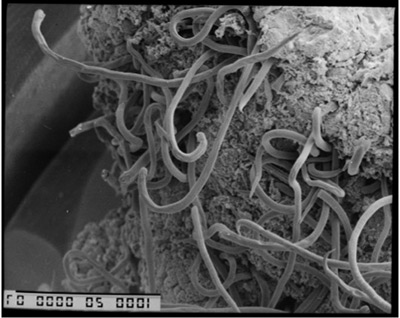
Featured image: Nematodes, pictured inside a sheep on Scottish isle St Kilda. If the immune system has to choose between fighting this worm and malaria, how should it prioritize? (credit: Graham Group)

(Audio note: Unfortunately, this week’s recording is not great. First, it starts a few minutes into the interview, so you miss the introduction; second, a recording issue distorted the quality. If anyone has a better-quality recording, let us know!)

Our guest this week was Dr. Andrea Graham, a professor in the Department of Ecology and Evolutionary Biology here at Princeton. She brought us her insight into the immune system, so we dove into the good and bad sides of the cells that usually keep us healthy. Toward the end, I talk briefly about the importance of sea ice algae in the Arctic regions, and how those Northern ecosystems might be in danger if the ice sheets shrink.

7143053047_72905000a2_o.jpg
Dr. Andrea Graham, researching sheep in Scotland. (see full album)

Andrea finds the immune system fascinating. It’s a decentralized system, with no one governing body, so it must deal with problems locally: each cell works independently. When white blood cells gang up on diseases in the body, they communicate their strategies by sending each other small protein messages. These cytokines let nearby white blood cells attack the bacteria in unison; they might also transmit messages globally through the blood stream to share antibody information with the rest of the body (this is how long-term immunization works).

The problem with decentralized systems is that they can overreact by all acting at once. If every white blood cell in the body reacts simultaneously to a new threat, the whole stream is flooded with cytokines. Your immune system’s overreaction causes fever and swelling–and sometimes even death. It’s hard to produce medicines that work against these cytokine storms, since there’s a delicate balance between stopping the immune system from self-harm and preventing it from fighting real diseases. Discovering a medicine that would slow the system gently is “the million dollar question,” Andrea says.

As with anything that has limited resources, the immune system competes with other systems in the body. It takes energy to fight nematodes and energy to reproduce, but sometimes there’s not enough energy to do both. Andrea’s group studied a sheep population, brought to a Scottish Isle centuries ago and left without predators since, to see if real groups of animals have individuals choosing between health and reproduction.

The big breakthrough came when the group found anti-correlations between sheep who reproduced often and sheep whose immune systems cleaned away parasites effectively. In fact, many sheep had healthy worm populations living in the gut, even though the worms were harmful and cost the individual resources. Trade-offs like this mean a great immune system isn’t always beneficial.
microglia_and_neurons
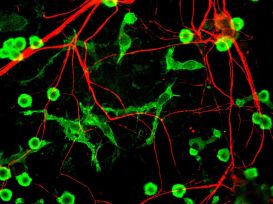
This alternative study from Imperial College blames overactive immune systems for schizophenia.

Another balance we discussed was having a weak immune system versus to an overly-strong one. White blood cells clump together to suffocate bacteria and other threats, but they can go overboard and clump up more dangerously. These groups of white blood cells block passageways over time, leading to illness. Lupus is one example of an autoimmune disease that acts in this way–and Andrea’s group is looking for correlations between being lupus-prone and having a strong immune system. By joining an existing collaboration that studied the population of Taiwan over time, the group found evidence for that correlation.

Finally, I ended the show with science news: algae living in the seasonal polar ice caps of the Arctic are crucial bedrock of the Northern food chain. The result comes out of this study from the Alfred Wegener Institute in Germany. Scientists drew fat samples from tens of species in the Arctic Ocean, tracing the composition of fats in the animals back to sea algae living in the ice. Evidently, 60-90% of the nutrition delivered to herbivores comes from this food source, which is worrying since the ice caps are quickly shrinking.

We’ll be back next week with more, better-recorded radio. Thanks for tuning in!

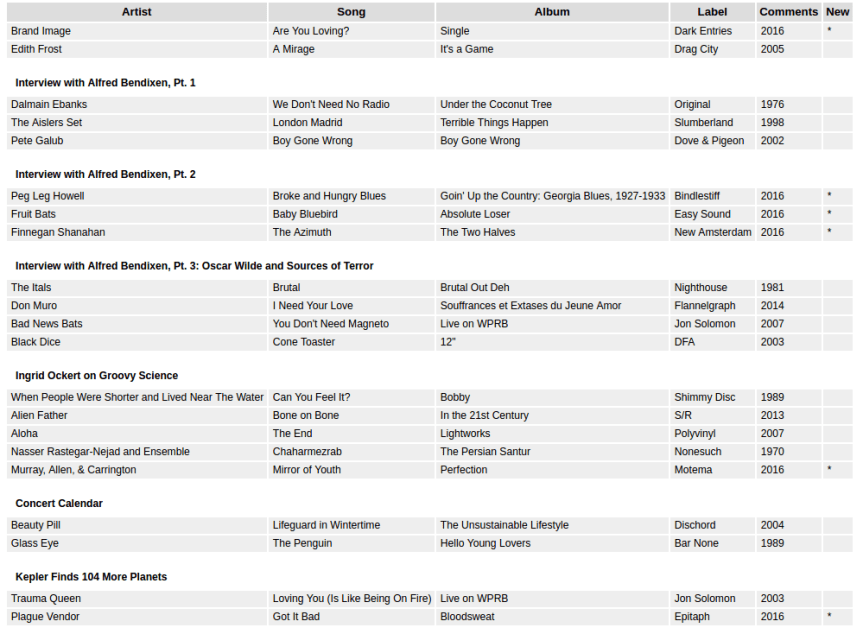
The full playlist is on WPRB.com, or below.

Screenshot from 2016-07-29 18-25-47.png

7/19/16 Show feat. Dr. Alfred Bendixen on science fiction + Ingrid Ockert with Groovy Science

KatnissFeatured image: Katniss, of the best-selling book/movie series The Hunger Games. (courtesy Wall Street Journal).

Our show this week welcomed Alfred Bendixen, Professor of English at Princeton University, who spoke with us about science fiction and the philosophy behind it. The discussion hit on many of our past shows, and gets into questions on cultural evolution and epistemology. Then, we close with Ingrid Ockert, returning to the show with another book review. She covers Groovy Science, a series of essays about the connections between 1960s scientists and hippies.

Alfred focuses his literary studies on genres that sit on the border between scholarly and popular. Detective novels, horror stories, science fiction–academia usually ignores these categories, even though they reflect aspects of society worth studying. Science fiction,

jekyllHyde
The mix of science and fantasy in Jekyll and Hyde. 

Alfred says, is written at the intersection of three ways we seek knowledge about the world: science, religion, and storytelling. Since the genre can dive into all three methods, it gives a unique perspective on our aspirations and fears about the future.


As an example of how sci-fi can inform us about our culture, Alfred brings up The Hunger Games. This enormously-popular series describes a dystopian world with a sadistic government of unaware aristocrats. Its heroine, Katniss, is named after a plant–in contrast to the broken bureaucracy that governs humans in the books, she turns to nature for stability and comfort. The story leaves plenty of room for interpretation, and can be championed by right- and left-wingers alike. The Hunger Games complex and unsettling speculation about our civilization’s future is what makes it successful, both on bestseller lists and for Alfred’s examination. As he says: “the greatest works of literature provide multiple lenses.”

As a genre, though, Alfred prefers the term “speculative fiction” to sci-fi. The writing is interesting because it wonders about our future, mixing probable developments in technology with fantasy. “Think of every science fiction story as a thought experiment,” puts Alfred, as if authors are considering the consequences of particular decisions our society makes now. The best of these stories are introspective, giving plenty of room to ponder. Alfred wonders about the hero of The Martian, sitting alone on Mars, who spends hours and hours growing potatoes but not much time contemplating his lonely existence. It’s “hard” science fiction, firmly seated in facts and real science, but it fails at examining our place in the universe and the consequences of sending humans to other worlds.

the-martian.png
The Martian, a book without much introspection.

I asked Alfred about the Juno orbiter, mentioned in our last show, which is slated to commit suicide into Jupiter to avoid spreading life to Europa and other moons. These questions about space travel are hugely prevalent in science fiction, of course, but the way they’ve been approached has changed over time. Many books assume that exploring the universe is a triumph of mankind over nature. We explore other planets, learn about the vastness of space, and experience the fragility of life in alien environments–but we never worry about polluting the Solar System or contaminating other worlds with unwanted life. As science fiction has developed, it has begun to take on more complicated pictures of morality in science. Modern works might ask: what do we stand to gain by going to space, and what do we stand to lose?

Finally, we ended the interview with an ongoing project of Alfred’s: studying “sources of terror” in American literature. There might be universal human responses to fear, but what if we examine cultural differences in our responses instead? For example, British stories feature castles owned by aristocrats, and the protagonist’s goal is to find her proper place in the world. In American stories, though, we don’t have castles: the thing to fear (and to conquer) is the expanse of nature itself, the Wild West of the American continent. And when our stories conclude, we don’t find a place for ourselves, we create one.

terminator-genisys-review-01.jpg
The Terminator’s villainous portrayal of robots.

The way we process fear in stories changes over time, too: look at robots as an example. Early literature was terrified by androids and mechanization, represented as inhuman villains in Terminator or I, Robot. But as technology has become central to our everyday lives, we have a more ambiguous relationship with robots in literature, with some benevolent and some evil. As our culture’s opinions develop gray areas and nuance, so do our stories.


After the interview, Ingrid Ockert came on air to give a summary on a book about the history of science. This week, it was Groovy Science, a collection that examines the relationship between science and counter culture during the 60s-70s.  Our stereotype of scientists after WWII was one of a bored academic in a lab, writing notes in a white labcoat. But this stodgy picture fails to incorporate the real social role of scientists in the following decades. As hippies and scientists interacted, new research became prevalent: finding better materials for surfboards, brewing better craft beer, investigating the effects of psychedelics in a lab… Groovy scientists left the shelter of academia to work on such projects, and the role that science plays in our lives has changed as a result.

Thanks to both of our wonderful guests this week!

As always, the playlist is below or on WPRB.com.

Screenshot from 2016-07-21 11-03-22.png

7/12/16 Show feat. Gloria Tavera (re-air) on Pharmaceutical R&D and Access to Medicines, plus the future of the Juno spacecraft

In this episode of These Vibes Are Too Cosmic, we re-aired an interview with Gloria Tavera, researcher in immunology and clinical translation at Case Western Reserve University andtavera_gloria president of the board of directors for Universities Allied for Essential Medicines. (Interview begins a couple minutes in to the recording.)
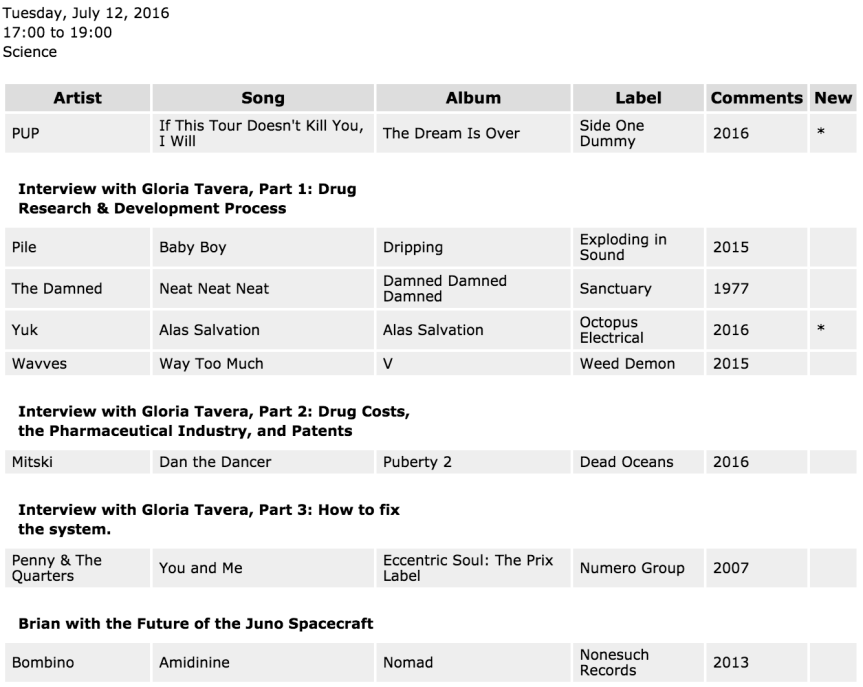
This interview was first aired in January 2016 (and was actually Part II, where in Part I Tavera discussed immunology and her research in malaria). In our discussion we take a deep dive in to the research and development process for pharmaceuticals. This takes us to the murky world of drug costs and the twisted incentive structure we have here in the US. In the final part, Tavera walks us through how this structure could be changed to obtain a better, more efficient pharmaceutical system that works for the public rather than the drug company share-holders.

In the last 15 minutes of the show Brian tells us about the fascinating, kamikaze future planned for the Jupiter satellite, Juno (and why!).


Screen Shot 2016-07-13 at 6.03.30 PM

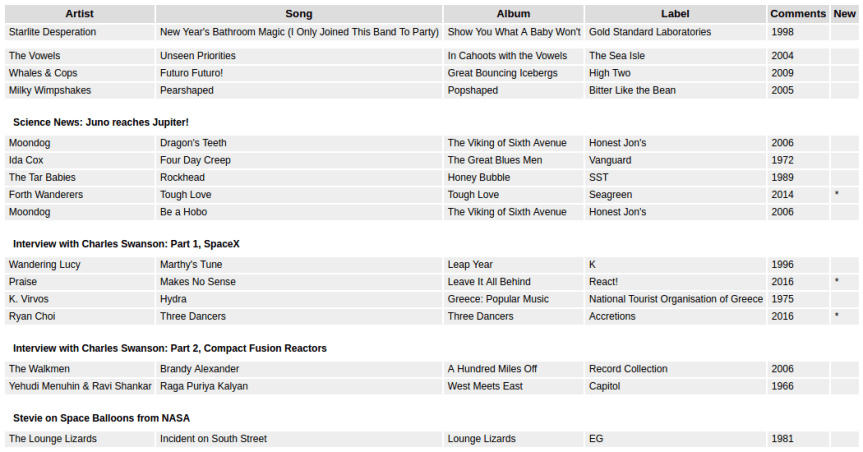
7/5/16 Show feat. Charles Swanson on compact fusion and SpaceX plus Juno on Jupiter/space balloons

crs6_launch_water.jpg

Featured Image: A SpaceX Falcon 9 launches from Cape Canaveral, FL, carrying a capsule full of cargo to the International Space Station in April 2015.

We were lucky enough to have a show full of space this week, covering all sorts of travel outside our atmosphere: NASA’s Juno orbiter just reached Jupiter last night, and long-duration atmospheric balloons are almost ready to launch regularly from New Zealand. But best of all, we had Charles Swanson, current PhD candidate in Plasma Physics at Princeton and former employee of SpaceX, tell us about space travel and his views on fusion energy.

Charles had always been looking to space, and he paid attention when Elon Musk’s revolutionary rocket venture SpaceX began in 2002. He earned an internship at the company in 2012, where he worked firsthand on the difficult mission of landing a rocket on the ground. To make spaceflight an everyday venture, we need to be recycling our vehicles: imagine if every airplane flight ended in a crash landing and we had to live with one-time-use 747s! But firing things into space requires immense speeds, so it’s very difficult to have rockets survive both the ascent into orbit and the return down to our planet.

In the end, SpaceX had to engineer its rockets to withstand the brutal vibrations of a

crs1dragonrotate2_full.jpg
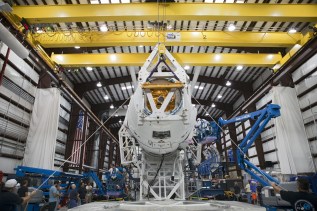
SpaceX’s Falcon 9 rocket under construction. Courtesy NASA.

launch alongside the destructive environments of high atmosphere and outer space. Alongside working on the reusable Dragon capsule, Charles played a crucial role in this endeavor: he tested the self-destruction button for the rocket. In a way, this is the most important part, since making a mistake with the landing is far worse than never landing at all. Of course, engineering a self-destruction button is a big task. The button must never be pressed accidentally (even by shaking during an ascent into space), but if you do press it, the button had better work. Charles’s experience speaks to the true difficulty of designing anything for space: it will have to endure nature at its most severe.

On the whole, Charles is optimistic about the future of spaceflight. He sees the present day as an age where launching rockets is open to companies, not just governments. And this could blow open the space industry–we’ll see a lot more tech development in the field over the next decades, and who knows what possibilities might lie in that direction for consumers and scientists. Charles had a lot to say about Musk’s influence on the company: his decisions happened on every level, from budgeting and big-picture plans to engineering the minutiae of engine wiring.

tokamaks
A cartoon of a tokamak, courtesy of EUROfusion.

After the internship at SpaceX, Charles did the only natural thing and began pursuing a PhD in Plasma Physics at Princeton. In his role as a researcher, Charles studies a special time of fusion reactor (a topic we’ve covered before on this show). But today, the leading choice for making fusion happen is big and costly: the tokamak contains a plasma very well, even if its structure takes years to build. An alternative reactor type that  keeps fusion power cheap and small is the FRC (Field Reversed Configuration).

The FRC’s versatile, simpler design comes from using the plasma itself to act as a magnet. A plasma is just a charged gas, and Charles’s group creates currents in the plasma that help to confine itself. Therefore, the whole system saves on magnet costs and can be much smaller: think small enough to fit on a spaceship or in your garage. An exciting future use for these machines might just be as fusion rockets, which could thrust a rocket across the galaxy using fusion power.

PFRC
An older version of the Princeton FRC which used to sit in Sam Cohen’s lab. It has since been upgraded, but the machine still fits on a tabletop.

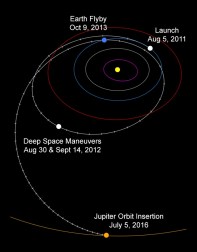
Before and after Charles talked with us, we got to some massive news for space explorers. Our show was timely enough to happen the very day that Juno arrived at Jupiter–and this is years in the making! The spacecraft Juno lifted off from Cape Canaveral here on Earth in

juno-trajectory-2016-1

2011, then took two years to circle the sun before arriving back near Earth for a gravitational assist.  Now, three years later, it finally reached the Giant Planet. What we know about Jupiter came from Galileo, a craft launched in 1989: it surveyed the many moons, and gave glimpses into Jupiter’s formation. We’ve had to wait until now for our newest technology, which is capable of seeing through Jupiter’s clouds, to learn more about the giant’s inner makeup. Give it a few years, and we may learn more about how the Solar System formed from its observations.

Stevie closed the show with a final way to travel to space–well, near Earth space, but still far above our atmosphere. Ballooning already gives scientists a great option for seeing the sky without interference from the turbulent air above us. Instead of sending a telescope into space with a rocket, letting it float up on a huge balloon is less violent for the instrument and saves us money. We have places like McMurdo in Antarctica that do this regularly (that’s where Stevie’s SPIDER telescope launched), but having a new path in the sky would let us have longer trips. To this end, NASA wants to build a New Zealand balloon base, capable of sending off long-lasting aircraft–and it’s working on the Super Pressure Balloon to help. The researchers just set a new record for balloon flight, and Stevie is optimistic about where this is headed. Stay tuned for more ways into space and more telescopes scouring the sky!

As always, the playlist is at WPRB.com or below.

070516_playlist


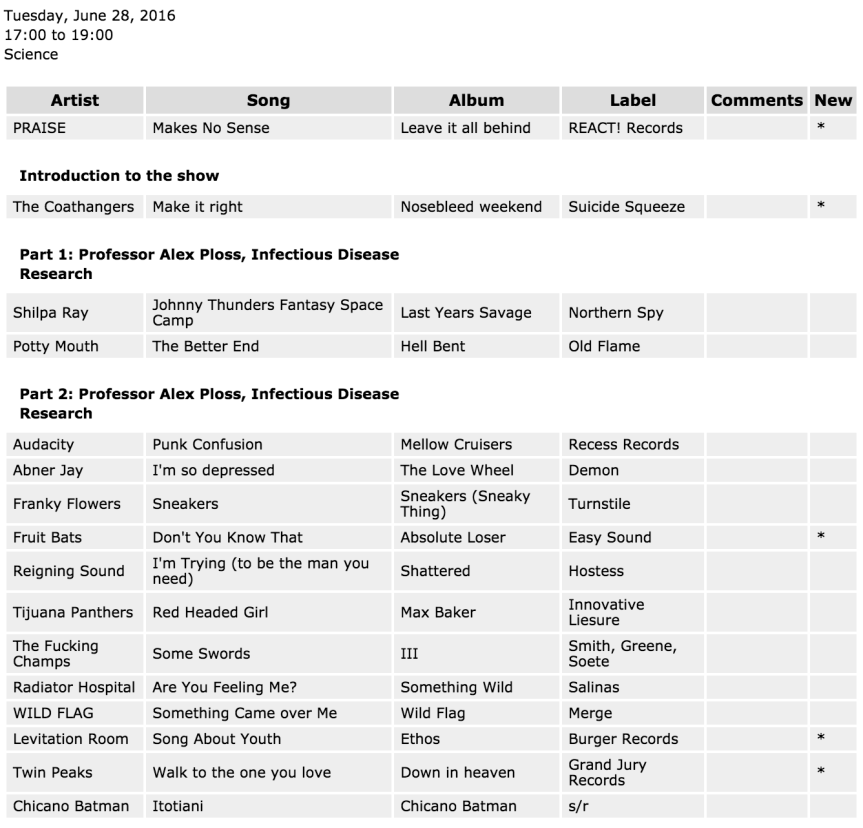
6/28/16 Show feat. Professor Alexander Ploss on Research in Infectious Diseases and It’s Global Importance

Featured image is that of an interactive map of vaccine-preventable disease outbreaks across the globe, created by the Council on Foreign Relations. You can find it, and explore it yourself, at this link.

In this installment of These Vibes Are Too Cosmic, we spoke with Dr. Alexander Ploss,

Dr. Alexander Ploss
Professor Alexander Ploss, Princeton University

professor in molecular biology here at Princeton. His research focuses on immune responses to human pathogens – specifically those infecting the liver, including hepatitis B and C viruses, yellow fever and dengue viruses and parasites causing malaria in humans. His group combines methods in tissue engineering, molecular virology and pathogenesis, and animal construction, to create and apply technologies to study human liver diseases caused by infectious diseases and if possible intervene in them. Specifically, he works to create “humanized mice” so we can study in lab mice diseases that typically only infect humans (and other very related species like great apes). In this interview, he discusses how his lab does this and the importance of this research.

I asked Professor Ploss to come speak with us because this topic of infectious diseases is incredibly important. Almost a quarter of the all human deaths worldwide occur due to infectious diseases. And, according to the WHO, in high-income countries like the United States, 7 in every 10 deaths are among people aged 70 years and older, and we perish primarily due to non-communicable diseases like cardiovascular diseases and cancer.
In contrast, in low-income countries nearly 4 in every 10 deaths are among children under 15 years, with only 2 in every 10 deaths are among people aged 70 years and older. In low income countries people predominantly die of infectious diseases like the ones studied by Professor Ploss.

Take a listen.


Screen Shot 2016-06-29 at 9.19.20 PM

6/21/16 Show feat. astrophysicist Chuck Steidel on galaxy formation & redshift + Stevie on New LIGO

quaz490_sdss_big

Featured Image: The sky, as viewed from New Mexico or Chile by Sloan Digital Sky Survey. Pointed out is a quasar at extreme redshift, almost 15 billion light years away.

Dr. Chuck Steidel, Caltech astrophysicist and former WPRB DJ, was kind enough to come into the studio during a visit to Princeton several weeks ago. He and his son Nicky (a current DJ at the station) were putting together a clash-of-generations show, so we snagged him for a talk about galaxy formation, extreme redshift, and next-generation telescopes. After that, Stevie brings us a highlight of recent LIGO results: more black-hole mergers have been detected!

Chuck is interested in the ancient universe. Back in those days, soon after the Big Bang, the first clouds of gas were clumping together to form rocks and stars. It was a chaotic time: stars were igniting at alarming rates, and UV radiation would have caused serious sunburns for creatures like us. But understanding this period can tell us how early stars formed–which helps us learn how stars progressed to form complicated elements like carbon and oxygen.

Of course, looking at something so old is not easy: it’s so far away that not much light reaches us, and the light that does has actually warped. Since the universe is expanding, the light gets redder and redder as it travels. If our telescopes on Earth can see enough light to detect these ancient star clusters, it can use how “red” the light gets as a measure of how far away the galaxy is. And this is a great tool: if a galaxy’s light is “redshifted” enough, Chuck knows it’s an old enough galaxy that it still has stars forming quickly.

20061007165757Schema_Redshift.png
Redshift “Doppler effect,” as shown on ScienceBlogs.

Of course, when the light gets redder it gets harder to see. The signal starts to blend in with light emitted from our atmosphere. So, the best plan is to put giant telescopes up in space: they need to be large to collect lots of light, but also far above the Earth to avoid atmospheric defects. Keep in mind, sending telescopes to space costs money and takes time for organizations like NASA to coordinate. As they wait for these projects to develop, astrophysicists use ground telescopes to get initial observations of distant galaxies for hints about the better data to come.

27128487781_05231bf354_o
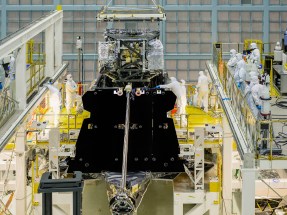
JWST, currently under construction at NASA Goddard.

One example of a next-generation telescope, steps beyond Hubble in many ways, is the upcoming James Webb Space Telescope. Not only will it have much finer resolution in the infrared for seeing distant galaxies, it’s fitted with a sensitive spectrometer to measure the precise colors of these objects. And Chuck is especially excited about that, because it will allow him to learn what elements are being churned up in these early galaxies. For now, the team takes measurements on two ground telescopes: Keck in Hawaii and Palomar in San Diego.


In the end, Chuck and I agree that science done just to satisfy human curiosity is a worthwhile pursuit. It may not lead to a better app or cure cancer, but most humans wonder about the universe outside our planet. Science for science’s sake might lead to technology we use elsewhere, but advancement is not the main point-and that’s OK. We close out with Chuck’s recollections of summers spent in the WPRB basement, where he hosted shows every day and often visited City Gardens in Trenton to interview alternative bands passing through.

After the interview, Stevie brings us more exciting news concerning our detection of gravity waves. You’ve heard in the news about LIGO’s first discovery, where they heard two black holes merge together from a billion light years away. The team has spent decades building and

LIGO-wave-location
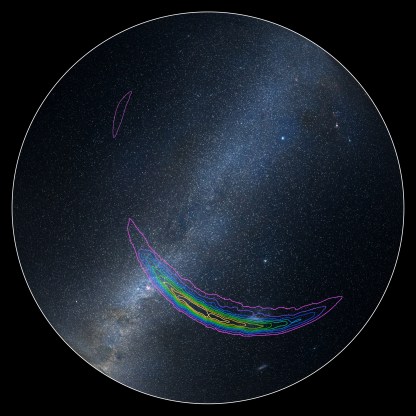
The region in the sky where the second black-hole merger was found by LIGO in December.

perfecting a massive laser observatory, one that measures tiny shifts in laser light to detect small movements in the structure of space. Only massive gravitational events (like collisions between black holes and neutron stars) can cause movements this big. And it’s getting better, because LIGO just announced a second detection of gravitational waves that they found in December. With this development, it appears even more likely that we can use gravity-wave observations to tell us about the most massive things in our universe. So stay tuned for more revolutionary science from the scientists at LIGO!


As always, the playlist is either below or at WPRB.com.Screen Shot 2016-06-22 at 10.01.13 PM.png

6/14/16 Show feat. author Mary Roach on her new book Grunt: the Curious Science of Humans at War (+ Inventing the American Astronaut w/Ingrid Ockert)

In this week’s These Vibes, the great non-fiction writer and New York Times bestselling author Mary Roach called in to the studio to discuss her new book Grunt: The Curious Science of Humans at War. Her past works include Gulp: Adventures on the Alimentary Canal, Packing for Mars: The Curious Science of Life in the Void, and Stiff: The Curious Lives of Human Cadavers.

Mary-Roach-(c)-Jen-Siska
Mary Roach. Credit: Jen Siska

In Grunt, Roach tackles the varied and interesting science and scientists behind everything that could possibly be done to keep a human beings intact – in all meanings of the word – in the extreme and often bizarre circumstances of war. Of course, it can’t cover everything, but the many topics include heat exhaustion, sleep deprivation on submarines, using maggots to clean decaying wounds (beginning on the battlefield, but now extending to difficult to treat infections), the testing and careful choices made by military uniform designers, misadventures in shark repellant, and quite a bit more. One might think that a topic like how they make and test the fabric for an infantry uniform would be really dry – but it’s really…not. Roach has an informal style that somehow manages to handle dark and serious topics with care, but without being too over-bearing. Grunt is both light-hearted and big-hearted, while being outstandingly informative, and without ever – not for a second – being dry. (She has a similar style to Bill Bryson, an author I love dearly. He wrote A Walk in the Woods and A Shot History of Nearly Everything, just to name a couple.)

mary-roach-space
Mary Roach on a parabolic flight, doing research for her prior book, Packing for Mars.

Clearly, I sincerely enjoyed reading this book. There’s this kind of interplay between what we naively think should be the case in a situation (e.g. maggots are gross and we should steer clear) and what’s actually going on when you (or Mary Roach) do a bit of research (maggots are outstanding for cleaning difficult wounds).

As I was reading I kind of came to think of it as a nerd’s beach read. Do pick it up!

Update: Mary Roach did a fun question/answer on the various terms she learned while researching for Grunt. Check it out here:

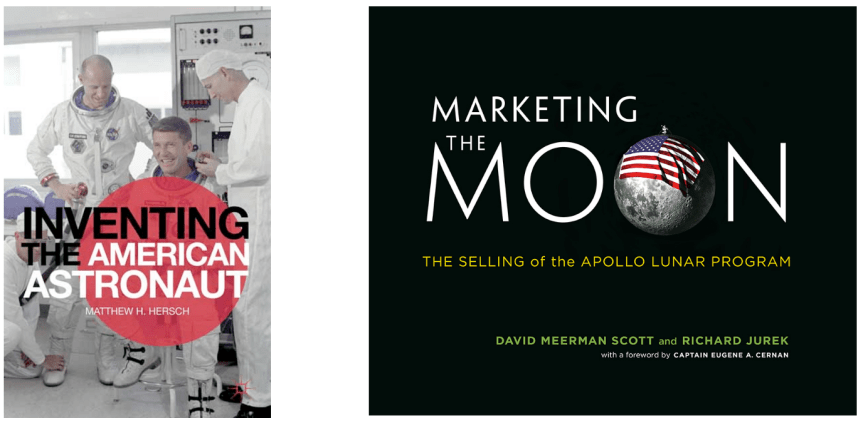
Later in the show (around 1 hour 42 minutes in), doctoral researcher in science history and regular contributor to These Vibes, Ingrid Ockert, gives an excellent and interesting report on the book Inventing the American Astronaut, by Matthew Hersch. In her piece she takes us through the ins and outs of 1960’s space culture. She also mentioned Hidden Figures (to be published this Fall and made in to a movie), by Margot Lee Shetterly, and Marketing the Moon: The Selling of the Apollo Lunar Program (MIT Press), by David Meerman Scott.

Screen Shot 2016-07-14 at 4.22.00 PM.png


Screen Shot 2016-06-15 at 9.08.58 AM

6/7/16 Show feat. Kabir Khanna on Political Psychology and Partisanship – Happy NJ Primary Voting Day

(Featured image above is from exeterstreethall.org.)

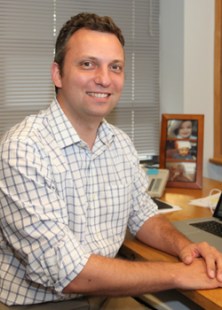
Today we discussed political psychology with Kabir Khanna, doctoral researcher in politics here at Princeton University. Kabir’s specialty is political psychology and public opinion.

kabirkhanna
Kabir Khanna, researcher in political psychology

We discuss both the polarized partisanship of elected officials, and how that compares to the electorate.  More specifically, Kabir explained that though it is clear that politicians have become more extreme on the liberal/conservative spectrum, we don’t quite know if the electorate as a whole has done the same – this is much harder to divine. Kabir discussed some methods of surveying the population to get a better handle on the truth of the situation. In fact, “the truth” and how to get there was much of our musings on today’s show.

This of course led us to discuss surveys, polls, and statistics. In particular, we discuss the details of some of Kabir’s work – which was featured in The New York Times’, The Upshot earlier this year. The work focused on how our opinion of the current state of the economy is affected by our politics, and how that affects our statement of factual pieces of information.

In this study, conducted with Kabir’s adviser Markus Prior and collaborator Gaurav Sood, they gave the participants a knowledge quiz and split them up in to three groups:

  1. group 1 was just given the quiz,
  2. group 2 was given the same quiz and told they’d get a dollar for every question they answered accurately, and
  3. group 3 again received the same quiz, but instead of getting a dollar for correct answers they were directly encouraged to be as accurate as possible.

The study found that “…[w]hen survey respondents were offered a small cash reward — a dollar or two — for producing a correct answer about the unemployment rate and other economic conditions, they were more likely to be accurate and less likely to produce an answer that fit their partisan biases.” (From the Upshot article, a very nice summary of this study and a complementary one by a group at Yale University.)

Towards the end of the show we play music by Kabir Khanna’s band, Gulps – a local New Brunswick punk band that Kabir drums for – and discuss their music a bit. (Check out their Facebook page for upcoming shows and news!)


We also mentioned a past show with chemist-and-crystal-maker, Quinn Gibson.


playlist - 6-7-16

5/31/16 Show feat. Professor David Spergel on His Research Spanning Astrophysical Scales


Featured image is of gravitational lensing in Hubble Deep Field images. See how there’s copies of galaxies and smudging. These distortions in the image are due to large massive astronomical masses between Earth and the galaxies being imaged. Photo credit: NASA

**Apologies to Professor Spergel and listeners for the poor sound quality in part 1 of the interview. We were having trouble with mics, but it was fixed for the remainder of the interview.**

wfirst_turnaround_web
Credit: NASA

In this installment of These Vibes Are Too Cosmic we interviewed Professor David Spergel, chair of the Astrophysical Sciences Department here at Princeton University, on his research. Professor Spergel has been awarded many accolades for his research including a MacArthur Fellowship (“Genius Grant”) in 2001, Nature’s Ten People Who Mattered in 2014, and the Heineman Prize in 2015. He is part of several scientific collaborations including the historic Wilkinson Anisotropy Probe (WMAP) satellite to map the cosmic microwave background, and currently the Atacama Cosmology Telescope and the Wide Field Infrared Survey Telescope (WFIRST).

Professor Spergel is known for having incredible depth and breadth of knowledge in astrophysics. In part 1, he takes us through his research spanning astronomical scales from planets to our entire universe. In part 2, we delve in to dark matter and energy, the strangeness of our universe, and the WFIRST satellite (Spergel is co-chair of the NASA science team). In the last part we answer a few listener questions which brings us to the risks involved in astronomy, the formation of our solar system (the planet Venus is weird, but it’s not a spaceship), and archeoastronomy.

Other mentions:


Playlist:

Introduction @ 12:24
Part 1 @ 20:37
Part 2 @44:56
Part 3 @ 1:20:39

Screen Shot 2016-06-01 at 10.22.10 AM

5/24/16 Show feat. Cameron Ellis on Consciousness and Cognitive Neuroscience, plus Ingrid Ockert Reviews “Making Nature”


In this installment of These Vibes, graduate researcher in cognitive neuroscience at Princeton University, Cameron Ellis, joined us in the studio to discuss his work on mental

Screen Shot 2016-05-24 at 10.25.47 PM
Cameron Ellis, Princeton University

processing as well as consciousness. In this three part interview Cameron details his research where he images the brains of infants, and what we can learn from it. Additionally, we pick apart what “consciousness” means, from both a scientific and philosophical point of view. We discuss the varying degrees of consciousness and how this relates to the consciousness of animals, like very intelligent animals such as ravens. And we discuss how this conversation can get sticky, particularly if one begins to equate intelligence with consciousness.

Further, Cameron mentions that consciousness wasn’t really studied scientifically until the 1990s, but since then there have been important milestones. For example, doctors are now better at determining the level of consciousness of an individual with “locked-in syndrome,” when someone is aware but cannot communicate verbally due to almost complete paralysis, and they can now make the patient’s time richer even in the face of the debilitating illness.

Cameron and I discussed so much, including his path to studying neuroscience and consciousness, partially by reading the book The Origin of Consciousness in the Breakdown of the Bicameral Mind, by Julian Jaynes. I encourage you to listen.

Then, past guest and doctoral candidate in science history, Ingrid Ockert returned to the studio to review the book Making “Nature”: The History of a Scientific Journal by Melinda Baldwin. She summarizes the book which focuses on the – you guessed it – history of the famous scientific journal Nature – how it began in the late 1800s as a popular science magazine and then developed in to a rigorous peer-reviewed journal. Many topics are explored in the book such as the fractured nature of science research in the 19th century due to, among other things, language barriers, and how pay walls limit peoples access to science and who can do science. We discuss this further and mention Neil Turok’s TED talk on the subject of the African Institute for Mathematical Sciences (AIMS), due to his detailing of the skewed nature of scientific research today away from, for example, African countries. Take a look:

Later, we bring this issue to today and discussed how scientific journals contain papers with research primarily funded by taxpayers’ money, yet are behind a paywall. This was discussed towards the end of a prior interview with immunologist Gloria Tavera, last semester.

At the end of Ingrid’s review, she leaves us with some interesting open questions and a few interesting companion books for further reading:

  1. Victorian Popularizers of Science: Designing Nature for New Audiences, by Bernard Lightman,
  2. Science for All: The Popularization of Science in Early Twentieth-Century Britain, by Peter Bowler, and
  3. Scientific Babel: How Science was Done Before and After Global English, by Michael Gordon.


Give it a listen.


Screen Shot 2016-05-24 at 10.19.46 PM