2/9/16 Show. The science of art conservation with Dr. Lora Angelova + a short piece on gravitational waves.


Featured image is an artist’s conception of gravitational waves from a binary system. From LIGO.org.

Image with the recording is of the inside of the Tate Britain museum in London.
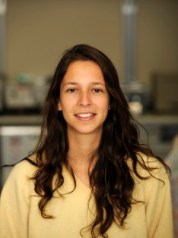
Dr. Lora Angelova in her old lab at UCL (University College London)
Dr. Lora Angelova at her old office at the University College London.

The main portion of this show is an interview with Dr. Lora Angelova – a chemist and researcher at the Tate Britain in London, England. What this means is, she uses chemistry, material sciences, physics, art history – and whatever else she needs – all towards the effort of conserving art. Currently, her research focuses on developing methods of surface cleaning artworks. Throughout our interview she takes us through some of the work involved to keep a piece of art in a state as close to its original as possible, and how much of an effort that takes. It’s truly a labor of love.

In the interview we discussed her work with NanoRestART, and micro-emulsions. Lora explained micelles, and that lead us to how soap works. Then we spoke a little on the surface of our cells – as it’s a similar concept.

From sustainablescientist.net
From sustainablescientist.net.


cellmembranes15
Simplified cell-membrane. See how it’s a double layer of the micelle?

Additionally, here’s a great YouTube video Brian suggests. The video discusses this lipid structure and how it can calm the waves in a lake.

After the interview, I spoke for a while about gravitational waves. Here’s approximately what I said on them:

If I were a betting woman, I’d say that you’re about to hear a lot in the news about these entities called “gravitational waves.” That is, if you keep up with science and tech news.

On Thursday, the LIGO experiment is having a press conference. BUT it’s been rumored for months that they might have seen something in their instrument. LIGO stands for Laser Interferometer Gravitational-wave Observatory. And what they search for is, you guessed it, gravitational waves.

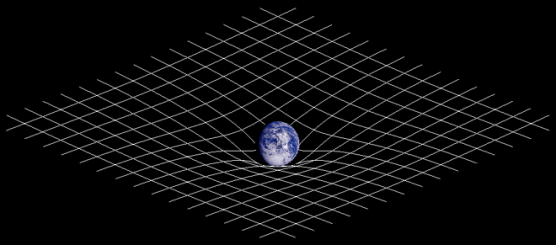
From general relativity we know that gravity – the force that makes apples fall and keeps us here on Earth, and maintains the Earth orbiting the Sun – isn’t like the other forces. The other three forces: the electromagnetic, strong, and weak forces – all operate via particle interactions. So if two objects are attracted or repelled due to the electromagnetic space_warp_GRforce, this comes about because of particle exchange. But when two objects are gravitationally attracted to each other, this comes about due to the fact that massive objects actually warp the spacetime around them. Like when you sit on your bed with lots of stuff on it and everything falls in to you. Alternatively, think of a rubber sheet pulled taught with a bowling ball set on it. The bowling ball warps the sheet, causing any marbles
a_horseshoe_einstein_ring_from_hubble
Einstein ring image taken by the Hubble Telescope.

you throw on to the sheet to fall in to the ball. This is how gravity works.

And, in our sky, we can see gravity do this due to its effect on light. Light always takes the shortest path through spacetime, so if spacetime curves due to some massive object, then the light will curve. This effect creates these fascinating images on the sky called Einstein rings – these are absolutely gorgeous and dramatic and totally incredible. You can see one of these to the right of this page, but google for images. There’s many.

So what’s a gravitational wave? Well, if gravity is curvature of spacetime, then a gravitational_wavesgravitational wave is an oscillation in spacetime. Think of it like a stretching and compressing of a small bit of space – first vertically stretched and horizontally compressed, then horizontally stretched and vertically compressed, and again and again, back and forth – but that stretching and compressing action is traveling, at the speed of light, away from its source.
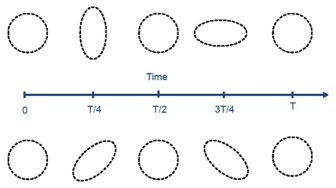
The LIGO instrument uses this property – and lasers – to try to measure gravitational waves. Essentially, they have VERY very precise lasers aimed across a distance, and if this light from the laser is stretched or compressed just a little tiny bit, then LIGO will pick it up. And if that stretching and compressing has the right signature, then it could be a gravitational wave.
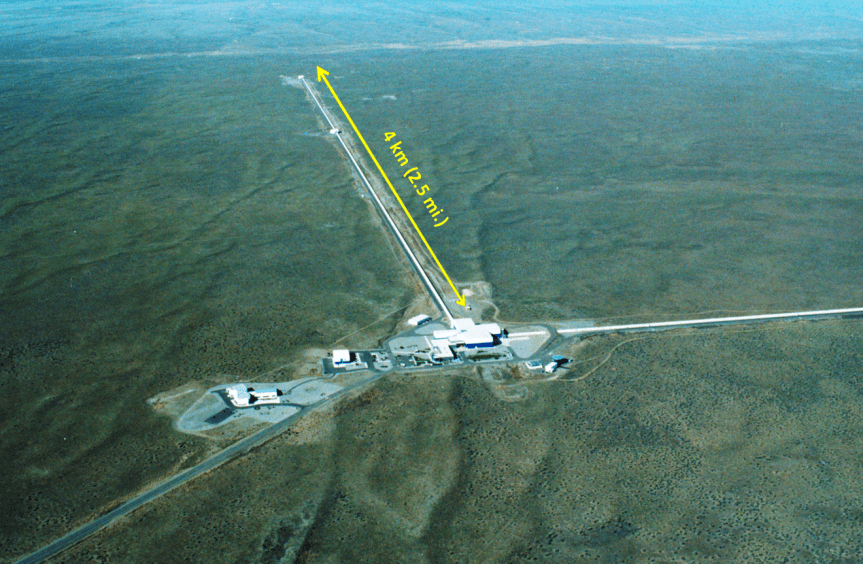
LHO_aerial_w_distance_arrow
From LIGO at Caltech website.

A good next question is, where does the gravitational wave come from? What’s the source? Well, a gravitational wave is theorized to radiate out from just about any massive, moving source. So this could be, for example, two neutron stars spinning around each other at fantastic speeds, colliding black holes. Or you, driving in your car.

A key thing to note is that gravity is SO MUCH weaker than any of the other forces. This is why a magnet that you hold in your hand could attract a paperclip via the electromagnetic force, but could never really attract anything gravitationally. If you’re in to numbers, gravity is about 30 orders of magnitude – that’s a 10 with 30 zeros after it – weaker than the electromagnetic force.

And this is why LIGO is looking to observe gravitational waves from two neutron stars spinning around each other at fantastic speeds, but isn’t worried about picking up the waves from you driving in your car. And this is also why it’s so hard – and why it’s never been done before. But LIGO has been diligent…and there have been rumors of discovery for weeks now. So…watch this space.

And just so you know – gravitational waves have never been directly observed before, but

BinaryStars_pic04E
Figure showing how gravitational waves radiate from a binary pulsar system, like the Hulse-Taylor system. From http://resources.edb.gov.hk

it’s on very very strong theoretical footing. First off, they come out of General Relativity, which has been tested time and time again. And second, they have been measured indirectly.

Here’s what we’ve seen. As a system – like binary neutron stars or black holes – radiate gravitational waves, they lose energy… this will cause the objects to spiral in towards each other and eventually collide. And this has been observed! Cue the Hulse-Taylor pulsar.

In the Hulse-Taylor system a…

…decrease of the orbital period [was observed] as the two stars spiral together. Although the measured shift is only 40 seconds over 30 years, it has been very accurately measured and agrees precisely with the predictions from Einstein’s theory of General Relativity. The observation is regarded as indirect proof of the existence of gravitational waves. Indeed, the Hulse-Tayor pulsar is deemed so significant that in 1993 its discoverers were awarded the Nobel prize for their work.

(Quoted from Cardiff University website.)

So, we are pretty sure they exist. And if we are able to observe gravitational waves directly from sources like black holes and dark matter, that would be totally revolutionary for astrophysics! It would show us the universe us in a whole, brand new way.

And with that, we’re all pretty pumped to hear what LIGO has to say on Thursday. And sometime soon I’ll try to get someone from the collaboration in here to talk about it.


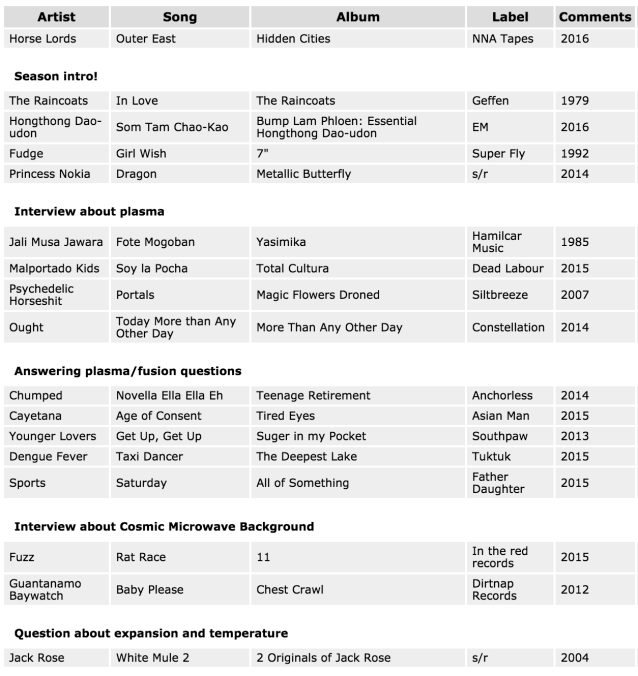
Playlist:

Screen Shot 2016-02-10 at 1.57.27 PM

2/2/16 Show. Intro to the new! co-hosted! show, and lots on plasma physics and cosmology.

Feature image: Behold! The cosmic microwave background. It was emitted just after the universe was one big plasma. Credit: Planck HFI telescope.

Welcome to the new and improved These Vibes Are Too Cosmic. Brian Kraus and Stevie christen their new time slot of 5-7pm on Tuesdays. We introduce the new format for the show – we’re switching off taking the helm each week (next week Stevie, the week after that Brian, and so on) serving up steaming offerings of science and music.

But this week, in this new show we’re so pumped about, we decided to introduce our listeners to….ourselves. We play music we love, interview each other on our respective research fields, and take questions from listeners.


Plasma physics (Brian): I work on plasmas, which are basically electrified gases. Imagine the process of melting a solid, and then boiling a liquid: in both cases, the atoms in the material are more and more free to move around as they gain energy. In a plasma, the electrons around the atoms have enough energy to escape the atomic nucleus, and what you’re left with is a gas of charged particles: negative electrons zooming around the heavier positive ions. You’d know a plasma if you saw one: they glow, like the plasma ball to the right or the lightning during a rainstorm.

plasma-lamp_2
A toy plasma ball – touch it, and one of the filaments runs to your finger (courtesy of Wikipedia).


The applications of plasma are numerous – from lightbulbs to space propulsion – but the most famous reason to study plasmas is to make fusion energy. This is the nuclear process where small atoms collide together to form bigger ones, which results in a huge energy gain for fused particles. Fusion energy could become a safe source of power, driving electrical grids with energy from seawater. The main issue is plasma containment, which means we have to keep the hot plasma (often at 10 million degrees C) from melting the walls of the container we keep it in. The most common device for magnetically confining a plasma is called a tokamak, which is basically a donut that keeps particles spinning around on a racetrack as they heat up.

mast-_plasma_bright3
MAST tokamak, a plasma containment device (courtesy of CCFE).


My own work concerns measuring properties of plasmas with probes. Since the plasma is an electrified gas, it can conduct currents and respond to voltages – which are very easy to tap into by sticking a metal wire in the middle of the plasma! By varying the bias on the metal probe (putting stronger or weaker batteries on it), I can push or pull on the electrons in the plasma. Through this general method, we can deduce the plasma’s temperature and density at many points, so we have a good map of what it’s actually doing.

You can learn a lot more about plasmas, and my work studying them, by listening to an older show where Stevie interviews me about all of this in greater detail.

plasmaProbeCropped
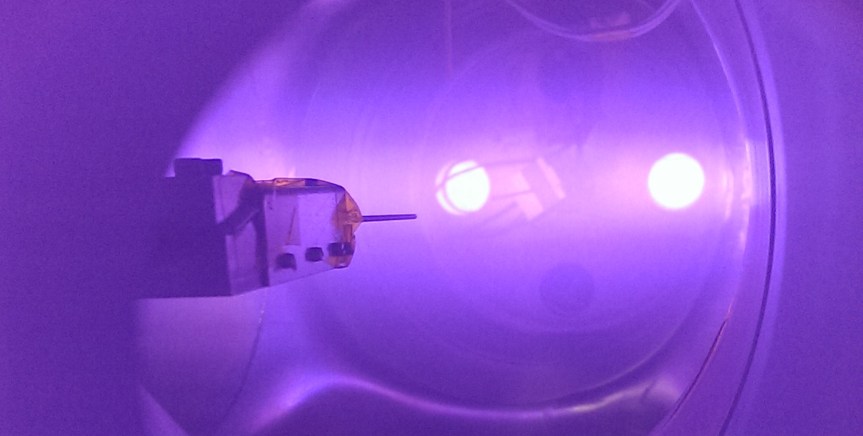
A xenon plasma that I study with the probe assembly to the left. You can see the plasma beam – the bright part in the middle – streaming toward the probe, which we use to measure properties like density and temperature.

Observational Cosmology (Stevie): I work on the SPIDER instrument, a telescope with the aim to measure the polarization in the cosmic microwave background radiation (CMB, the featured image up top). The CMB is, believe it or not, microwave radiation that bathes our entire universe. Not only is this radiation the oldest in our universe, it serves as a snapshot of our universe at that time it was emitted – over 14 billion years ago. Since it’s
discovery in the 1960s (a great story unto itself), we’ve learned the CMB (like our universe) is almost entirely homogeneous and isotropic, but with tiny variations that map to density perturbations in

bill+spider
Bill Jones, PI of SPIDER, working on the instrument in Antarctica.

our early universe. These perturbations were the seeds of all the astrophysical structures we see around us today. Currently, the cosmic background radiation is our richest source of information on the evolution and large scale structure of our universe.


At only 2.7 degrees Kelvin, this radiation is difficult to measure, but not impossible. It is still just light with a defined energy ( = wavelength) and polarization. Through decades of effort scientists have carefully mapped the temperature of the CMB. Now, the forefront of observational cosmology is to map the polarization. Incredibly, the patterns in the polarization of the CMB have the capacity to

Screen Shot 2016-02-02 at 10.47.37 PM.png
SPIDER, during its first flight in January 2015, hanging below a giant weather balloon above Antarctica.

tell us about our universe back before the CMB was even emitted, pushing our understanding of our universe back to a time just moments after the Big Bang.

The SPIDER collaboration manages this task by cooling polarization-sensitive detectors to
less than a degree above absolute zero, and then sending them to the edge of space for a 20 day flight in weather balloon above Antarctica. SPIDER’s first flight was last January (2015). The flight was successful. We’re currently analyzing our rich new data set and preparing for a second flight in the next few years. As a grad student on this project, I’m pretty psyched.


Find more on wprb.com.


1/28/16 Show feat. Anthony Berger on Cellular Decision Making and Biomedical Engineering


Our bodies are made up of hundreds of different types of cells, each with their own specific task. They react to all sorts of internal and internal stimuli as they go about their business. Sometimes they’re instructed to move left/right, reproduce, kill themselves, etc. If this all goes haywire (think, cancer), and oh man are there so many ways it could, it can profoundly affect our lives, or end them.

tony_eyes
Anthony Berger. He looks maniacal, but these eyes are all for important scientific research.

In this interview I discuss cellular decision making and biomedical engineering with Anthony Berger, PhD student at the University of Wisconsin, Madison. Tony’s work focuses on how cells respond to the structural properties of their environment – i.e. whether the tissue around them is stiff, stretchy, soft, etc. Specifically, Tony studies how tissue stiffness and fiber architecture affects the development of vasculature (blood veins) within the tissue.  To accomplish this, he designs materials that can flex to allow for changes in the rigidity of a material without changing the density of that material (a very important point in the design).

All of my designs have been based around natural materials — I generally take some sort of form of collagen (gelatin in most cases) and chemically alter it to be less flexible.  We then embedd nodules of vascular cells within the tissue and observe how the cells invade into the material and develop a system of vessels.


I liken it to an office building with people working in it.  The building is the tissue and the people are the cells doing all the work.  Drugs and chemical growth factors/hormones are like emails to the people telling them to do specific things.  Changes in different physical aspects of the tissue would be like changing certain aspects of the building — if the floors were made out of trampolines, work efficiency would probably be much different than if they were concrete.  The point is the cells are generally what do everything in your body and a lot of focus is put on them, but the physical environment, often overlooked as something that is just there, has the potential to influence a cell’s behavior.

As an example, Tony guides us through how this relates to breast cancer. Note: the stiff lump a woman may feel in her breast isn’t actually the cancer, rather an area of stiff tissue that creates a preferred environment for breast cancer to take root. Scientists aren’t sure exactly why, hence research. Take a listen!


Playlist:

Artist Song Album Label
Iggy Pop The Passenger Lust for Life Virgin
Introduction to the show
First Aid Kit Winter is all over you The Big Black and the Blue Jagadamba
Anthony Berger interview, Pt. 1 Biomed Engineering and Cellular Decision Making
Tacocat I hate the weekend Lost Time s/r
Anthony Berger interview, Pt. 2 Biomed Engineering and Cellular Decision Making  
Protomartyr What the wall said Under the color of official right Hardly art
Mourn Your brain is made of candy Mourn Captured tracks
Chastity Belt IDC Time to go home Hardly Art
Hop Along Waitress Painted Shut Saddle Creek
Paul Simon (General MD Shirinda, The Gaza Sisters) I know what I know Graceland Sony
Anthony Berger interview, Pt. 3 Discussing the music
Bad Brains I against I I against I s/r
Shilpa Ray Johnny Thunders Fantasy Space Camp Last Year’s Savage Northern Spy
Girl Band In Plastic Holding Hands With Jamie Rough Trade
Sylvan Esso Come down Syvan Esso Partisan Records
Daddy Issues Shitty World Can We Still Hang Infinity Cat
Bob Dylan Pledging My Time – Take 1 (3/8/1966) Bob Dylan, the cutting edge sampler 1965-1966 (Bootleg Series Vol 12) Columbia
Karen O Rapt Crush Songs Cult
Palehound Dry Food Dry Food Exploding in Sound

1/7/16 Show feat. Gloria Tavera on Pharmaceutical R&D, Drug Pricing, and How to Fix the System

The featured image is from Hepatitis C Infographic by Chase Perfect on the price hike of the drug.
Scroll to the bottom of the page to listen to the interview-only version.

tavera_gloriaIn my second interview with Gloria Tavera, MD/PhD student at Case Western Reserve University in Cleveland, we dig deep in to drugs. (Click here to listen to my first interview with Gloria on malaria immunology and access to medicines.)

First, Gloria takes us through the research and development process – the timeline and the costs. That brought us to drug pricing and the role of the pharmaceutical industry. You bet we discuss Martin Shkreli and his company’s price hike of the drug Daraprim from $13.50 to $750. Gloria explains what Daraprim is and how this kind of price hike is not only possible, but totally legal. It all has to do with drug patenting, which we discuss a bit, especially in reference to something called “evergreening” (aka “me too” drugs) – a technique used my drug companies to extend their exclusive patent past the 20 year mark.

In the final part of the interview, Gloria walks us through how this structure could be changed to obtain a better, more efficient pharmaceutical system that works for the public rather than the drug company share-holders. She discusses how the incentive structure needs to change, using a “push, pull, pool” mechanism.

In the show I quoted two articles that do an excellent job explaining these topics:

(1) LA Times op-ed on Big Pharma’s pricing drugs.

Big Pharma, while of course contributing to innovation, has increasingly decommitted itself from the high-risk side of research and development, often letting small biotech companies and the NIH do most of the hard work. Indeed, roughly 75% of so-called new molecular entities with priority rating (the most innovative drugs) trace their existence to NIH funding, while companies spend more on “me too” drugs (slight variations of existing ones.)

But if Big Pharma is not committed to research, what is it doing? First, it is well known that Big Pharma spends more on marketing than on R&D. Less well known is how much it also spends on making its shareholders rich. Pharmaceutical companies, which have become increasingly “financialized,” distribute profits to shareholders through dividends and share buybacks designed to boost stock prices and executive pay.

(2) Vox article explaining the news around Martin Shkreli, the pharmaceutical head recently arrested for securities fraud – though that’s not why the public hate the guy. I guess he’s also an a-hole on Twitter and bought some singular copy of a Wu-Tang album, but we have other beef.

But really the hatred for Shkreli comes from how unapologetic he was about the price increase [of Daraprim by 5,500 percent]. Other companies have pursued similar pricing strategies without stoking so much backlash.

As Forbes’s Matthew Herper wrote, “Questcor Pharmaceuticals raised the price of its drug, Acthar Gel, from $40 to $28,000 a vial. The reward? It was one of the best-performing stocks in America until Mallinckrodt bought it for $5.6 billion last year. Valeant Pharmaceuticals has done big price increases on numerous drugs. The stock’s up 740% over five years and its founder, Michael Pearson, is a billionaire. Only Shkreli has drawn the American public’s rage.”


Additionally, we touched on the history of the drug industry. Below is just a snippet from an excellent infographic that takes you through the key events in the 80’s that created the system we have in place today.

Screen Shot 2016-01-07 at 7.28.05 AM


And of course there was music.

Playlist:

Artist Song Album Label
Shilpa Ray Shilpa Ray on Broadway Last Year’s Savage Northern Sky
Intro to the show
Fatoumata Diawara Alama Fatou World Circuit Limited
Neutral Milk Hotel Holland 1945 In An Aeroplane Over the Sea Domino Recording
Bob Dylan Stuck inside of Mobile with the Memphis Blues Again The Cutting Edge Sampler, 1965-1966 (Bootleg Series Vol. 12) Columbia/Legacy
Shye Ben Tzur, Jonny Greenwood Roked Junun ATC Management
Interview with Gloria Tavera, Pt 1 Drug Research and Development Process
Dan Auerbach Trouble Weighs a Ton Keep it Hid Nonesuch Records
Beat Happening Red Head Walking Look Around Domino Recording
The Beverleys Visions Brutal Buzz Records
Interview with Gloria Tavera, Pt 2 Drug costs, the pharmaceutical industry, and patents
Abner Jay I’m So Depressed One Man Band Subliminal Sounds
The Sadies Hold on, Hold on In Concert Volume 1 Yep Roc
Beach Slang Hard Luck Kid The Things We Do To Find People Who Feel Like Us Polyvinyl
Palehound Molly Dry Food Exploding in Sound
Interview with Gloria Tavera, Pt 3 How to fix it.
Adult Mom Survival Momentary Lapse of Happily Tiny Engines


Just want to listen to the interview? Don’t have time for the music? Here ya go.

12/24/15 Show feat. Lucianne Walkowicz on Exoplanets and Alien Megastructures

af6bbdfdd36307c7cb26702fd0da799d8bd7f505_800x600Happy Christmas, listeners! In this rockin’ show Lucianne Walkowicz called in to WPRB from the Adler Planetarium in Chicago, where she works on NASA’s Kepler Mission as well as the Large Synoptic Survey Telescope (a telescope currently being built down in Chile). In this interview we focus on the Kepler mission’s search for exoplanets – these are planets outside of our solar system. We discuss questions such as: What makes a planet habitable? How does a star’s properties influence the planet’s habitability? How does Kepler go about finding these planets when they’re so much smaller and dimmer than their accompanying star? How could we know if there is life on these planets? And much more!
We delved in to some mysteries found by the Kepler mission, including KIC 8462852, aka “Tabby’s Star.” In late October, news stories about this anomalous star went viral as speculation swirled about what it could be. One of the theories stated that the star’s weird signature could be evidence of an advanced alien civilization. In this interview, Lucianne tells us why. (To listen to the interview – just the interview without the rest of the music, etc. of the rest of the show – click here.)

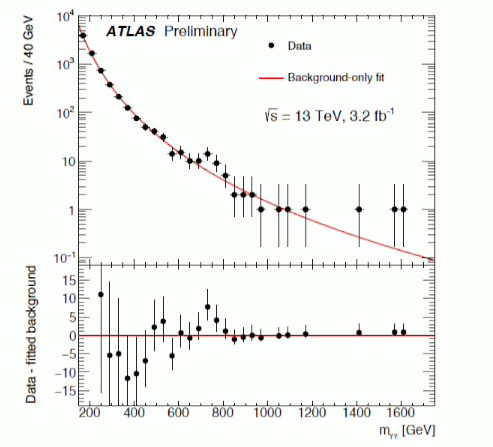
Towards the end of the show I played a short interview with particle physicist Stephane Cooperstein on recent findings out of the Large Hadron Collider in Switzerland – and what they could mean. More information here. In the interview we mention the plot below.cwrui2owiaat7o52b


Extra resources:

Lucianne’s rad punk band, DITCH CLUB, just released a new EP! Listen here:


Show playlist:

Artist Song Album Label
Wanda Jackson, The Cramps Funnel of Love Heart Trouble CMH Records
Intro (2:35)
Gang of Four Ether Entertainment Warner Brothers
The Wyrms War Machine At Wizard Island Negative Fun Records
Car Seat Headrest Oh! Starving Teens of Style Matador
Jeff Rosenstock You, in weird cities We cool? Side one dummy records
Lucianne Walkowicz, Part I Exoplanets, Stars, and Alien Megastructures N/A
Nana Grizol Galaxies Ruth Orange Twin Records
Dismemberment Plan What do you want me to say? What do you want me to say? b/w since you died DeSoto Records
Pochoclo Las Trillizas de Oro ¡Chicas! Spanish Female Singers Vol.2 1963-78 VAMPISOUL
Lucianne Walkowicz, Part II Exoplanets, Stars, and Alien Megastructures N/A
Ditch Club King of Cups EP ditchclub.bandcamp.com
Ditch Club Reality Check EP ditchclub.bandcamp.com
Worriers Yes All Cops Imaginary Life Don Giovanni
The Fall My New House This Nation’s Saving Grace Beggars Banquet Records
Interview with Stephane Cooperstein New Results from the Large Hadron Collider N/A
Old Town School of Folk Music Twist and Shout Songs For Wiggleworms Old Town School
Joanna Gruesome Wussy Void Weird Sister Slumberland
Blonde Redhead Cat on Tin Roof Barragán Blonde Redhead


12/17/15 Show Discussing Women and Minorities in STEM and the Arts with Simone Sneed

Featured image above is from Empower Magazine article, “Overcoming the rarity of underserved minorities in STEM”.

simonesneed_headshotIn this episode of These Vibes Are Too Cosmic I speak with Simone Sneed, board liaison at the Environmental Defense Fund and professor at NYU in Civic and Social Organization, on the troubling statistics of women and minorities in STEM (science, technology, engineering, and mathematics) fields. We get deep in to this topic, speculating on how it came about and what can be done about it as well as current initiatives working towards getting more minorities in STEM fields. Additionally, we discuss the analogous trends in arts and business/non-profits.
Simone Sneed also writes for many news sources, including the Huffington Post. One of my favorite of her pieces is on “What the Shutdown Taught Us About Women’s Leadership.”

Screen Shot 2015-12-17 at 11.11.04 AM
Scientists and engineers working in science and engineering occupations: 2013 Image and statistics from NSF.gov


At the end of the show, I jump back on the mic to mention a recent press release from the president of the American Astronomical Society in response to a new study claiming that the GRE physics exam shows little correlation with success in the field and that the scores appear to be systematically biased against women and minoritiesThen I briefly mention some new results out of the Large Hadron Collider! More on that in the next show.


Some extra resources:


Playlist for the show:

Artist Song Album Label
LCD Soundsystem Watch the tapes Sound of Silver Parlaphone
Intro (3:47 – 9:17)
Jonathan Richman & The Modern Lovers New England Roadrunner: The Berserkeley Collection Sanctuary
New Madrid Forest Gum Sunswimmer New West Records
Elia Fleta Tu vida cambio Chicas! Spanish female singers vol 2 1963-78 vampisoul
Downtown Boys Montro Full Communism Don Giovanni
Part 1: Simone Sneed (20:55 – 36:51)
Lou Reed Walk on the wild side Transformer RCA
Carseat Headrest Something soon Teens of Style Matador
Happyness Refrigerate Her Weird little birthday Bar none records
Kim Jung Mi Haenim Now Lion Productions
Part 2: Simone Sneed (52:21 – 1:16:00)
Shamir Youth Ratchet XL Recordings
tUnE-yArDs Bizness W H O K I L L 4AD Ltd
Little Dragon Klapp Klapp Nabuma Rubberband Seven Four Entertainment
Leikeli47 Heard em say Leikeli47 Hard Cover
Part 3: Simone Sneed (1:31:30 – 1:37:06)
G.L.O.S.S. Outcast Stomp DEMO s/r
Girl Band Um Bongo Holding Hands with Jaime Rough Trade
Skinny Girl Diet Dimethyltryptamine Skinny Girl Diet Fiasco Recordings
The Distillers Drain the blood Drain the blood Reprise Records
Mic Break (1:49:45 – 1:53:06)
Sales Renee Sales EP s/r
Outro: Science news! (1:56:00 – 1:59:00) The AAS/pGRE and the new LHC findings

12/10/15 Show Discussing Big Science with Guest Co-Host Brian Kraus, Plasma Physicist

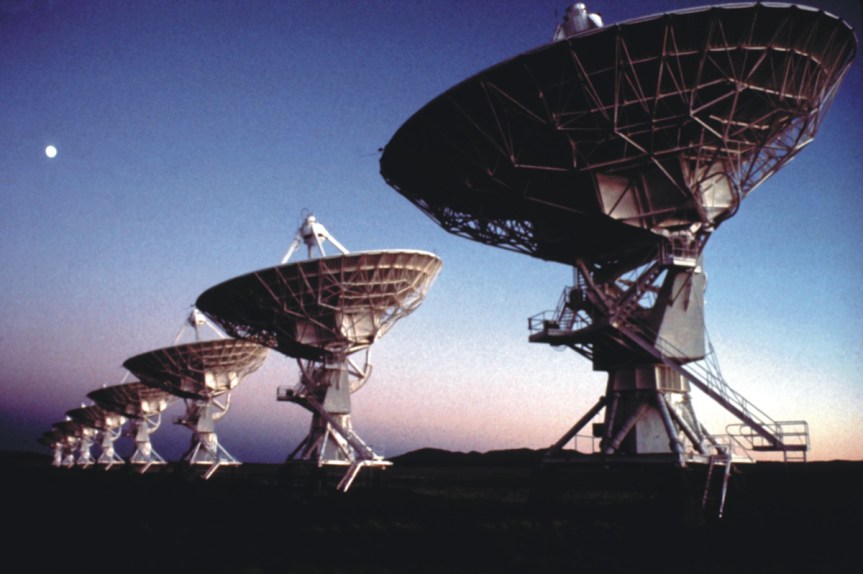
(Featured image above is of the Very Large Array telescopes. Image from the National Radio Astronomy Observatory.)

In this show Brian and I discuss what’s called “Big Science.” What we mean when we use that descriptor, and some of the amazing examples across the science fields including satellites to undersea observatories to particle colliders and fusion reactors. We also discuss some of the overwhelming obstacles to big science — from funding to choosing a project a whole field agrees on to getting thousands of scientists across the world to collaborate smoothly. There are positive and less so examples of these, and we mention several. Additionally, we dig a little bit in to how we got here. How big science projects became necessary, when they weren’t just decades prior.

And interweaved with all of that is, as always, music.

Discussion begins at about 3 minutes in.

(Cover image of the recording is from the ALICE experiment (one of the four detectors at interaction points in the Large Hadron Collider) at CERN.)

Some mentions during the show:


Playlist below:

Artist Song Album Label
The Tuts Christmas is in the air Have Faith with Kate Nash This Christmas 10p Records
Intro (3:00)
Mourn Otitis Mourn Captured tracks
Sally ford and the sound outside They told me Untamed Beast Partisan Records
Courtney Barnett Shivers Blue Series Third man records
Dark Dark Dark In your dreams Wild go Supply and Demand
Mic break 1 Big science
Chastity Belt Seattle Party No Regrets Help yourself
Shopping No show Why Choose fat cat
Grimes SCREAM (feat. Aristophanes) Art Angels 4AD records
Skating Polly Ugly Fuzz Steilacoom Chap Stereo
Mic break 2 Big science
Dan Aurebach The Prowl Keep it hid V2 Records
MOTO Gagging on the Edge of Love Ampeg Stud / Motoerectus Motopac
Beat Happening Indian Summer Indian Summer 7″ Domino
Wreckless Eric Whole Wide World Greatest Stiffs Stiff Records
Mic break 3 Big science
Wolf Eyes T.O.D.D. I am a problem: mind in pieces Third man records


12/3/15 Show feat. Gloria Tavera (Case Western) on Malaria, Immunology, and the Fight for Equal Access to Medicines

Malaria is a colossal global problem. In Africa, a child a minute perishes due to the parasite. It’s easy not to be aware of this in the US, where malaria hasn’t been a problem for many years – but 3.4 billion people (half the world’s population) lives in areas at risk of the disease.

untitled-thumbnailIn this episode of These Vibes Are Too Cosmic I speak with Gloria Tavera, MD/PhD student at Case Western Reserve University in Cleveland, Ohio. We discuss the general mechanics of our immune systems and malaria’s effect on it. We get in to why malaria is so difficult to treat and why so many children die from the parasite. Gloria explains the new malaria vaccine – both why it’s exciting and how it is far from a full solution (or even a full malaria vaccine), but rather an important step along the road to eradication.
In the last portion of the show we discuss another deeply important topic, and a great passion of Gloria’s: equal access to medicines worldwide. Gloria is president of the board of directors for UAEM (Universities Allied for Essential Medicines), an organization that uses a muti-tiered approach to leveling the access to affordable medications across the world, and particularly in developing countries. Gloria uses the example of insulin. In Sub-Saharan Africa people commonly die of diabetes due to the fact that insulin is rare and, when available, unaffordable. The system is stacked against them.

So, listen up, learn about our world, and get fired up!

Some extra info on malaria immunity (from Gloria Tavera):

news-malaria-breakthrough-510-x-288

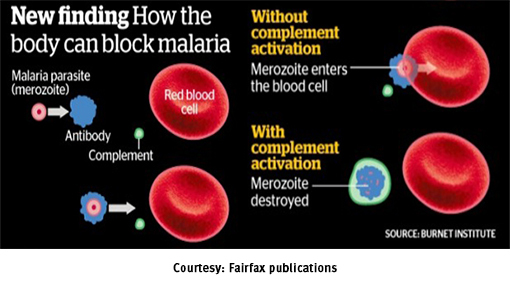
The figures above (found here) show how an antibody, along with a set of molecules called complement, can bind a malaria parasite and keep it from invading a human red blood cell, which keeps it from surviving and reproducing.

news_graphical_abstract
The second figure above on that page shows how the set of molecules, called complement, bind to antibodies and make the antibodies even more effective at killing the malaria parasite and keeping it from entering human red blood cells.
More information on the fight for access to medicines (from Gloria Tavera):
UAEM creates a report card that grades universities on their access to medicines policies. We do this every other year (this one’s from 2015, then next one will be released in 2017).

Here’s a short video we made that explains what is wrong with the current reseach and development system and how we propose to fix it.

Related to that video, is a petition to the World Health Organization (WHO) that we have created. We are calling on World Health Organization member states to fund a pool of money (prize funding) for researchers to create drugs, diagnostics and vaccines that are targeted to help solve diseases of major public health importance, that will be available royalty-free.

If you’re interested in going even deeper, read the recent LA Times piece from Economist Mariana Mazzucato, on problems and solutions regarding our current, global biomedical research and development system.


Playlist for the show:

Artist Song Album Label
The Coathangers Springfield Cannonball Suck My Shirt Suicide Squeeze
Show intro
Angel Olsen Creator, Destroyer Strange Cacti Bathetic Records
Sleater Kinney Hey Darling No Cities to Love Sub Pop
Courtney Barnett Boxing Day Blues (Revisited) Blue Series Third Man
Wolf Eyes Enemy Ladder I am a problem: Mind in pieces Third Man
Gloria Tavera Malaria Immunology
Swearin’ Just Swearin’ Salinas
Candi Stanton Sweet Feeling Stand By your man Parlophone
Fugazi Waiting Room 13 Songs Dischord
Beat Happening Foggy Eyes Indian Summer 7″ Domino
Gloria Tavera Malaria Immunology
Nap Eyes No man needs to care Whine of the mystic Paradise of bachelors
Hunx & his punx You think you’re tough Street punk Hardly art
Patti Smith Smells like teen spirit – radio edit Outside society Sony
Gloria Tavera UAEM
Queens of the Stoneage

(Interviewee pick)

Mosquito song Songs for the deaf Interscope
Willy Mason

(Interviewee pick)

Oxygen Where the humans eat Virgin records
Hinds

(Interviewee pick)

Trippy gum Very best of hinds so far Mom and pop


11/12/15 Radio Show feat. Quinn Gibson on Crystals, Semiconductors, and Solid State Chemistry

Quinn Gibson is a doctoral candidate in chemistry here at Princeton University where he works in a solid state chemistry group, the CavaLab. From what I gather, they’re all about looking for materials with new and interesting properties. First they make predictions based on physics and chemistry, then they synthesize the materials — metal crystals — and characterize them. In their lab, one edict is “don’t be a baby about blowing stuff up.” So, kids. If you want to blow stuff up without living a life of crime, chemistry may be for you.

Just how the invention of the transistor has revolutionized every aspect of our lives, the new materials that Quinn creates, like these weird things called topological insulators, could change everything. He explains it all right here in this show.

Also check out Quinn’s music at qfolk.bandcamp.com. We play a couple tunes on the air and he tells us how they came about.

P.S. Check out Jack on Fire’s new songs on their soundcloud (this show features the excellent tune, Beat the Rich)!

The featured image is from a scanning tunneling microscope. It’s used to image the surface of a 3D topological insulator in order to better get at its properties. From:  http://wwwphy.princeton.edu/~yazdaniweb/

Artist Song Album Label
Chumped Hot 97 Summer Jam Teenage Retirement Anchorless Records
Intro
Taco Cat Psychadelic Quincinera NVM Hardly Art
Renny Wilson Juke Box Hero Punk Explosion/Extension Mint records
Best Coast Last Year The Only Place Kemado Records
Mbongwana Star Coco Blues From Kinshasa Nonesuch
Interview with Quinn Gibson Solid State Chemistry
Torres Honey Torres SR
State Lines Water Song For the Boats Tiny Engines
The Lookouts Once Upon a Time Spy Rock Road Don Giovanni
Jack on Fire Beat the Rich N/A https://soundcloud.com/jackonfiredc
Boogarins 6000 Dias Manual Other Music
Interview with Quinn Gibson Solid State Chemistry
Qfolk Eloquence Songs I wrote qfolk.bandcamp.com
Qfolk When they came Songs I wrote qfolk.bandcamp.com
White Lung In Your Home Deep Fantasy Domino Records
Blackbird Raum Silent Spring Blackbird Raum SR
World/Inferno Friendship Society The Packed Funeral The Packed Funeral Alternative Tentacles
Interview with Quinn Gibson
Mika Miko Take it serious CYSLABF Kill Rock Stars
Black Breath Fallen Heavy Breathing Southern Lord Recordings
Mitski I don’t Smoke bury me at makeout creek Don Giovanni
Reviver Antennas Versificator Exigent
Mischief Brew Gimme Coffee, or Death Songs from Under the Sink Fistolo Records

11/5/15 Radio Show feat. Elizabeth Davison and Anastasia Quintana on the Power of Networks

Elizabeth Davison is a graduate student in Mechanical and Aerospace Engineering here at Princeton University where she studies the capability of using networks to measure the processes in our brain. We speak generally on what a network is, what are neural networks vs. “a network of neurons”, and her work specifically, then we broaden to applications.

Next, with Tasha Quintana, doctoral candidate at the Nicholas School of Environment at Duke University, we discuss one powerful application of networks — information sharing in fisheries in Baja California. Then we go on to discuss work to broaden successful networks in Baja to larger networks, like the environment we all share.

For more information on this fascinating topic, Elizabeth Davison recommends:

Another beautiful representation of networks and information flow. This image is a network of information flow in the sciences through citations. Follow the link and you can click on different portions of the ring to see how certain fields have a lot of interactions, as well as looking at the data journal-by-journal.
http://well-formed.eigenfactor.org/
From well-formed.eigenfactor.org, this beautiful image tracks information flow in the sciences by following citations in journal articles.
Additionally, we got some music in! Here’s what we played:
Artist Song Album Label
The Descendants Myage Milo Goes to College Cesstone Music
Aye Nako Killswitch The Blackest Eye Don Giovanni
Ethiocolor Helle Loyo Helle Ioha S/T Selam
Mika Miko Business Cats CYSABF Kill Rock Stars
Interview with Liz Davison, Part 1 Networks
Young Fathers I heard Tape 2 Just isnt music
GLOSS Masculine Artifice Demo S/R
Shopping No Show Why Choose FatCat
Adam Miller Death Row Democracy http://www.adammillerdrums.com/#!beats/ctd9 S/R
Stromae quand c’est Racine Carree Mosaert
Interview with Liz Davison, Part 2 Networks
Pens Love Rules Love Rules/You only like me when I’m telling you I’m wrong De Stijl Records
Palehound Dixie Dry Food Exploding in Sounds Records
Speedy Ortiz No Below Major Arcana Carpark Records
Lord Nelson Shengo West Indies Funk Vol 3 Voodoo Jazz
Mischief Brew Coffee, God, and Cigarettes Songs from Under the Sink Fistolo Records
Interview with Tasha Quintana, Part 1 Fisheries as networks
Stone Foxes Stomp Bears & Bulls Boonie Blues
My Morning Jacket Rocket Man Chapter 1: The Sandworm Cometh Darla Records
Interview with Tasha Quintana, Part 2 Fisheries as networks
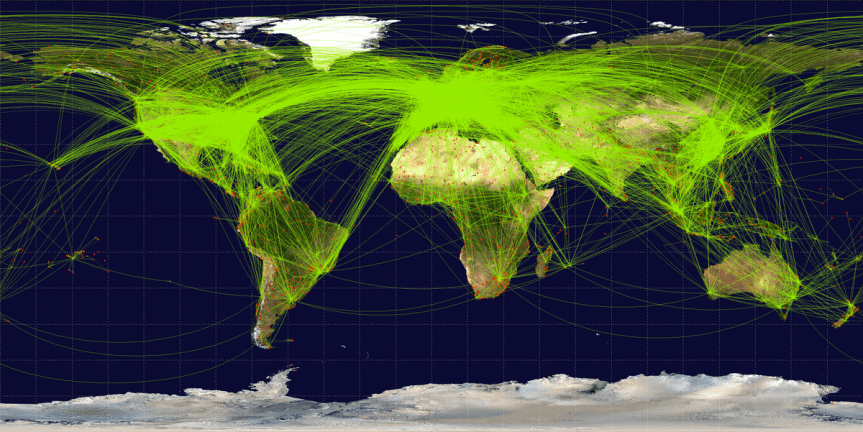
(The featured image for this post is from “World-airline-routemap-2009” by Jpatokal – Own work. Licensed under CC BY-SA 3.0 via Commons – https://commons.wikimedia.org/wiki/Fi…)