Short show due to the new 6-8pm time slot and a sports interruption. We give an update on science events in the area and share some science news, as well as some new music, as always.
Science news:
First results from the NASA twin study with astronaut Scott Kelly and his brother (who stayed on Earth), Mark. Right now the analysis of the data is in the early stages, but there are potentially interesting results with telomeres – the ends of the DNA chromosome whose diminishment tends to correlate with aging.
Brian presented an interesting study about differences in gene behavior between genders and implications for disease susceptibility.
In this week’s installment of These Vibes, we spoke with Tamara Patton, doctoral researcher at the Woodrow Wilson School at Princeton and in the Nuclear Futures Lab, on her work using emergent technologies, specifically virtual reality, in nuclear arms control. She also delves in to the prospect of nuclear proliferation and arms control under the Trump presidency and the upcoming nuclear weapon ban treaty taking place this March at the UN.
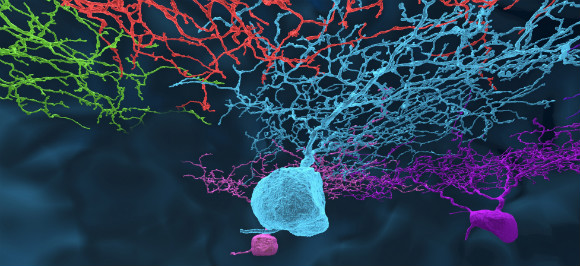
Featured image is from Eyewire the connectome project run by Sebastian Seung at Princeton University.
Image in the Mixcloud embed above is from the Human Connectome Project at the University of Southern California.
This show is a little different. The plan was to have author and professor Patrick Phillips on for the first hour, alas there had to be a rescheduling at the last minute. Instead we will be interviewing Patrick Phillips on his book Blood at the Root at the end of next month (January 2017), so stay tuned.
Hour 1: Lots of music and some science news, including self-driving cars. Hour 2:Thomas Macrina on machine learning, neuroscience, and mapping our brain – our connectome. Hour 3: Kasey Wagoner, lecturer in physics at Princeton, on the bedrock scientific principle called the Equivalence Principle. In this discussion, Kasey tells us about the history, the principle’s importance, and current tests.
Zero-knowledge object-comparison set-up. In our discussion with Sébastien Phillipe, these are the “detectors” filled with flourocarbon droplets floating in gel. (What bubbles when hit by neutrons.) Image Credit: (c) Nuclear Futures Laboratory
Pt 1: Introduction to the show and the physics of baseball with Kasey Wagoner, lecturer in physics at Princeton University and member of the Atacama Cosmology Telescope collaboration. Kasey described the physics behind the curve in the curveball, and why knuckleballs are so hard to hit (and catch). Additionally, there’s a physical explanation for what baseball players call the “sweet spot” on a bat.
is an expert in the topics of nuclear weapons non-proliferation, arms control, and disarmament. We discussed his dissertation research on an experimental setup to make use of something called the “zero knowledge proof” to solve an acute problem in nuclear disarmament — verification. Listen in to learn more.*
This interview was a kind of part 2 to our earlier interview with Julien de Lanversin on nuclear energy, arms, and policy. That show would provide good background on this interview with Sébastien, but it’s necessary. I highly recommend giving it a listen.
For further reading, in the show we mention a New Yorker article featuring Sébastien Phillipe and his graduate adviser, Professor Alex Glaser. Though we had trouble with the analogy for the zero knowledge proof that was used in the piece, it’s a great article.
Additionally, Stevie mentions a recent NPR piece on the current state of US-Russia relations which is relevant to these discussions on nuclear arms and verification.
Pt 3 (2.5 hours in): Brief interview with Lizzie Wade, Latin America correspondent for Science magazine, discussing her recent piece on how the Colombia peace deal affects ecologists and biologist who wish to study the nation’s biodiverse countryside. (Unfortunately, the article is behind a paywall, but if you happen to be a subscriber, you should be able to find it by looking for “Colombia peace deal blow dismays ecologists.”)
This was These Vibes Are Too Cosmic’s radioactive WPRB pledge drive show! Once a year, WPRB takes a week to raise money for the station – and make our entire operating budget for the year. (WPRB lives at Princeton University, but is an independent station – Princeton only donates the space.) If you’re seeing this, you (probably) can still donate! Just go to pledge.wprb.com.
Here’s the show:
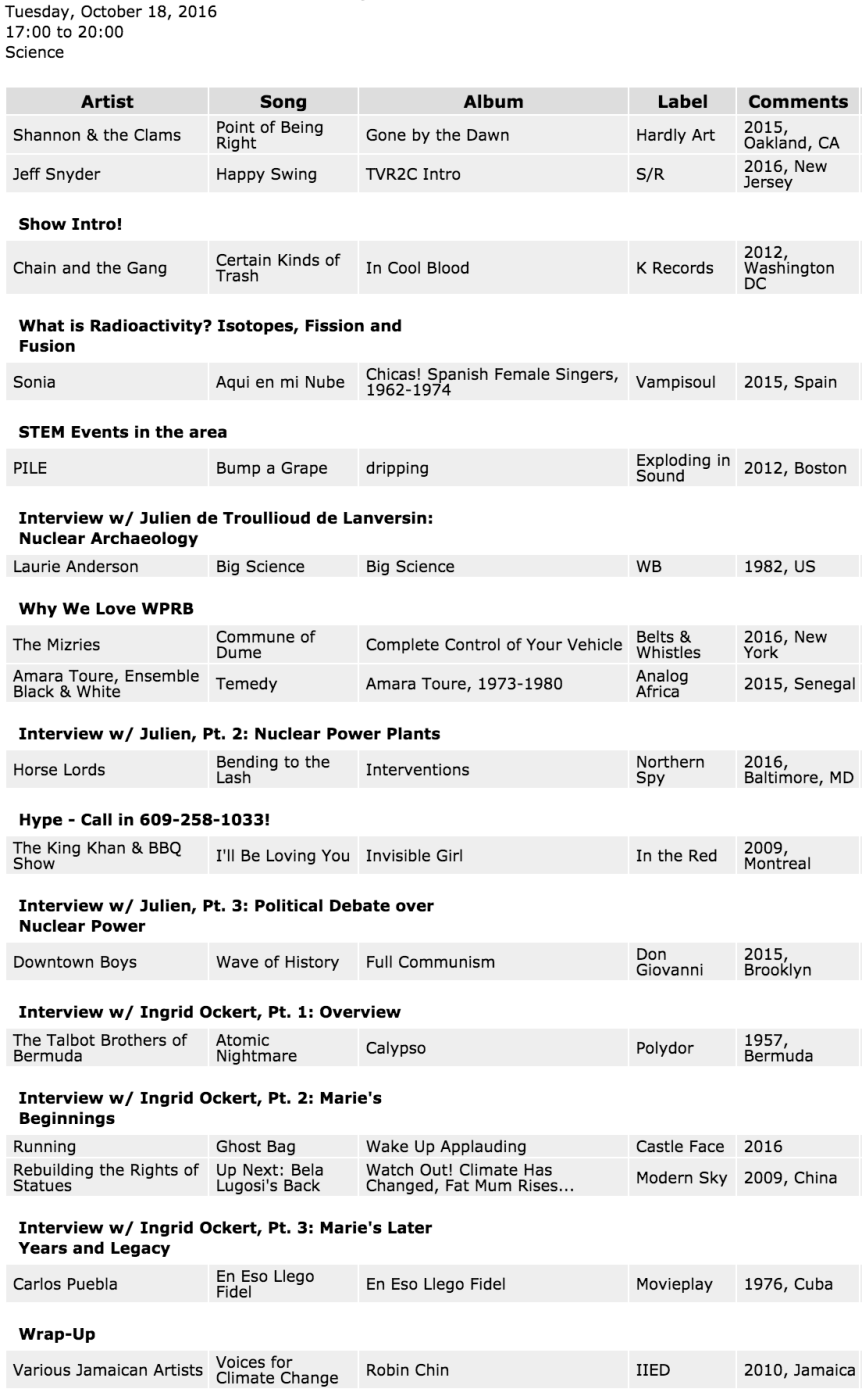
Part 1: Introduction, Brian & Stevie provide a kind of primer on the science of radioactivity and announce some science events in the area.
Futures Laboratory at Princeton University. Our discussion centered around nuclear energy, disarmament, and nuclear archaeology. We discuss both the science involved, and the global security policy. Towards the end of the segment, Julien explains how a nuclear power plant converts Uranium-235 fuel to energy, and the key points of the Iran nuclear deal.
Part 3 (2 hours in): Brian and Ingrid Ockert discuss the life of Marie Curie and the history of the discovery of radioactivity!
In this installment of These Vibes we covered much ground. Our long form interview (one hour in to the recording) was with molecular ecologist and population biologist Bridgett vonHoldt, assistant professor in Ecology and Evolutionary Biology at Princeton University. Professor vonHoldt’s research centers around using the concept of epigenetics to understand evolutionary change. Epigenetics, as Professor vonHoldt explains, is the study of changes in an organism that come about due to gene expression rather than the genes themselves. Specifically, she researches the epigenetics of canids — these are canines like our beloved dogs and the Yellowstone wolf — and the evolutionary biology of the domestication of dogs.
New Nobel Prize in physics announcement (the winners include Princeton’s own, Professor Duncan Haldane) for “theoretical discoveries of topological phase transitions and topological phases of matter.” We discuss a little of what this means.
Nature as Muse – Friends of Princeton Open Space has invited four creative professionals to lead workshops in the Mountain Lakes Preserve that inform how nature influences fragrances (perfumer), cuisine (chef), poetry (writer), and branding and design (graphic designer). 4 Sundays in October, beginning October 9th. (Click link for more information.)
In this installment of These Vibes, we welcomed Joseph Amon, visiting lecturer at the Woodrow Wilson School here at Princeton and Vice President for neglected tropical diseases at Helen Keller International, on human rights, the rights to health and education and their interdependence, and neglected tropical diseases. Later in the interview he describes his path, which takes us in to a discussion on the different approaches to addressing human rights deficiencies.
Show schedule:
First hour: Science news and a survey of the science research being done by astronauts on the International Space Station (ISS).
Second hour (56 minutes in): Interview with Joseph Amon. Interview-only recording below.
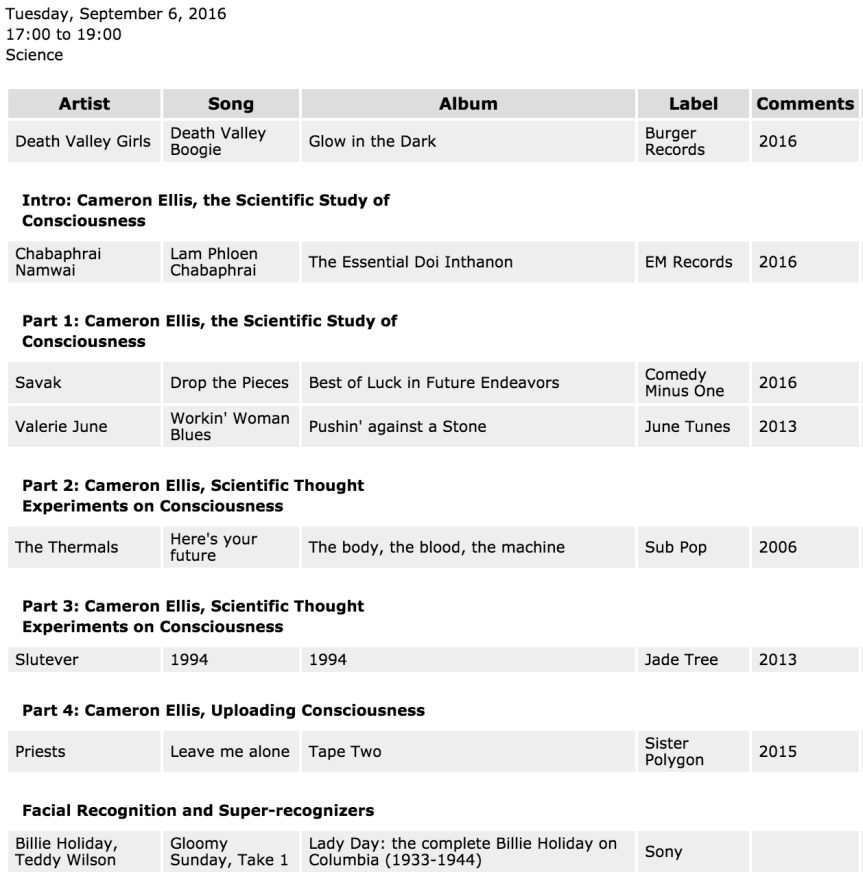
In this episode, we brought Cameron Ellis back in the studio. Cameron is a graduate researcher in Cognitive Neuroscience in the Turk Browne lab here at Princeton, whose research focuses on consciousness and mental processing. We first talked to Cameron back in May (2016 – in that show he walked us through the nitty gritty of his research, as well as the fascinating history of the study of consciousness as a scientific discipline and the important research that has had a profound effect on peoples’ lives.
Here’s a short, incomplete list of the topics we discuss in the show:
What does the term consciousness even mean? If we’re going to talk about it, we need to be able to define it. Or perhaps is the study of consciousness our attempt to, in fact, scramble for a definition?
What is the idea of qualia? and why is it important to the discourse on consciousness? That brought us to the discussion of the Mary’s room (aka the Knowledge Argument) – roughly, does experience add anything if you already know everything on a topic – thought experiment and the Inverted Spectrum (is what you see as green what I see as green? how could we know?).
Shortly after, we discussed the Chinese Room thought experiment (could a computer be conscious?), language learning, and Strong AI.
In the last part of the interview Cameron explains the concept of uploading consciousness and the Simulation Hypothesis (that our universe is actually a simulation within the computer of another universe – no but really though).
At the very end of the show, Brian jumps on the mic to discuss a recent New Yorker article on so-called super-recognizers, and a new squad of them in the London police force. Super recognizers are individuals who are incredibly skilled at facial recognition. This may sound strange, but we all know people (and may even be this way ourself) who are terrible at recognizing faces – people with something called face blindness – so it makes sense that there are individuals on the other end of the spectrum, those that are extremely attuned at recognizing an individual, even as they’re trawling through the thousands of faces in a CCTV video searching for that serial lawbreaker.
This week on These Vibes, Stevie interviewed Matt Grobis, graduate researcher in the department of Ecology and Evolutionary Biology here at Princeton. Matt is also director and co-founder of Princeton Open Labs which organizes science outreach talks and activities for local schools, and writes for a couple blogs: Highwire Earth, an interdisciplinary blog on sustainable development in our changing and growing society where he’s managing editor and co-founder (Matt and Julio Herrera Estrada, the fellow founder of Highwire, came on TVR2C previously for a short segment where they discussed the site) and The Headbanging Behaviorist, which mixes science, activism, and music (so he fits right in here at These Vibes Are Too Cosmic).
We began our discussion with some of the things animals can do together that they cannot especially do alone. Examples of these are migration and predator evasion. For example, the fish shiners prefer to stay in shadows because that will protect them from predators lurking above, but – as Matt discusses in the show – they can’t see the gradients in light well, and thus have difficulty find the shadows unless they’re in a group. Individuals could measure the light level where they were and would change their speed to match it, but they couldn’t actively move to darker areas, so they’re much more likely to be snapped up by a predator. (Here’s the study that found this.)
Grobis conducts his research both in a lab with actual schools of minnows in a tank and cameras recording their movement (he even has some fake predator concoction to scare the fish), as well as “theoretically” – read: with computer models (like this interestingSchool of minnows, from wikicommons.
agent-based model he mentions in the show). Matt’s lab research measures what’s called the “startle.” This is the wave that passes through a school of minnows, for example, when they are, well, startled. In the show Matt also calls this a “cascade.” (Here’s the original paper on startles , also featured in Cell, that Matt’s research is building on.) Matt is seeing if the mechanisms by which the cascade spreads hold up when there’s elevated perception of risk in the environment. Preliminary results indicate that under increased perception of risk, startles might spread a bit differently!
As an example of interesting group behavior, Matt later discussed a specific study (“Uninformed individuals promote democratic consensus in animal groups”, Couzin et al. 2011) that was done with schools of fish. In this experiment the group cannot break apart, but part of the group wants to go towards a blue stimulus and another part really wants to go towards yellow – the behavior that emerges is interesting and seems very relevant to human situations we get in to all the time. (Choosing a dinner place in a big group, anyone?) You can take a look at the study here, and read a blog entry in Headbanging Behaviorist where Matt discusses what happened behind the scenes (a kind of “making of” of the study – this will be much more accessible than reading the paper itself).
After the interview, Matt noted that “one of the reasons Couzin et al. 2011 is so cool is that they started with the models and found the results in that theoretical universe on their computers. Then, they really hammered it home by showing it’s true in the real world too. So it’s more a good example of the power of combining theoretical models with experiments.” How cool!
In the show we received some excellent listener questions. One listener asked whether Matt’s research on the behaviors of groups could be used to control humans. From this we determined that maybe “control” was a bit strong, but that perhaps this group research could help us better guide traffic, be it in a street or a busy transit hub like an airport. Remember, “ants don’t have traffic jams.”
(In this part Matt mentioned research on autonomous robots that his adviser Iain Couzin is working on. It’s sponsored by the Office of Naval Research and is shared with Mechanical and Aerospace Engineering Professor Naomi Leonard.)
If you live in the Princeton area, and especially if you have school-aged children, please check out Matt Grobis’s side project Open Labs!
In this episode of These Vibes Are Too Cosmic, we re-aired an interview with Gloria Tavera, researcher in immunology and clinical translation at Case Western Reserve University and president of the board of directors for Universities Allied for Essential Medicines. (Interview begins a couple minutes in to the recording.)
This interview was first aired in January 2016 (and was actually Part II, where in Part I Tavera discussed immunology and her research in malaria). In our discussion we take a deep dive in to the research and development process for pharmaceuticals. This takes us to the murky world of drug costs and the twisted incentive structure we have here in the US. In the final part, Tavera walks us through how this structure could be changed to obtain a better, more efficient pharmaceutical system that works for the public rather than the drug company share-holders.
In the last 15 minutes of the show Brian tells us about the fascinating, kamikaze future planned for the Jupiter satellite, Juno (and why!).
















 president of the board of directors for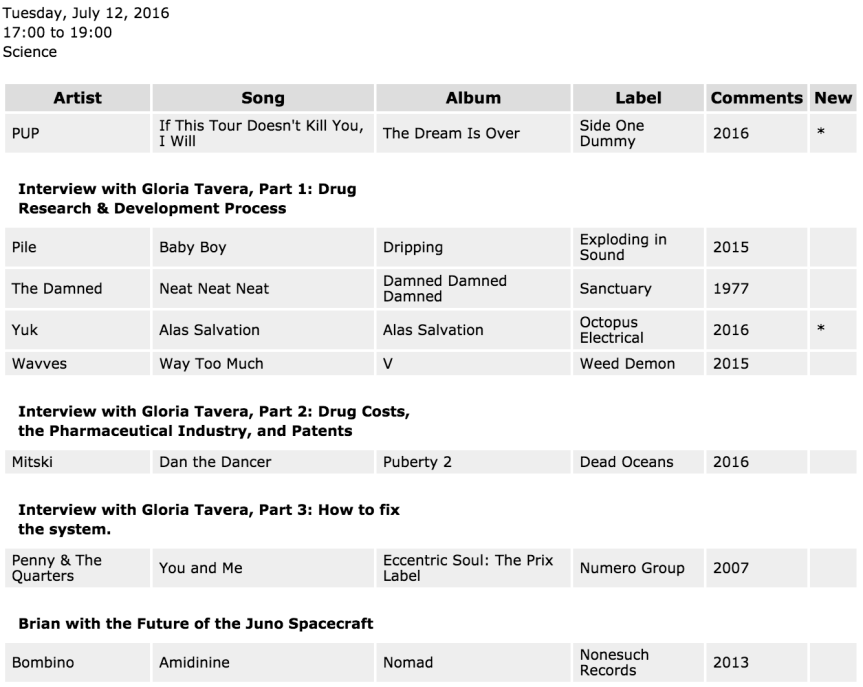
 These Vibes Are Too Cosmic