Featured image is from NASA. See below for explanation and credits.
It was a bit of a chaotic show in the studio. Just before start, we were told that our show would be interrupted a half hour in by basketball. Plans were thrown out and the drawing board went up. Blessedly, the sports only hijacked our live-stream. The day turned in to a beautiful show of music, with a great discussion on dark matter just before the end (around 1.5 hours in). The planned airing of an interview on exoplanets with astronomer and TED fellow Lucianne Walkowicz has been postponed.
The featured image for this post is from NASA. It’s the famed bullet cluster we mentioned so many times on the show! Two galaxies clusters collided, producing the image. Hot gas from normal matter colliding and interacting is in pink, and dark matter is in blue. You can see the dark matter just flew right past everything, maintaining its spherical shape.
This composite image shows the galaxy cluster 1E 0657-56, also known as the “bullet cluster.” This cluster was formed after the collision of two large clusters of galaxies, the most energetic event known in the universe since the Big Bang. Hot gas detected by Chandra in X-rays is seen as two pink clumps in the image and contains most of the “normal,” or baryonic, matter in the two clusters. The bullet-shaped clump on the right is the hot gas from one cluster, which passed through the hot gas from the other larger cluster during the collision. An optical image from Magellan and the Hubble Space Telescope shows the galaxies in orange and white. The blue areas in this image show where astronomers find most of the mass in the clusters. The concentration of mass is determined using the effect of so-called gravitational lensing, where light from the distant objects is distorted by intervening matter. Most of the matter in the clusters (blue) is clearly separate from the normal matter (pink), giving direct evidence that nearly all of the matter in the clusters is dark. The animation below shows an artist’s representation of the huge collision in the bullet cluster. Hot gas, containing most of the normal matter in the cluster, is shown in red and dark matter is in blue. During the collision the hot gas in each cluster is slowed and distorted by a drag force, similar to air resistance. In contrast, the dark matter is not slowed by the impact, because it does not interact directly with itself or the gas except through gravity, and separates from the normal matter.
In the last half hour of the show Brian and I, and our friend and fellow DJ Tristan, spoke about dark matter for a while. Honestly, the wikipedia page for dark matter is great if you’re looking for more information on the topic.
Photo credit where credit is due: X-ray: NASA/CXC/CfA/M.Markevitch et al.; Optical: NASA/STScI; Magellan/U.Arizona/D.Clowe et al.; Lensing Map: NASA/STScI; ESO WFI; Magellan/U.Arizona/D.Clowe et al.
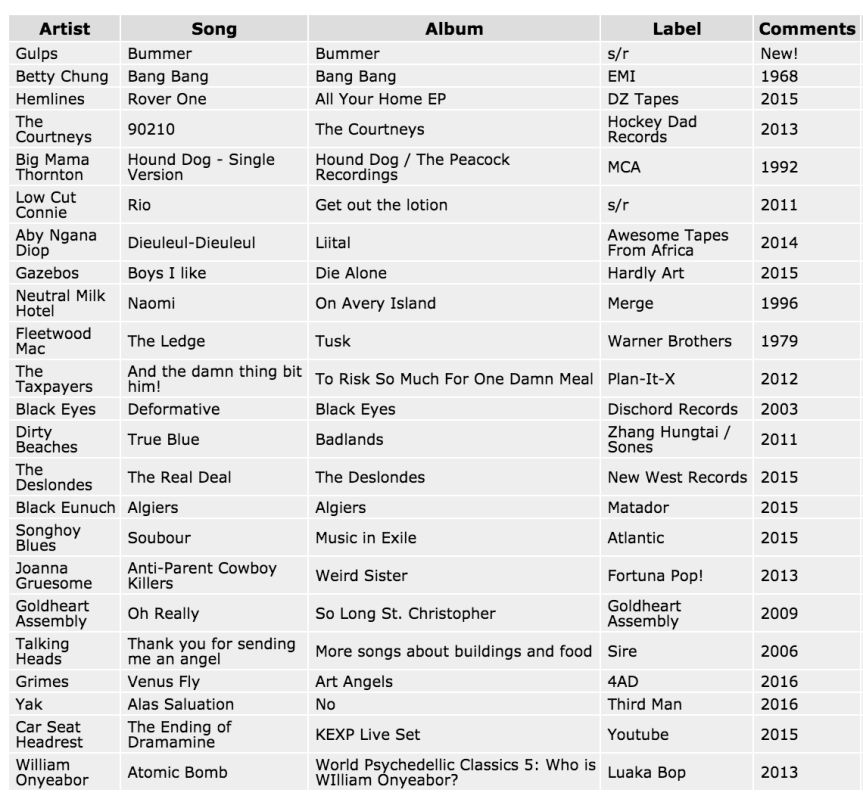
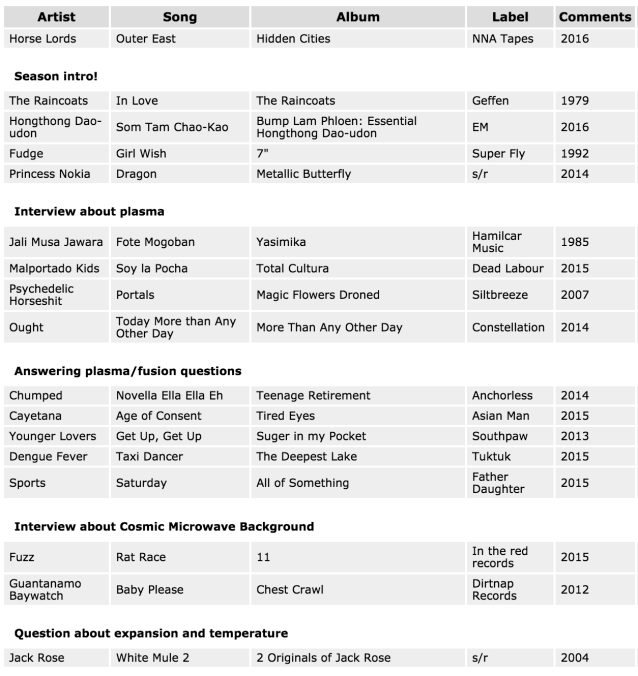
Playlist:
Check out the band, Gulps! They’re a new, totally rockin’ local New Jersey band that’s playing a lot of shows.
Featured image of Pluto, taken by New Horizons during its flyby of the dwarf planet. Courtesy NASA, which has a spectacular gallery of other images too.
This week on These Vibes Are Too Cosmic, we interview Aida Behmard, a post-baccalaureate scholar at Princeton, whose research involves finding exoplanets and postulating about the types of extremophile alien life that might live there.
Aida has been digging through a trove of data from the HATNet project, a series of ground-based telescopes pointed up at swaths of the sky to try and find stars with planets orbiting around them. She searches through the history of telescope measurements, trying to find the moment when a planet orbits right in front of a star. When the star’s brightness decreases incrementally, the researchers can tell that a planet has blocked some starlight and thus can learn about the eclipsing planet. And it works–so far, the project has discovered 56 exoplanets around distant stars!
Motivated by the origins of life, Aida hopes to learn about the atmospheres of these new exoplanets and thus narrow down what kind of life might live there. These extremophile organisms, maybe used to harsh atmospheres and even radiation, could exist in many different forms surprisingly different from the kind of life we’re used to on Earth. To understand the possibilities, Aida communicates with biologists about what living structures might exist so far away.
We talked a bit about the wild astrophysical spirals that can exist around the centers of galaxies, active galactic nuclei. These insane structures have materials spinning inward into massive black holes, which produces violent amounts of radiation all over the spectrum–from radio waves to X-rays and beyond. Since these signals are so widespread (even including visible light, like the NASA image shown), it’s easy to see light from galactic nuclei all over the sky, through all kinds of telescopes that we use to observe outer space.
Finally, Aida is the director of a new outreach project at Princeton, Open Labs. This program organizes science talks aimed at different grade levels, and it brings in classes from local schools to hear about all kinds of research going on at Princeton. Check it out!
After Aida left, we went on to talk about the new observations of Pluto by NASA’s New Horizons mission. The new knowledge we have about Pluto’s geography is stunning, and will keep planetary geophysicists busy for years to come. The surface of the dwarf planet is mostly made of 40 Kelvin (supercold!) nitrogen and water, which are both solids at this temperature. Their consistency is different, though: the nitrogen ice is soft, like quicksand, and the water is rock-hard. Thus, Pluto has frozen features like Sputnik Planum, shown to the right. It’s a massive nitrogen sea, with glaciers and mountains of rock-ice floating around it and inside it. Still, there’s tons more to learn about Pluto, since the low-bandwidth connection we have with New Horizons means it will be months more before we harvest all its wonderful images.
To end the show, Stevie talked all about SIGSALY, a system of cryptography used in World War II that kept messages secret with vinyl records. These massive stations would be set up at important military bases around the world, and then two matching records (one message, one decoder) had to be played in unison for a highly-secret message to be understood. This technique, which involved briefcases of decoder records and 55 tons of high-tech processing equipment per station, paved the way for modern cryptographic techniques and data processing (that allows us to communicate in war and for you to use your cell phone). Learn all about it here!
Featured image above is from an article from 2013 where a group at Berkeley is working to make windows even smarter, in a different way.
In this special show for WPRB’s all-vinyl week, Brian covers the tunes and Stevie speaks to our guests, Princeton graduate researchers Nick Davy and Melda Sezen. It was beautiful chaos in the studio.
Nick and Melda work on Smart Windows, under Professor Lynn Loo in Chemical and Biological Engineering. “Smart Windows” refers to glass that can change colors (darken) when a current is applied. This happens due to the electrochromic (electro=electrical responding, chromic=color) material polyaniline. Polyaniline is magical. It dissolves in water, and is just green when no current is applied (see image), but when connected to an energy source, like a battery or a solar cell, it can be tuned to be varying shades of blue, and even transparent. Nick and Melda’s collaboration
Poly-aniline.
works to improve this technology by introducing organic* solar cells as an extra varnish on the windows, producing both the energy needed to change the color of the glass and hopefully some excess to power your home, etc.
So, in the show we in to the nitty gritty of how smart glass works, and how Nick and Melda are fabricating and improving the technology. We then dive in to other applications of organic solar cells and polyaniline, for example wearable technology.
If you’re looking for something about smart windows that’s little higher level, take a look here.
At the very end of the show, Brian jumps on the mic to give us a little history of vinyl, including cylinder vinyl, and how LPs are made!
*In chemistry speak, “organic” = carbon based. In this case, think “plastic.”
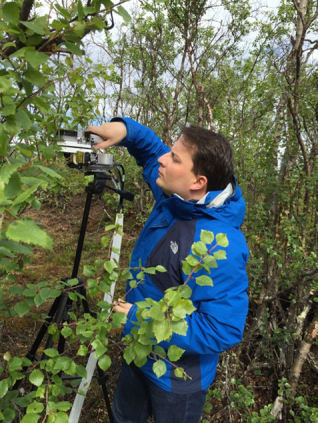
This week’s interview features Dr. Paul Gauthier, an Associate Research Scholar in the Department of Geosciences here at Princeton University. As a plant physiologist, he’s an expert in plant behavior, including respiration and photosynthesis. Specificially, Paul researches the connection between environmental stresses and carbon balance within plants — how much carbon do they store (via photosynthesis) and how much do they exhale (via respiration)?
A key point that Paul stresses is the delicate balance most plants maintain between storing energy and releasing it. Like us, all plants have to breath all the time, expelling CO2 into the atmosphere. While the trunk, roots, and branches all respire, the leaves of the plant photosynthesize energy out of sunlight to store new energy for further growth. Every plant invests years and years of energy into stores for later growth: just check out this video of an acorn, which shows the slow growth from seed to shrub of an oak tree. All this energy had to be produced and saved by the parent tree that produced the acorn!
Paul’s science analyzing the carbon balance within plants goes from the lab (where sunflowers are his favorite specimen) to the natural forests of Sweden. There, Paul and his group can investigate the strange effect that 24-hour days can have on plants–imagine staying awake without a rest for two months on end, as all trees north of the Arctic Circle must do. Such stresses introduce interesting adaptations into the plants genes, which help them respire less, and thus hold on to their carbon more efficiently.
As climate change transforms the environment around us, plants are especially susceptible to small changes. Paul explains that a drought in California, made more common by climate change’s dramatic effects, can deplete a plant’s storage of carbon and energy. A particular tree may seem healthy as soon as extreme weather ends, but in reality it will take many years to bounce back from using up all its invested energy. In this way, it’s hard to measure the immediate impact of climate change on forests: detrimental effects may not appear for 8-10 years.
You can keep up on Paul’s research by following him on Twitter! @LabGauthier
Finally, Stevie and Brian end the show with a re-cap of gravity waves (which you’ve been hearing about all over the news this week, and as Stevie predicted on our previous show). The LIGO experiment successfully detected a faint signal of spacetime fluctuations, which match Einstein’s predictions exactly. Somewhere a billion light-years away, two massive black holes collided and caused a ripple in the fabric of our space to propagate toward the Earth–just in time for us to measure it! Physicists are hugely excited about the new possibilities this discovery gives us for understanding our universe, and we hope you’ll pay attention for new developments. Who knows what we’ll eventually find.
Featured image is an artist’s conception of gravitational waves from a binary system. From LIGO.org.
Image with the recording is of the inside of the Tate Britain museum in London.
Dr. Lora Angelova at her old office at the University College London.
The main portion of this show is an interview with Dr. Lora Angelova – a chemist and researcher at the Tate Britain in London, England. What this means is, she uses chemistry, material sciences, physics, art history – and whatever else she needs – all towards the effort of conserving art. Currently, her research focuses on developing methods of surface cleaning artworks. Throughout our interview she takes us through some of the work involved to keep a piece of art in a state as close to its original as possible, and how much of an effort that takes. It’s truly a labor of love.
In the interview we discussed her work with NanoRestART, and micro-emulsions. Lora explained micelles, and that lead us to how soap works. Then we spoke a little on the surface of our cells – as it’s a similar concept.
From sustainablescientist.net.
Simplified cell-membrane. See how it’s a double layer of the micelle?
After the interview, I spoke for a while about gravitational waves. Here’s approximately what I said on them:
If I were a betting woman, I’d say that you’re about to hear a lot in the news about these entities called “gravitational waves.” That is, if you keep up with science and tech news.
On Thursday, the LIGO experiment is having a press conference. BUT it’s been rumored for months that they might have seen something in their instrument. LIGO stands for Laser Interferometer Gravitational-wave Observatory. And what they search for is, you guessed it, gravitational waves.
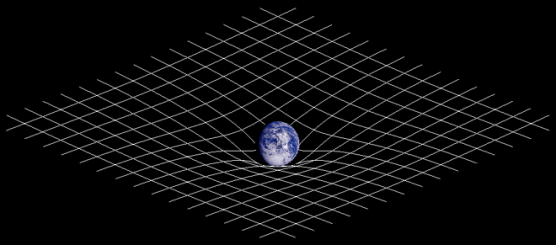
From general relativity we know that gravity – the force that makes apples fall and keeps us here on Earth, and maintains the Earth orbiting the Sun – isn’t like the other forces. The other three forces: the electromagnetic, strong, and weak forces – all operate via particle interactions. So if two objects are attracted or repelled due to the electromagnetic force, this comes about because of particle exchange. But when two objects are gravitationally attracted to each other, this comes about due to the fact that massive objects actually warp the spacetime around them. Like when you sit on your bed with lots of stuff on it and everything falls in to you. Alternatively, think of a rubber sheet pulled taught with a bowling ball set on it. The bowling ball warps the sheet, causing any marbles
Einstein ring image taken by the Hubble Telescope.
you throw on to the sheet to fall in to the ball. This is how gravity works.
And, in our sky, we can see gravity do this due to its effect on light. Light always takes the shortest path through spacetime, so if spacetime curves due to some massive object, then the light will curve. This effect creates these fascinating images on the sky called Einstein rings – these are absolutely gorgeous and dramatic and totally incredible. You can see one of these to the right of this page, but google for images. There’s many.
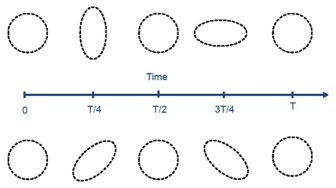
So what’s a gravitational wave? Well, if gravity is curvature of spacetime, then a gravitational wave is an oscillation in spacetime. Think of it like a stretching and compressing of a small bit of space – first vertically stretched and horizontally compressed, then horizontally stretched and vertically compressed, and again and again, back and forth – but that stretching and compressing action is traveling, at the speed of light, away from its source.
The LIGO instrument uses this property – and lasers – to try to measure gravitational waves. Essentially, they have VERY very precise lasers aimed across a distance, and if this light from the laser is stretched or compressed just a little tiny bit, then LIGO will pick it up. And if that stretching and compressing has the right signature, then it could be a gravitational wave.
From LIGO at Caltech website.
A good next question is, where does the gravitational wave come from? What’s the source? Well, a gravitational wave is theorized to radiate out from just about any massive, moving source. So this could be, for example, two neutron stars spinning around each other at fantastic speeds, colliding black holes. Or you, driving in your car.
A key thing to note is that gravity is SO MUCH weaker than any of the other forces. This is why a magnet that you hold in your hand could attract a paperclip via the electromagnetic force, but could never really attract anything gravitationally. If you’re in to numbers, gravity is about 30 orders of magnitude – that’s a 10 with 30 zeros after it – weaker than the electromagnetic force.
And this is why LIGO is looking to observe gravitational waves from two neutron stars spinning around each other at fantastic speeds, but isn’t worried about picking up the waves from you driving in your car. And this is also why it’s so hard – and why it’s never been done before. But LIGO has been diligent…and there have been rumors of discovery for weeks now. So…watch this space.
And just so you know – gravitational waves have never been directly observed before, but
Figure showing how gravitational waves radiate from a binary pulsar system, like the Hulse-Taylor system. From http://resources.edb.gov.hk
it’s on very very strong theoretical footing. First off, they come out of General Relativity, which has been tested time and time again. And second, they have been measured indirectly.
Here’s what we’ve seen. As a system – like binary neutron stars or black holes – radiate gravitational waves, they lose energy… this will cause the objects to spiral in towards each other and eventually collide. And this has been observed! Cue the Hulse-Taylor pulsar.
In the Hulse-Taylor system a…
…decrease of the orbital period [was observed] as the two stars spiral together. Although the measured shift is only 40 seconds over 30 years, it has been very accurately measured and agrees precisely with the predictions from Einstein’s theory of General Relativity. The observation is regarded as indirect proof of the existence of gravitational waves. Indeed, the Hulse-Tayor pulsar is deemed so significant that in 1993 its discoverers were awarded the Nobel prize for their work.
So, we are pretty sure they exist. And if we are able to observe gravitational waves directly from sources like black holes and dark matter, that would be totally revolutionary for astrophysics! It would show us the universe us in a whole, brand new way.
And with that, we’re all pretty pumped to hear what LIGO has to say on Thursday. And sometime soon I’ll try to get someone from the collaboration in here to talk about it.
Feature image: Behold! The cosmic microwave background. It was emitted just after the universe was one big plasma. Credit: Planck HFI telescope.
Welcome to the new and improved These Vibes Are Too Cosmic. Brian Kraus and Stevie christen their new time slot of 5-7pm on Tuesdays. We introduce the new format for the show – we’re switching off taking the helm each week (next week Stevie, the week after that Brian, and so on) serving up steaming offerings of science and music.
But this week, in this new show we’re so pumped about, we decided to introduce our listeners to….ourselves. We play music we love, interview each other on our respective research fields, and take questions from listeners.
Plasma physics (Brian): I work on plasmas, which are basically electrified gases. Imagine the process of melting a solid, and then boiling a liquid: in both cases, the atoms in the material are more and more free to move around as they gain energy. In a plasma, the electrons around the atoms have enough energy to escape the atomic nucleus, and what you’re left with is a gas of charged particles: negative electrons zooming around the heavier positive ions. You’d know a plasma if you saw one: they glow, like the plasma ball to the right or the lightning during a rainstorm.
A toy plasma ball – touch it, and one of the filaments runs to your finger (courtesy of Wikipedia).
The applications of plasma are numerous – from lightbulbs to space propulsion – but the most famous reason to study plasmas is to make fusion energy. This is the nuclear process where small atoms collide together to form bigger ones, which results in a huge energy gain for fused particles. Fusion energy could become a safe source of power, driving electrical grids with energy from seawater. The main issue is plasma containment, which means we have to keep the hot plasma (often at 10 million degrees C) from melting the walls of the container we keep it in. The most common device for magnetically confining a plasma is called a tokamak, which is basically a donut that keeps particles spinning around on a racetrack as they heat up.
MAST tokamak, a plasma containment device (courtesy of CCFE).
My own work concerns measuring properties of plasmas with probes. Since the plasma is an electrified gas, it can conduct currents and respond to voltages – which are very easy to tap into by sticking a metal wire in the middle of the plasma! By varying the bias on the metal probe (putting stronger or weaker batteries on it), I can push or pull on the electrons in the plasma. Through this general method, we can deduce the plasma’s temperature and density at many points, so we have a good map of what it’s actually doing.
You can learn a lot more about plasmas, and my work studying them, by listening to an older show where Stevie interviews me about all of this in greater detail.
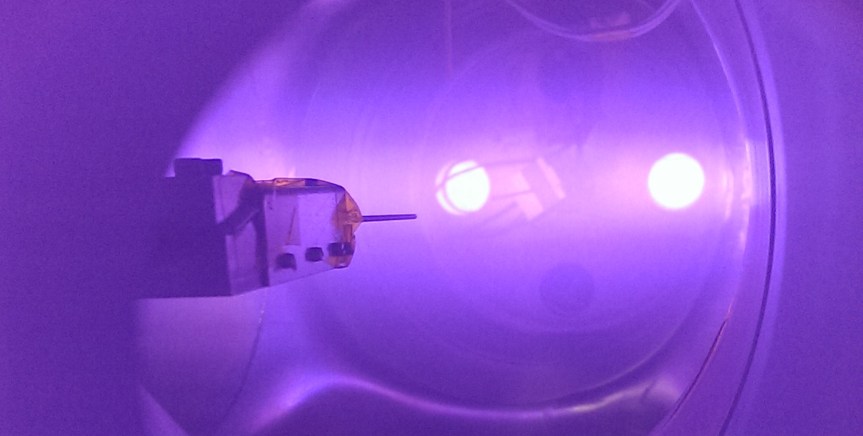
A xenon plasma that I study with the probe assembly to the left. You can see the plasma beam – the bright part in the middle – streaming toward the probe, which we use to measure properties like density and temperature.
Observational Cosmology (Stevie): I work on the SPIDER instrument, a telescope with the aim to measure the polarization in the cosmic microwave background radiation (CMB, the featured image up top). The CMB is, believe it or not, microwave radiation that bathes our entire universe. Not only is this radiation the oldest in our universe, it serves as a snapshot of our universe at that time it was emitted – over 14 billion years ago. Since it’s discovery in the 1960s (a great story unto itself), we’ve learned the CMB (like our universe) is almost entirely homogeneous and isotropic, but with tiny variations that map to density perturbations in
Bill Jones, PI of SPIDER, working on the instrument in Antarctica.
our early universe. These perturbations were the seeds of all the astrophysical structures we see around us today. Currently, the cosmic background radiation is our richest source of information on the evolution and large scale structure of our universe.
At only 2.7 degrees Kelvin, this radiation is difficult to measure, but not impossible. It is still just light with a defined energy ( = wavelength) and polarization. Through decades of effort scientists have carefully mapped the temperature of the CMB. Now, the forefront of observational cosmology is to map the polarization. Incredibly, the patterns in the polarization of the CMB have the capacity to
SPIDER, during its first flight in January 2015, hanging below a giant weather balloon above Antarctica.
tell us about our universe back before the CMB was even emitted, pushing our understanding of our universe back to a time just moments after the Big Bang.
The SPIDER collaboration manages this task by cooling polarization-sensitive detectors to
less than a degree above absolute zero, and then sending them to the edge of space for a 20 day flight in weather balloon above Antarctica. SPIDER’s first flight was last January (2015). The flight was successful. We’re currently analyzing our rich new data set and preparing for a second flight in the next few years. As a grad student on this project, I’m pretty psyched.
Our bodies are made up of hundreds of different types of cells, each with their own specific task. They react to all sorts of internal and internal stimuli as they go about their business. Sometimes they’re instructed to move left/right, reproduce, kill themselves, etc. If this all goes haywire (think, cancer), and oh man are there so many ways it could, it can profoundly affect our lives, or end them.
Anthony Berger. He looks maniacal, but these eyes are all for important scientific research.
In this interview I discuss cellular decision making and biomedical engineering with Anthony Berger, PhD student at the University of Wisconsin, Madison. Tony’s work focuses on how cells respond to the structural properties of their environment – i.e. whether the tissue around them is stiff, stretchy, soft, etc. Specifically, Tony studies how tissue stiffness and fiber architecture affects the development of vasculature (blood veins) within the tissue. To accomplish this, he designs materials that can flex to allow for changes in the rigidity of a material without changing the density of that material (a very important point in the design).
All of my designs have been based around natural materials — I generally take some sort of form of collagen (gelatin in most cases) and chemically alter it to be less flexible. We then embedd nodules of vascular cells within the tissue and observe how the cells invade into the material and develop a system of vessels.
I liken it to an office building with people working in it. The building is the tissue and the people are the cells doing all the work. Drugs and chemical growth factors/hormones are like emails to the people telling them to do specific things. Changes in different physical aspects of the tissue would be like changing certain aspects of the building — if the floors were made out of trampolines, work efficiency would probably be much different than if they were concrete. The point is the cells are generally what do everything in your body and a lot of focus is put on them, but the physical environment, often overlooked as something that is just there, has the potential to influence a cell’s behavior.
As an example, Tony guides us through how this relates to breast cancer. Note: the stiff lump a woman may feel in her breast isn’t actually the cancer, rather an area of stiff tissue that creates a preferred environment for breast cancer to take root. Scientists aren’t sure exactly why, hence research. Take a listen!
Playlist:
Artist
Song
Album
Label
Iggy Pop
The Passenger
Lust for Life
Virgin
Introduction to the show
First Aid Kit
Winter is all over you
The Big Black and the Blue
Jagadamba
Anthony Berger interview, Pt. 1
Biomed Engineering and Cellular Decision Making
Tacocat
I hate the weekend
Lost Time
s/r
Anthony Berger interview, Pt. 2
Biomed Engineering and Cellular Decision Making
Protomartyr
What the wall said
Under the color of official right
Hardly art
Mourn
Your brain is made of candy
Mourn
Captured tracks
Chastity Belt
IDC
Time to go home
Hardly Art
Hop Along
Waitress
Painted Shut
Saddle Creek
Paul Simon (General MD Shirinda, The Gaza Sisters)
I know what I know
Graceland
Sony
Anthony Berger interview, Pt. 3
Discussing the music
Bad Brains
I against I
I against I
s/r
Shilpa Ray
Johnny Thunders Fantasy Space Camp
Last Year’s Savage
Northern Spy
Girl Band
In Plastic
Holding Hands With Jamie
Rough Trade
Sylvan Esso
Come down
Syvan Esso
Partisan Records
Daddy Issues
Shitty World
Can We Still Hang
Infinity Cat
Bob Dylan
Pledging My Time – Take 1 (3/8/1966)
Bob Dylan, the cutting edge sampler 1965-1966 (Bootleg Series Vol 12)
This week, Brian Kraus subs again for These Vibes are Too Cosmic in a live-radio, middle-of-the-night special. The science topic is the Earth’s atmosphere, with all its layers and
A weather balloon being released for transit. Credit: US Navy. Found at kids.britannica.com
peculiarities.
First he talks about the regions you might encounter climbing up into space, from the troposphere–our watery, weathery home–to the exosphere, where space weather from the Sun interacts with our satellites.
Then, the focus moves to the stratosphere, which protects us from dangerous UV radiation: it’s a battle between ozone and chlorofluorocarbons/volcanoes, where our climate hangs in the balance! Big science again comes into play, with hordes of satellites and weather balloons taking regular measurements so we stay informed.
Finally, Brian goes into depth about weather balloons (which you can buy yourself!). How do we make weather balloons? How do we recover them when they all inevitably pop? And what scientific instruments are used to keep track of temperature and pressure as they float up into the stratosphere? I close with a public service announcement: if you find a downed weather balloon, you should follow its instructions and mail it back to the National Weather Service for analysis.
First, Gloria takes us through the research and development process – the timeline and the costs. That brought us to drug pricing and the role of the pharmaceutical industry. You bet we discuss Martin Shkreli and his company’s price hike of the drug Daraprim from $13.50 to $750. Gloria explains what Daraprim is and how this kind of price hike is not only possible, but totally legal. It all has to do with drug patenting, which we discuss a bit, especially in reference to something called “evergreening” (aka “me too” drugs) – a technique used my drug companies to extend their exclusive patent past the 20 year mark.
In the final part of the interview, Gloria walks us through how this structure could be changed to obtain a better, more efficient pharmaceutical system that works for the public rather than the drug company share-holders. She discusses how the incentive structure needs to change, using a “push, pull, pool” mechanism.
In the show I quoted two articles that do an excellent job explaining these topics:
Big Pharma, while of course contributing to innovation, has increasingly decommitted itself from the high-risk side of research and development, often letting small biotech companies and the NIH do most of the hard work. Indeed, roughly 75% of so-called new molecular entities with priority rating (the most innovative drugs) trace their existence to NIH funding, while companies spend more on “me too” drugs (slight variations of existing ones.)
But if Big Pharma is not committed to research, what is it doing? First, it is well known that Big Pharma spends more on marketing than on R&D. Less well known is how much it also spends on making its shareholders rich. Pharmaceutical companies, which have become increasingly “financialized,” distribute profits to shareholders through dividends and share buybacks designed to boost stock prices and executive pay.
(2) Vox article explaining the news around Martin Shkreli, the pharmaceutical head recently arrested for securities fraud – though that’s not why the public hate the guy. I guess he’s also an a-hole on Twitter and bought some singular copy of a Wu-Tang album, but we have other beef.
But really the hatred for Shkreli comes from how unapologetic he was about the price increase [of Daraprim by 5,500 percent]. Other companies have pursued similar pricing strategies without stoking so much backlash.
…As Forbes’s Matthew Herper wrote, “Questcor Pharmaceuticals raised the price of its drug, Acthar Gel, from $40 to $28,000 a vial. The reward? It was one of the best-performing stocks in America until Mallinckrodt bought it for $5.6 billion last year. Valeant Pharmaceuticals has done big price increases on numerous drugs. The stock’s up 740% over five years and its founder, Michael Pearson, is a billionaire. Only Shkreli has drawn the American public’s rage.”
Additionally, we touched on the history of the drug industry. Below is just a snippet from an excellent infographic that takes you through the key events in the 80’s that created the system we have in place today.
And of course there was music.
Playlist:
Artist
Song
Album
Label
Shilpa Ray
Shilpa Ray on Broadway
Last Year’s Savage
Northern Sky
Intro to the show
Fatoumata Diawara
Alama
Fatou
World Circuit Limited
Neutral Milk Hotel
Holland 1945
In An Aeroplane Over the Sea
Domino Recording
Bob Dylan
Stuck inside of Mobile with the Memphis Blues Again
The Cutting Edge Sampler, 1965-1966 (Bootleg Series Vol. 12)
Columbia/Legacy
Shye Ben Tzur, Jonny Greenwood
Roked
Junun
ATC Management
Interview with Gloria Tavera, Pt 1
Drug Research and Development Process
Dan Auerbach
Trouble Weighs a Ton
Keep it Hid
Nonesuch Records
Beat Happening
Red Head Walking
Look Around
Domino Recording
The Beverleys
Visions
Brutal
Buzz Records
Interview with Gloria Tavera, Pt 2
Drug costs, the pharmaceutical industry, and patents
Abner Jay
I’m So Depressed
One Man Band
Subliminal Sounds
The Sadies
Hold on, Hold on
In Concert Volume 1
Yep Roc
Beach Slang
Hard Luck Kid
The Things We Do To Find People Who Feel Like Us
Polyvinyl
Palehound
Molly
Dry Food
Exploding in Sound
Interview with Gloria Tavera, Pt 3
How to fix it.
Adult Mom
Survival
Momentary Lapse of Happily
Tiny Engines
Just want to listen to the interview? Don’t have time for the music? Here ya go.


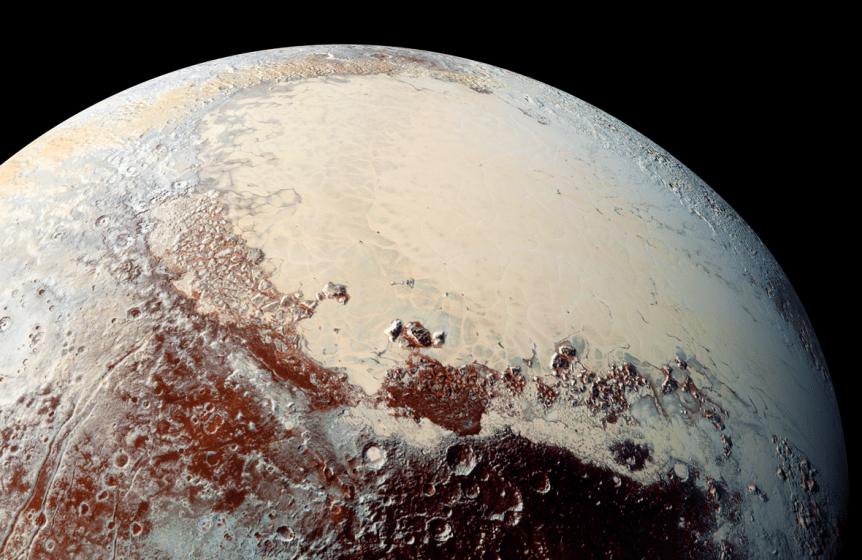 Featured image of Pluto, taken by New Horizons during its flyby of the dwarf planet. Courtesy NASA, which has a
  We talked a bit about the wild astrophysical spirals that can exist around the centers of galaxies, active galactic nuclei. These insane structures have materials spinning inward into massive black holes, which produces violent amounts of radiation all over the spectrum–from radio waves to X-rays and beyond. Since these signals are so widespread (even including visible light, like the NASA image shown), it’s easy to see light from galactic nuclei all over the sky, through all kinds of telescopes that we use to observe outer space.
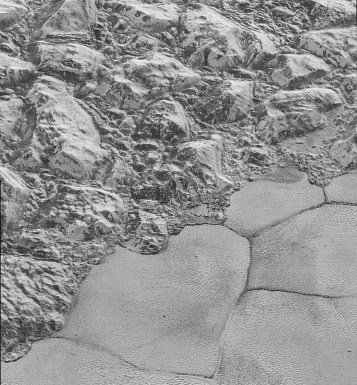 Pluto’s geography is stunning, and will keep planetary geophysicists busy for years to come. The surface of the dwarf planet is mostly made of 40 Kelvin (supercold!) nitrogen and water, which are both solids at this temperature. Their consistency is different, though: the nitrogen ice is soft, like quicksand, and the water is rock-hard. Thus, Pluto has frozen features like Sputnik Planum, shown to the right. It’s a massive nitrogen sea, with glaciers and mountains of rock-ice floating around it and inside it. Still, there’s tons more to learn about Pluto, since the low-bandwidth connection we have with New Horizons means it will be months more before we harvest all its wonderful images.

 In this special show for WPRB’s all-vinyl week, Brian covers the tunes and Stevie speaks to our guests, Princeton graduate researchers Nick Davy and Melda Sezen. It was beautiful chaos in the studio.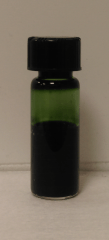
 are fabricating and improving the technology. We then dive in to other applications of organic solar cells and polyaniline, for example wearable technology.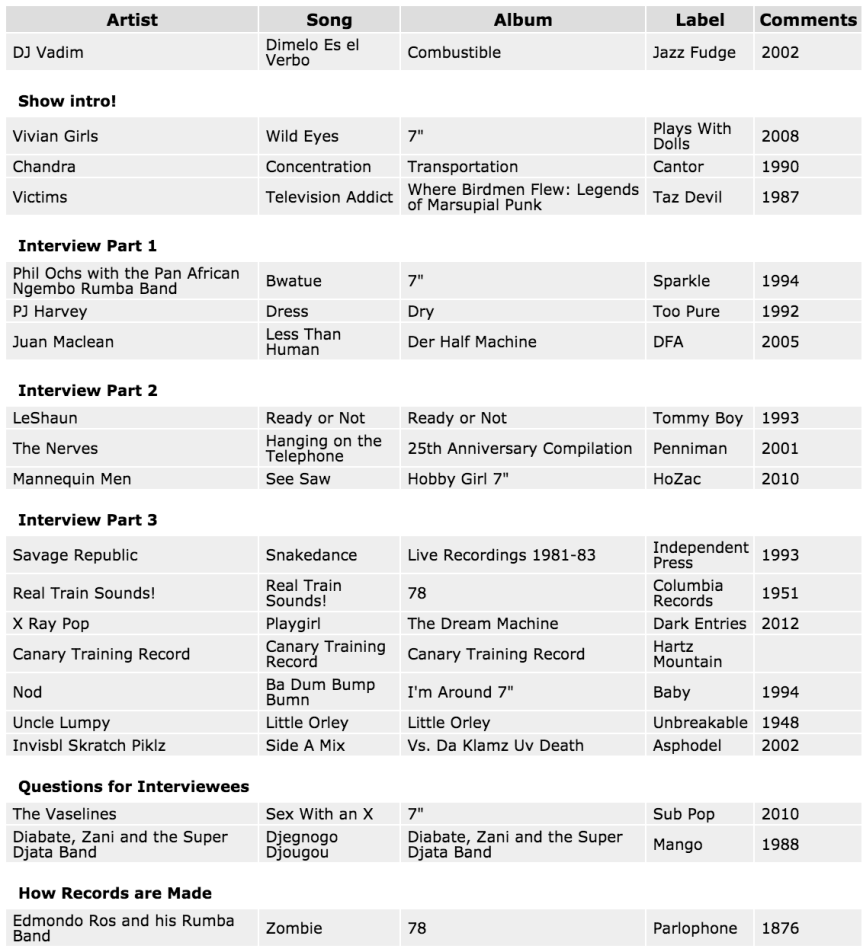

 As climate change transforms the environment around us, plants are especially susceptible to small changes. Paul explains that a drought in California, made more common by climate change’s dramatic effects, can deplete a plant’s storage of carbon and energy. A particular tree may seem healthy as soon as extreme weather ends, but in reality it will take many years to bounce back from using up all its invested energy. In this way, it’s hard to measure the immediate impact of climate change on forests: detrimental effects may not appear for 8-10 years.


 force, this comes about because of particle exchange. But when two objects are gravitationally attracted to each other, this comes about due to the fact that massive objects actually warp the spacetime around them. Like when you sit on your bed with lots of stuff on it and everything falls in to you. Alternatively, think of a rubber sheet pulled taught with a bowling ball set on it. The bowling ball warps the sheet, causing any marbles
 gravitational wave is an oscillation in spacetime. Think of it like a stretching and compressing of a small bit of space – first vertically stretched and horizontally compressed, then horizontally stretched and vertically compressed, and again and again, back and forth – but that stretching and compressing action is traveling, at the speed of light, away from its source.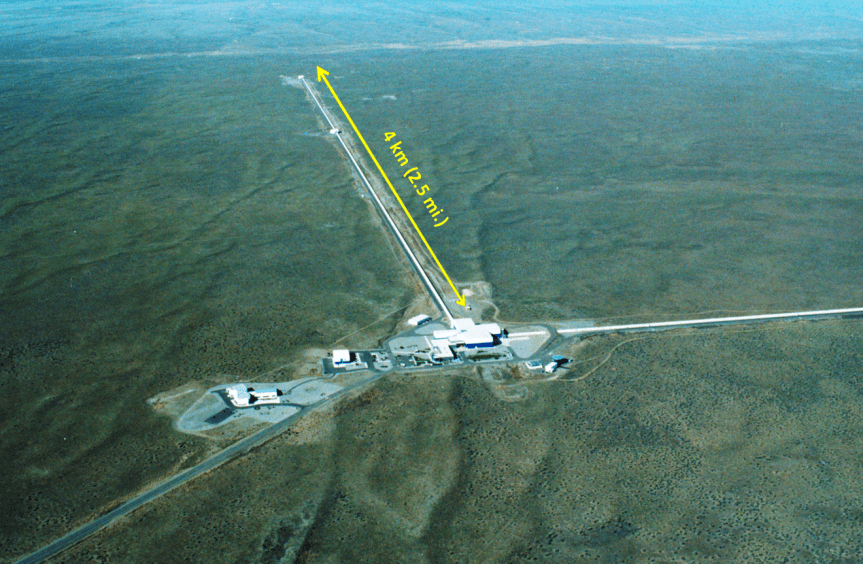





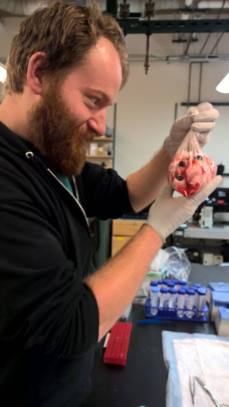



 In my second interview with Gloria Tavera, MD/PhD student at Case Western Reserve University in Cleveland, we dig deep in to drugs. (
 These Vibes Are Too Cosmic