8/2/16 Show feat. Sam McDougle on learning and motor skills (re-aired) + dynamo in the Earth’s core

FMRI

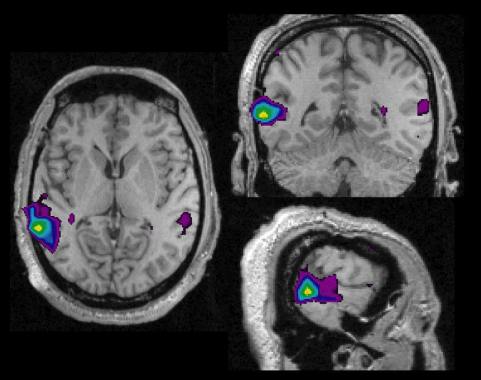
Featured Image: These fMRI images from Jean Gotman at McGill highlight a small part of the brain, because it’s statistically more active than it was at some other moment. Remember: the other 90% of the brain is still actively in use!

For this week’s show, we replayed an earlier interview from Sam McDougle, a graduate student in the Department of Neuroscience at Princeton. He and Stevie dive into his research on motor skills, learning, and the brain, and they debunk the ever-popular myth that we only use 10% of our neurons at once. After the interview, I describe the Earth’s dynamo problem and some new research from Osaka University that raises more puzzles than it solves.

Sam and the rest of the Taylor Lab want to know what the brain is doing when we learn new skills. We’re all used to the feeling when something clicks and a skill becomes easy for us: riding a bike, cutting with scissors, and typing have all become automatic for us eventually. But initially, developing a new task into a skill requires practice. Building up muscle memory and neuronal networks that fit the task is a long process in the brain, and it’s hard for science to unveil completely. As Sam says, researchers rarely find conclusions, they just scramble for hints until they can piece together ideas about the truth.

To study the learning process, Sam first experimented on mice, fitting them with brain electrodes and having them repeat behaviors. But even though the brain fundamentals are very similar between mice and humans, the complicated tasks that people have to learn go beyond the range of mouse-science. Now, Sam brings in human volunteers to study instead, and relies on less invasive data collection (like fMRI instead of electrodes inside the skull).
slide-3.jpg
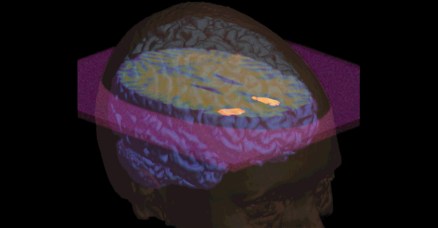
Fancy brain imaging from Princeton Neuroscience Institute.

To be clear, there’s a lot going on in the brain at once. An fMRI scan may just show a small blob of color somewhere in the brain, but this highlight just shows a place where the brain was more active than it used to be before the experiment. Sam’s brain scans might showcase, for example, neural areas that handle muscle memory; but even as these particular brain sections are especially active, the rest of the neurons are still abuzz. The myth that “we only use 10% of our brains” might have originated in Dale Carnegie’s famous self-help book, How to Win Friends and Influence People–and even there, it only appears as a misattributed quote in the foreword. So don’t believe the rumors, because your whole brain is always hard at work.

Testing hypotheses on human subjects is no easy matter. For one, Sam can’t have people learn nuanced skills in the experiment. To teach thirty subjects to play the violin and measure their brainwaves as they do it will take months, will cost a lot, and won’t be very repeatable from person to person. Instead, Sam and his colleagues have to think of tasks that are complicated enough that we must learn them, but are still so simple that the study can proceed quickly and repeatably.

One result of  the studies so far is the demonstration of “implicit” versus “explicit” motor skill learning. Teaching someone to snowboard might involve phrases like “keep your weight on your back leg” or “dig in to brake;” these “explicit” instructions give the learner some reference for improving quickly. But, verbal commands alone can’t do the whole job, since most of the learning comes from testing behaviors out.  Imagine reading a book about swimming and then jumping in the pool for the first time: you’d still have a lot to figure out about treading water. The implicit skills you develop from trying, failing, and trying again are ultimately the backbone of mastering a task. Sam’s results show that implicit and explicit learning are stored in different parts of the brain, and the research is still attempting to find connections between the two.

Sam closed the interview with a bit about his own musicianship. Among many projects, he plays and records his own music as Polly Hi. I anachronistically played a song from Deceleration, Sam’s newest album, which actually came out months after this interview last year.

I ended the show with a major problem in astrophysics and geology: why is the Earth still magnetized? From what we know about currents and electricity, magnetic fields should decay over time and eventually die out. However, the Earth has a strong magnetic field: it keeps us safe from the solar wind, helps maintain our atmosphere, and brings the auroras to the poles. So, something doesn’t add up. The Earth’s core must have some net current or flow that maintains the magnetic field over billions of years.

Scientists at Osaka University just did an experiment to simulate the Earth’s core and resolve this issue once and for all. The core is made of nickel and iron, so the group put iron wires into a diamond anvil–a device that generates gigantic pressures on a tiny area in a lab. By heating the wires with lasers and putting a current through them, the scientists measured how well iron can conduct a current in the middle of the Earth. Based on their measurements and how strong the Earth’s magnetic field is, the Earth should be about 700 million years old. The problem: it’s much, much older than that (over 4 billion years!).
earths layers
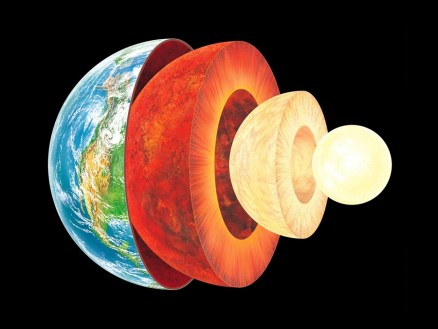
The Earth, decomposed into its parts. Don’t let pictures like this fool you into thinking we have it all figured out!

What does this puzzling result tell us? Largely, it’s that there are properties of the Earth’s core that we don’t understand at all. You might think that by being space explorers and mastering fracking and plate tectonics, we’d have figured out the composition of the Earth by now. Unfortunately, while we do understand the crust and mantle of our planet, the nickel-iron core is inaccessible to direct measurement. We can study waves that pass through the middle of the Earth, and we can study high-temperature high-pressure materials in the lab, but understanding the complex motions at the middle of the Earth is probably a long way away.

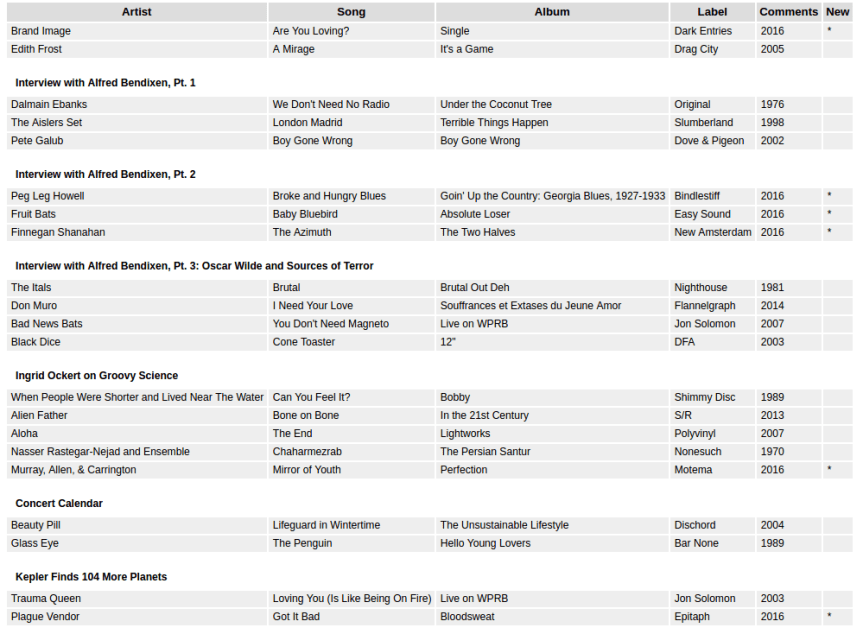
As always, the playlist is on WPRB or below.

Screenshot from 2016-08-02 20-10-34

7/26/16 Show feat. Dr. Andrea Graham on the immune system, cytokine storms, and sheep + ice algae

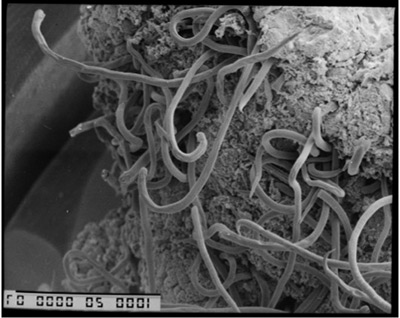
Graham_strongyle_nematode_400

Featured image: Nematodes, pictured inside a sheep on Scottish isle St Kilda. If the immune system has to choose between fighting this worm and malaria, how should it prioritize? (credit: Graham Group)

(Audio note: Unfortunately, this week’s recording is not great. First, it starts a few minutes into the interview, so you miss the introduction; second, a recording issue distorted the quality. If anyone has a better-quality recording, let us know!)

Our guest this week was Dr. Andrea Graham, a professor in the Department of Ecology and Evolutionary Biology here at Princeton. She brought us her insight into the immune system, so we dove into the good and bad sides of the cells that usually keep us healthy. Toward the end, I talk briefly about the importance of sea ice algae in the Arctic regions, and how those Northern ecosystems might be in danger if the ice sheets shrink.

7143053047_72905000a2_o.jpg
Dr. Andrea Graham, researching sheep in Scotland. (see full album)

Andrea finds the immune system fascinating. It’s a decentralized system, with no one governing body, so it must deal with problems locally: each cell works independently. When white blood cells gang up on diseases in the body, they communicate their strategies by sending each other small protein messages. These cytokines let nearby white blood cells attack the bacteria in unison; they might also transmit messages globally through the blood stream to share antibody information with the rest of the body (this is how long-term immunization works).

The problem with decentralized systems is that they can overreact by all acting at once. If every white blood cell in the body reacts simultaneously to a new threat, the whole stream is flooded with cytokines. Your immune system’s overreaction causes fever and swelling–and sometimes even death. It’s hard to produce medicines that work against these cytokine storms, since there’s a delicate balance between stopping the immune system from self-harm and preventing it from fighting real diseases. Discovering a medicine that would slow the system gently is “the million dollar question,” Andrea says.

As with anything that has limited resources, the immune system competes with other systems in the body. It takes energy to fight nematodes and energy to reproduce, but sometimes there’s not enough energy to do both. Andrea’s group studied a sheep population, brought to a Scottish Isle centuries ago and left without predators since, to see if real groups of animals have individuals choosing between health and reproduction.

The big breakthrough came when the group found anti-correlations between sheep who reproduced often and sheep whose immune systems cleaned away parasites effectively. In fact, many sheep had healthy worm populations living in the gut, even though the worms were harmful and cost the individual resources. Trade-offs like this mean a great immune system isn’t always beneficial.

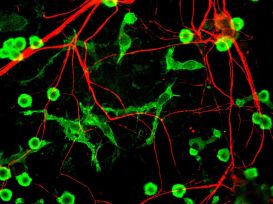
microglia_and_neurons
This alternative study from Imperial College blames overactive immune systems for schizophenia.

Another balance we discussed was having a weak immune system versus to an overly-strong one. White blood cells clump together to suffocate bacteria and other threats, but they can go overboard and clump up more dangerously. These groups of white blood cells block passageways over time, leading to illness. Lupus is one example of an autoimmune disease that acts in this way–and Andrea’s group is looking for correlations between being lupus-prone and having a strong immune system. By joining an existing collaboration that studied the population of Taiwan over time, the group found evidence for that correlation.

Finally, I ended the show with science news: algae living in the seasonal polar ice caps of the Arctic are crucial bedrock of the Northern food chain. The result comes out of this study from the Alfred Wegener Institute in Germany. Scientists drew fat samples from tens of species in the Arctic Ocean, tracing the composition of fats in the animals back to sea algae living in the ice. Evidently, 60-90% of the nutrition delivered to herbivores comes from this food source, which is worrying since the ice caps are quickly shrinking.

We’ll be back next week with more, better-recorded radio. Thanks for tuning in!

The full playlist is on WPRB.com, or below.

Screenshot from 2016-07-29 18-25-47.png

7/19/16 Show feat. Dr. Alfred Bendixen on science fiction + Ingrid Ockert with Groovy Science

KatnissFeatured image: Katniss, of the best-selling book/movie series The Hunger Games. (courtesy Wall Street Journal).

Our show this week welcomed Alfred Bendixen, Professor of English at Princeton University, who spoke with us about science fiction and the philosophy behind it. The discussion hit on many of our past shows, and gets into questions on cultural evolution and epistemology. Then, we close with Ingrid Ockert, returning to the show with another book review. She covers Groovy Science, a series of essays about the connections between 1960s scientists and hippies.

Alfred focuses his literary studies on genres that sit on the border between scholarly and popular. Detective novels, horror stories, science fiction–academia usually ignores these categories, even though they reflect aspects of society worth studying. Science fiction,

jekyllHyde
The mix of science and fantasy in Jekyll and Hyde. 

Alfred says, is written at the intersection of three ways we seek knowledge about the world: science, religion, and storytelling. Since the genre can dive into all three methods, it gives a unique perspective on our aspirations and fears about the future.


As an example of how sci-fi can inform us about our culture, Alfred brings up The Hunger Games. This enormously-popular series describes a dystopian world with a sadistic government of unaware aristocrats. Its heroine, Katniss, is named after a plant–in contrast to the broken bureaucracy that governs humans in the books, she turns to nature for stability and comfort. The story leaves plenty of room for interpretation, and can be championed by right- and left-wingers alike. The Hunger Games complex and unsettling speculation about our civilization’s future is what makes it successful, both on bestseller lists and for Alfred’s examination. As he says: “the greatest works of literature provide multiple lenses.”

As a genre, though, Alfred prefers the term “speculative fiction” to sci-fi. The writing is interesting because it wonders about our future, mixing probable developments in technology with fantasy. “Think of every science fiction story as a thought experiment,” puts Alfred, as if authors are considering the consequences of particular decisions our society makes now. The best of these stories are introspective, giving plenty of room to ponder. Alfred wonders about the hero of The Martian, sitting alone on Mars, who spends hours and hours growing potatoes but not much time contemplating his lonely existence. It’s “hard” science fiction, firmly seated in facts and real science, but it fails at examining our place in the universe and the consequences of sending humans to other worlds.

the-martian.png
The Martian, a book without much introspection.

I asked Alfred about the Juno orbiter, mentioned in our last show, which is slated to commit suicide into Jupiter to avoid spreading life to Europa and other moons. These questions about space travel are hugely prevalent in science fiction, of course, but the way they’ve been approached has changed over time. Many books assume that exploring the universe is a triumph of mankind over nature. We explore other planets, learn about the vastness of space, and experience the fragility of life in alien environments–but we never worry about polluting the Solar System or contaminating other worlds with unwanted life. As science fiction has developed, it has begun to take on more complicated pictures of morality in science. Modern works might ask: what do we stand to gain by going to space, and what do we stand to lose?

Finally, we ended the interview with an ongoing project of Alfred’s: studying “sources of terror” in American literature. There might be universal human responses to fear, but what if we examine cultural differences in our responses instead? For example, British stories feature castles owned by aristocrats, and the protagonist’s goal is to find her proper place in the world. In American stories, though, we don’t have castles: the thing to fear (and to conquer) is the expanse of nature itself, the Wild West of the American continent. And when our stories conclude, we don’t find a place for ourselves, we create one.

terminator-genisys-review-01.jpg
The Terminator’s villainous portrayal of robots.

The way we process fear in stories changes over time, too: look at robots as an example. Early literature was terrified by androids and mechanization, represented as inhuman villains in Terminator or I, Robot. But as technology has become central to our everyday lives, we have a more ambiguous relationship with robots in literature, with some benevolent and some evil. As our culture’s opinions develop gray areas and nuance, so do our stories.


After the interview, Ingrid Ockert came on air to give a summary on a book about the history of science. This week, it was Groovy Science, a collection that examines the relationship between science and counter culture during the 60s-70s.  Our stereotype of scientists after WWII was one of a bored academic in a lab, writing notes in a white labcoat. But this stodgy picture fails to incorporate the real social role of scientists in the following decades. As hippies and scientists interacted, new research became prevalent: finding better materials for surfboards, brewing better craft beer, investigating the effects of psychedelics in a lab… Groovy scientists left the shelter of academia to work on such projects, and the role that science plays in our lives has changed as a result.

Thanks to both of our wonderful guests this week!

As always, the playlist is below or on WPRB.com.

Screenshot from 2016-07-21 11-03-22.png

7/5/16 Show feat. Charles Swanson on compact fusion and SpaceX plus Juno on Jupiter/space balloons

crs6_launch_water.jpg

Featured Image: A SpaceX Falcon 9 launches from Cape Canaveral, FL, carrying a capsule full of cargo to the International Space Station in April 2015.

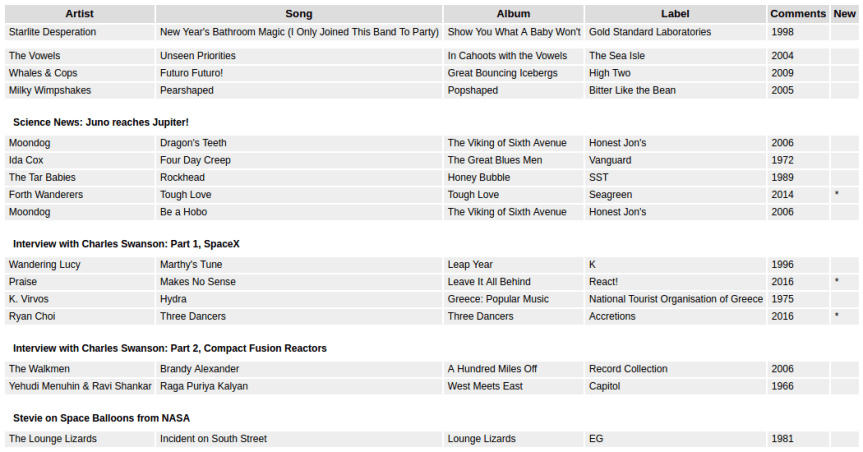
We were lucky enough to have a show full of space this week, covering all sorts of travel outside our atmosphere: NASA’s Juno orbiter just reached Jupiter last night, and long-duration atmospheric balloons are almost ready to launch regularly from New Zealand. But best of all, we had Charles Swanson, current PhD candidate in Plasma Physics at Princeton and former employee of SpaceX, tell us about space travel and his views on fusion energy.

Charles had always been looking to space, and he paid attention when Elon Musk’s revolutionary rocket venture SpaceX began in 2002. He earned an internship at the company in 2012, where he worked firsthand on the difficult mission of landing a rocket on the ground. To make spaceflight an everyday venture, we need to be recycling our vehicles: imagine if every airplane flight ended in a crash landing and we had to live with one-time-use 747s! But firing things into space requires immense speeds, so it’s very difficult to have rockets survive both the ascent into orbit and the return down to our planet.

In the end, SpaceX had to engineer its rockets to withstand the brutal vibrations of a

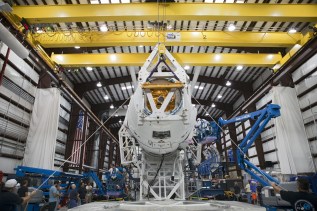
crs1dragonrotate2_full.jpg
SpaceX’s Falcon 9 rocket under construction. Courtesy NASA.

launch alongside the destructive environments of high atmosphere and outer space. Alongside working on the reusable Dragon capsule, Charles played a crucial role in this endeavor: he tested the self-destruction button for the rocket. In a way, this is the most important part, since making a mistake with the landing is far worse than never landing at all. Of course, engineering a self-destruction button is a big task. The button must never be pressed accidentally (even by shaking during an ascent into space), but if you do press it, the button had better work. Charles’s experience speaks to the true difficulty of designing anything for space: it will have to endure nature at its most severe.

On the whole, Charles is optimistic about the future of spaceflight. He sees the present day as an age where launching rockets is open to companies, not just governments. And this could blow open the space industry–we’ll see a lot more tech development in the field over the next decades, and who knows what possibilities might lie in that direction for consumers and scientists. Charles had a lot to say about Musk’s influence on the company: his decisions happened on every level, from budgeting and big-picture plans to engineering the minutiae of engine wiring.

tokamaks
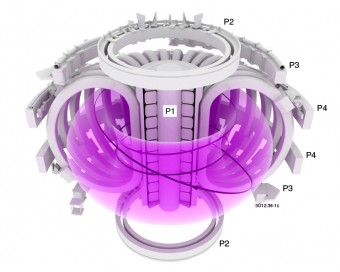
A cartoon of a tokamak, courtesy of EUROfusion.

After the internship at SpaceX, Charles did the only natural thing and began pursuing a PhD in Plasma Physics at Princeton. In his role as a researcher, Charles studies a special time of fusion reactor (a topic we’ve covered before on this show). But today, the leading choice for making fusion happen is big and costly: the tokamak contains a plasma very well, even if its structure takes years to build. An alternative reactor type that  keeps fusion power cheap and small is the FRC (Field Reversed Configuration).

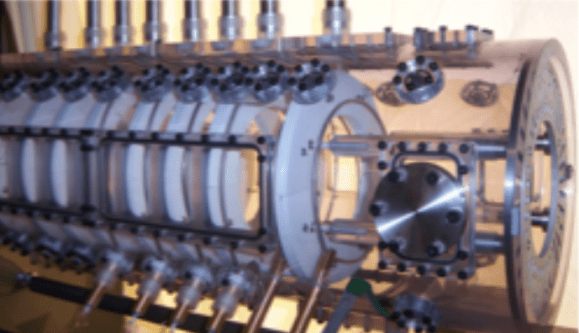
The FRC’s versatile, simpler design comes from using the plasma itself to act as a magnet. A plasma is just a charged gas, and Charles’s group creates currents in the plasma that help to confine itself. Therefore, the whole system saves on magnet costs and can be much smaller: think small enough to fit on a spaceship or in your garage. An exciting future use for these machines might just be as fusion rockets, which could thrust a rocket across the galaxy using fusion power.

PFRC
An older version of the Princeton FRC which used to sit in Sam Cohen’s lab. It has since been upgraded, but the machine still fits on a tabletop.

Before and after Charles talked with us, we got to some massive news for space explorers. Our show was timely enough to happen the very day that Juno arrived at Jupiter–and this is years in the making! The spacecraft Juno lifted off from Cape Canaveral here on Earth in

juno-trajectory-2016-1

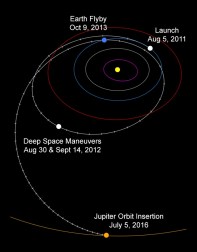
2011, then took two years to circle the sun before arriving back near Earth for a gravitational assist.  Now, three years later, it finally reached the Giant Planet. What we know about Jupiter came from Galileo, a craft launched in 1989: it surveyed the many moons, and gave glimpses into Jupiter’s formation. We’ve had to wait until now for our newest technology, which is capable of seeing through Jupiter’s clouds, to learn more about the giant’s inner makeup. Give it a few years, and we may learn more about how the Solar System formed from its observations.

Stevie closed the show with a final way to travel to space–well, near Earth space, but still far above our atmosphere. Ballooning already gives scientists a great option for seeing the sky without interference from the turbulent air above us. Instead of sending a telescope into space with a rocket, letting it float up on a huge balloon is less violent for the instrument and saves us money. We have places like McMurdo in Antarctica that do this regularly (that’s where Stevie’s SPIDER telescope launched), but having a new path in the sky would let us have longer trips. To this end, NASA wants to build a New Zealand balloon base, capable of sending off long-lasting aircraft–and it’s working on the Super Pressure Balloon to help. The researchers just set a new record for balloon flight, and Stevie is optimistic about where this is headed. Stay tuned for more ways into space and more telescopes scouring the sky!

As always, the playlist is at WPRB.com or below.

070516_playlist


6/21/16 Show feat. astrophysicist Chuck Steidel on galaxy formation & redshift + Stevie on New LIGO

quaz490_sdss_big

Featured Image: The sky, as viewed from New Mexico or Chile by Sloan Digital Sky Survey. Pointed out is a quasar at extreme redshift, almost 15 billion light years away.

Dr. Chuck Steidel, Caltech astrophysicist and former WPRB DJ, was kind enough to come into the studio during a visit to Princeton several weeks ago. He and his son Nicky (a current DJ at the station) were putting together a clash-of-generations show, so we snagged him for a talk about galaxy formation, extreme redshift, and next-generation telescopes. After that, Stevie brings us a highlight of recent LIGO results: more black-hole mergers have been detected!

Chuck is interested in the ancient universe. Back in those days, soon after the Big Bang, the first clouds of gas were clumping together to form rocks and stars. It was a chaotic time: stars were igniting at alarming rates, and UV radiation would have caused serious sunburns for creatures like us. But understanding this period can tell us how early stars formed–which helps us learn how stars progressed to form complicated elements like carbon and oxygen.

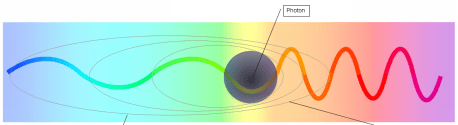
Of course, looking at something so old is not easy: it’s so far away that not much light reaches us, and the light that does has actually warped. Since the universe is expanding, the light gets redder and redder as it travels. If our telescopes on Earth can see enough light to detect these ancient star clusters, it can use how “red” the light gets as a measure of how far away the galaxy is. And this is a great tool: if a galaxy’s light is “redshifted” enough, Chuck knows it’s an old enough galaxy that it still has stars forming quickly.

20061007165757Schema_Redshift.png
Redshift “Doppler effect,” as shown on ScienceBlogs.

Of course, when the light gets redder it gets harder to see. The signal starts to blend in with light emitted from our atmosphere. So, the best plan is to put giant telescopes up in space: they need to be large to collect lots of light, but also far above the Earth to avoid atmospheric defects. Keep in mind, sending telescopes to space costs money and takes time for organizations like NASA to coordinate. As they wait for these projects to develop, astrophysicists use ground telescopes to get initial observations of distant galaxies for hints about the better data to come.

27128487781_05231bf354_o
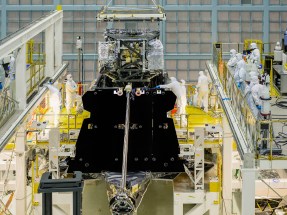
JWST, currently under construction at NASA Goddard.

One example of a next-generation telescope, steps beyond Hubble in many ways, is the upcoming James Webb Space Telescope. Not only will it have much finer resolution in the infrared for seeing distant galaxies, it’s fitted with a sensitive spectrometer to measure the precise colors of these objects. And Chuck is especially excited about that, because it will allow him to learn what elements are being churned up in these early galaxies. For now, the team takes measurements on two ground telescopes: Keck in Hawaii and Palomar in San Diego.


In the end, Chuck and I agree that science done just to satisfy human curiosity is a worthwhile pursuit. It may not lead to a better app or cure cancer, but most humans wonder about the universe outside our planet. Science for science’s sake might lead to technology we use elsewhere, but advancement is not the main point-and that’s OK. We close out with Chuck’s recollections of summers spent in the WPRB basement, where he hosted shows every day and often visited City Gardens in Trenton to interview alternative bands passing through.

After the interview, Stevie brings us more exciting news concerning our detection of gravity waves. You’ve heard in the news about LIGO’s first discovery, where they heard two black holes merge together from a billion light years away. The team has spent decades building and

LIGO-wave-location
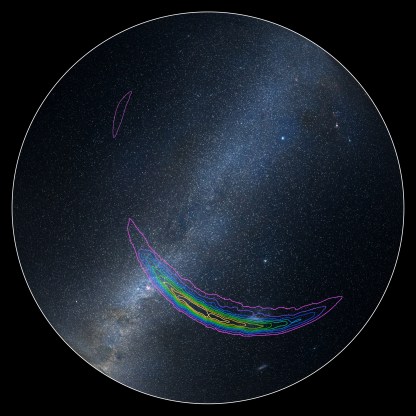
The region in the sky where the second black-hole merger was found by LIGO in December.

perfecting a massive laser observatory, one that measures tiny shifts in laser light to detect small movements in the structure of space. Only massive gravitational events (like collisions between black holes and neutron stars) can cause movements this big. And it’s getting better, because LIGO just announced a second detection of gravitational waves that they found in December. With this development, it appears even more likely that we can use gravity-wave observations to tell us about the most massive things in our universe. So stay tuned for more revolutionary science from the scientists at LIGO!


As always, the playlist is either below or at WPRB.com.Screen Shot 2016-06-22 at 10.01.13 PM.png

5/10/16 Show feat. Ecologist Justine Atkins on antelope decisions and protected areas + chaos

gorongosaAntelope

Featured photo: A herd of sable antelopes graze in Gorongosa National Park, Mozambique. Credit to Michael Paredes.

For this week’s show, Justine Atkins, a graduate student in the Department of Ecology and Evolutionary Biology at Princeton, came in and told us all about animal decision making and the (lack of) science behind protected areas for conservation.

justine4-1
Justine Atkins in the field.

First, we went over Justine’s current research: she wants to make a computer model that predicts animal behavior given particular constraints. For example, what would a herd of antelope decide to do if we build a fence across their grazing lands? Or if we take land they use as a resource for farming or urbanization? Of course, understanding an antelope’s state of mind in order to predict such things is no easy task.

The initial step is to evaluate what factors influence antelopes to make various decisions in the first place. Might a skinnier antelope take more risks to eat in a bountiful field, even if there might be predators around? To get real data that might answer questions like this, researchers like Justine have to sedate wild animals and collar them with GPS transponders (a full-time job, until all thirty antelope are monitored and back with their herd!). Noting which animals are pregnant, or old or young, or skinny or well-fed, can give insight when Justine downloads their traveling paths and looks for patterns.

In the end, this massive amount of data (months of location data for 10-20 animals) will feed back into Justine’s code. Her simulation has a number of variables to consider that might affect each animal’s next move: hunger, danger, memory of the area, pregnancy… Until the simulation can be checked against real data, it’s hard to know how an antelope will weigh these considerations. But once the variables are weighted properly and the simulation can reproduce real transportation patterns from the wild, Justine can use the simulation to predict the antelopes’ response to future situations.

All of this goes hand in hand with conservation efforts. A researcher looking to protect endangered species might want to establish new protected areas, and should have an idea how the animals will react to such changes in their environment. Justine also has an interest in the science behind protected areas, particularly for evaluating their effectiveness. How do we know that a new national park has really helped the biodiversity within? Measuring its success is a difficult problem, especially since there are lots of fluctuations in nature that might confuse the study. Plus, in science we usually use control groups, so that a parcel of land that had protection should be compared against a similar parcel that was left in its original state. This type of research is rarely done in designating new protected areas.

costa rica laselva.jpg
La Selva station in Costa Rica.

Justine went into detail with this problem of impact evaluation for protected areas in a blog post on Highwire Earth (which comes up a lot on our show!). She brought up a few examples of well-researched protected areas, like La Selva in Costa Rica. There, the scientists put numbers to the state of each acre of rainforest they protected: some untouched, some reduced to farmland a hundred years ago, some just returned to forest within the last decade. Comparisons between these areas can lead to insight on re-development of forest after humans have intervened. Similarly, the savanna biosphere in Gorongosa National Park in Mozambique, where Justine carries out her data-taking on wild antelope populations, is recovering from a period of rampant poaching during a recent civil war. Ecologists there have the opportunity to study animal bounce-back after such a shock.

After the interview, Stevie brought up a viral GIF of Jose Ramirez running to second base. On his way, he loses his helmet, kicks it wildly as he runs, and it flies off-screen–only to come back and hit him in the head as he slides into the base. WIRED and These Vibes are here to tell you that physics didn’t break to turn Jose’s helmet into a boomerang. The effect is a trick of conserved momentum and of a panning camera. Since Jose was running when he kicked the helmet, it actually went straight up in his frame of reference, but kept moving forward at the same speed as the baseball player’s sprint. And the helmet appears to dip backward because the camera is moving sideways fast enough to trick you. In the end, it’s a bit of slapstick that actually makes physical sense.

doublePendulum
Double-pendulum simulation, showing unpredictable chaotic behavior.

We closed out the show with a quick discussion of chaos theory. In physics, chaos means something specific: two systems begin in almost the same scenario, but after a while they look totally different. This happens in the weather, since a Tuesday that turns into a Saturday thunderstorm isn’t much different at all from a Tuesday followed by a sunny weekend. Tiny fluctuations in the atmosphere end up foiling our weather prediction: it turns out we can’t do better than about a week out, even if we knew the temperature and pressure all over the globe. Other chaotic systems include three bodies in space or a double pendulum. This is a fascinating topic that we only just started to dig in to, so keep looking if you’re interested!

As always, the playlist is here or at WPRB.

051016_playlist.png

4/26/16 Show: Jeff Snyder on electronic music and instrument design + tornadoes and dengue

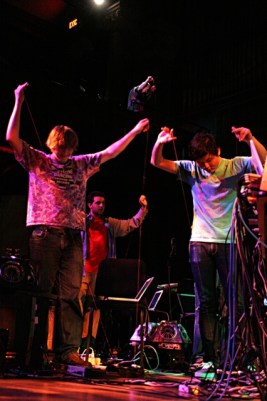
Featured video: The Princeton Laptop Orchestra (PLOrk) performs a piece “Skipstep” at a live concert in Spring 2014, featuring guest Sam Hillmer on saxophone.

This week’s show featured Jeff Snyder, Associate Research Scholar of Electronic Music at Princeton University. Jeff’s many roles in the local music scene gave us a lot of topics to discuss: directing the Princeton Laptop Orchestra (PLOrk, see video above!), keeping high-level electronic music composition at Princeton alive, and designing new and flexible instruments for Jeff’s own use and for consumers.

To start, PLOrk is an ensemble started by Dan Trueman, a professor of music, and Perry Cook, a professor of computer science. But instead of playing physical instruments, the group explores the conundrum of interfacing with electronics to make 1) innovative musical compositions that are 2) entertaining to watch live.

laptoporchestra2_ars
PLOrk performing, courtesy ArsTechnica.

To this effect, the orchestra makes music not only with laptops, but also with video game
controllers and algorithmic motion sensors to stretch the limits of their concert experience. Jeff brought up the example of making music with your eyebrow, which is possible with a little programming and a decent camera. PLOrk also interplays with more traditional instrumentalists, processing their sounds in real time. As the ensemble’s director, Jeff leads a diverse group of students (from math, neuroscience, finance…) through the process of programming software, writing pieces, and ultimately performing their works live.

Jeff’s further role as a faculty member at Princeton is to ensure that electronic music composition remains strong in academia. He points out the challenge of making a computer expressive: the composer has to “design in” the freedom and flexibility that physical instruments have naturally. A violinist can pull subtle emotions through their strings with changes in posture and technique, while a musician on a synthesizer has a relatively limited range of expression. Creating innovative interfaces between musician and instrument is thus a huge part of the writing process.

owenlake-headshot
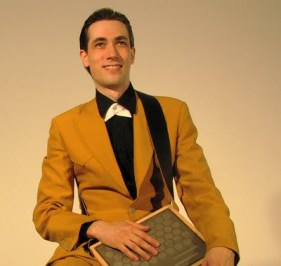
Jeff as Owen Lake.

Aside from academic responsibilities, Jeff plays in many musical groups (many of which you can hear on the show recording!). His duo exclusiveOr just features Jeff on an analog synthesizer and Sam Pluta on a computer. The team emphasizes the interplay of raw and processed sounds in their pieces, since Sam can only modify sounds from Jeff’s synthesizer and Jeff can’t modify any of his parts himself. Not one to be limited by genre or style, Jeff also plays in the experimental trio The Miz’ries and the electro-country group Owen Lake and the Tragic Loves. If you aren’t impressed yet, Jeff is co-founder of the Carrier Records music label, which has been releasing experimental work since 2009.


Lastly, the innovative performance of electronic music wouldn’t be possible without new instruments that bring versatility and expression to the world of synthesized tones. That’s why Jeff founded electronic-instrument company Synderphonics, an offshoot of Jeff’s desire to make new instruments for his own use. The company’s first and main product, the Manta, is an open-ended programmable keypad that reacts to sensitive changes in touch. In an age when everyone wants a sandbox to build their own unique soundspace, the Manta is ideal: a musician can tune its keys to respond to touch in an unlimited number of ways. But Jeff’s philosophy is different–the goal is to design an instrument that’s immediately recognizable, like the ghostly tone of the theremin decades ago. Whether or not that will fly in our era of customizability remains to be seen.

After the interview, I commemorate the fifth year since the Tuscaloosa-Birmingham

Chaparral_Supercell_2
Supercell storm, courtesy Wikimedia.

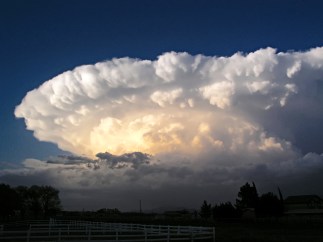
tornado of 2011 with a short piece about tornado formation. Just like instabilities can occur in plasmas when we try to contain fusion reactions, strange arrangements of fronts in the atmosphere can lead to instabilities in wind patterns during severe weather events. In tornadoes, a cold and dry front high in the sky covers a hot humid layer of air near the ground, and between them a vortex of shifting winds begins to form. When this vortex becomes vertical because of heating, it can form a supercell thunderstorm and becomes a prime environment for tornadoes to form. So stay safe out there: tornado season is well underway for much of the US.

Stevie then closed out our show with news about dengue fever. Now that Stevie has gone through dengue during her time in Indonesia, she runs a huge risk if she gets the disease a second time. It turns out there are four strains (“serotypes”) of dengue, and getting a new strain when you’ve already had one of them is bad news. Your body’s immune system wipes out a lot of the new virus because it’s similar to the old one, but the strains are different enough that some cells sneak below the radar and do a lot of damage. In fact, catching dengue again can be fatal. So it’s a big deal that a new vaccine is doing well in trials, fighting all the serotypes particularly well in humans. Let’s hope it works and becomes widely available, because 400 million people a year suffer through dengue fever.

As always, the playlist can be found below or at WPRB.com.

Screenshot from 2016-04-27 20-25-39

4/12/16 Show on Cell Walls and Antibiotics Feat. Anne McCabe

goldNanoparticleBilayer.jpg

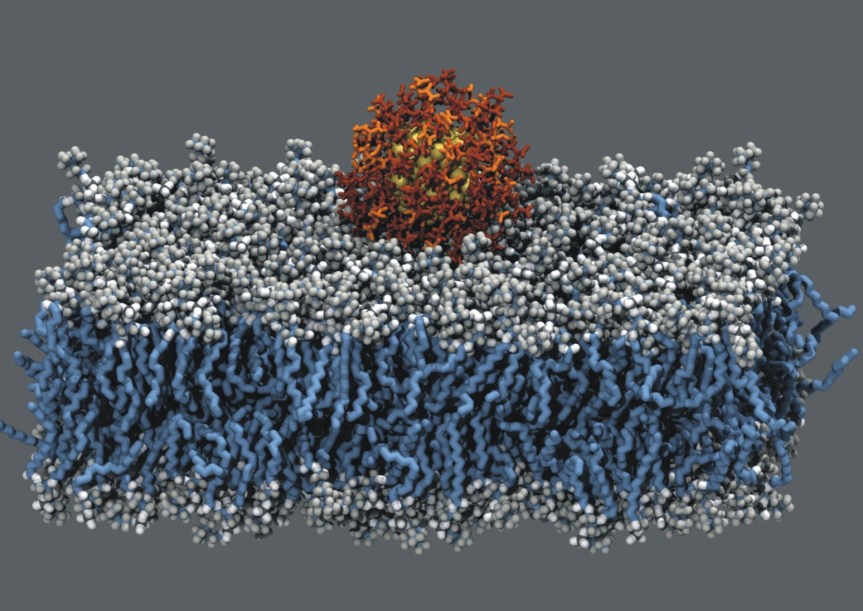
Featured Image: A visualization of a gold nanoparticle impinging on a cell wall, made of two layers of fatty molecules that repel water on both sides and keep a bacterial organism safe from the outside world. (courtesy S. Nielsen, UT Dallas)

This week, we interviewed PhD candidate Anne McCabe about bacterial cell walls and antibiotics! Anne works in the Department of Molecular Biology’s Silhavy Lab here at Princeton to decode how bacteria build protective cell walls around themselves. Understanding the genetics behind this construction could allow us to crack it, opening the pathway towards new antibiotics to stop diseases.RGS---Anne-McCabe-x250

A cell needs to isolate itself from the outside world somehow, and an easy way to do that is with fatty molecules that repel water on one side. Still, a cell needs to eat and exchange material with the outside world, so it has proteins embedded in the cell wall that intelligently sift particles from outside to inside and vice versa.

Anne deciphers the behavior of these protein ports through the wall by messing with the genetic codes of bacteria. She can introduce mutations in E. Coli’s genome that weaken its cell wall, making the bacteria weak to external dangers like antibiotics. As generations of bacteria suffer through the antibiotic onslaught, a few develop new mutations that help them survive, allowing Anne to track which proteins are defending the bacteria from our medicines.

Deconstructing bacterial defense is a complicated process, because a lot of cell wall proteins act together to protect bacteria from our attacks. But we need to figure it out–as antibiotics are overused in our society, many bacteria are slowly developing resistance to our medicines. If we want to protect ourselves against infections and disease, we need to discover new types of antibiotics and stay a step ahead of bacterial evolution. Anne’s research is a key approach to find more venues for productive medicines, but there’s a lot of options that deserve investigation: some come from soil microbes, others from the backs of sloths.

10850114_771171536263567_946927321817388830_nFinally, Anne is the recent chair of the Princeton Graduate Molbio Outreach Program, a huge organization of graduate students that arrange outreach in schools and at public events around the community. They have programs for children and adults, and aim for long-term collaborations between researchers and students. Look them up!
In the last few minutes of our broadcast, Stevie came on with two exciting stories of new science out this week. First, the company SpaceX has landed a space-going rocket on a barge in the Atlantic, finally successful after two previous attempts. This achievement means that the rocket gets recycled for another trip into orbit, dramatically lowering the cost of space flight for its next payload. It’s big news for a company that strives to make rocketeering economical.

We closed the show with a word about sonar: it’s being used for archaeology! A 200-foot object has been located with sonar off the coast of North Carolina, and there’s a good chance it’s the long-lost Agnes E. Fry shipwreck from the Civil War. The water is too dark and murky for surveying divers to see, so they’re taking images with sonar and mapping out the structure of the ship.

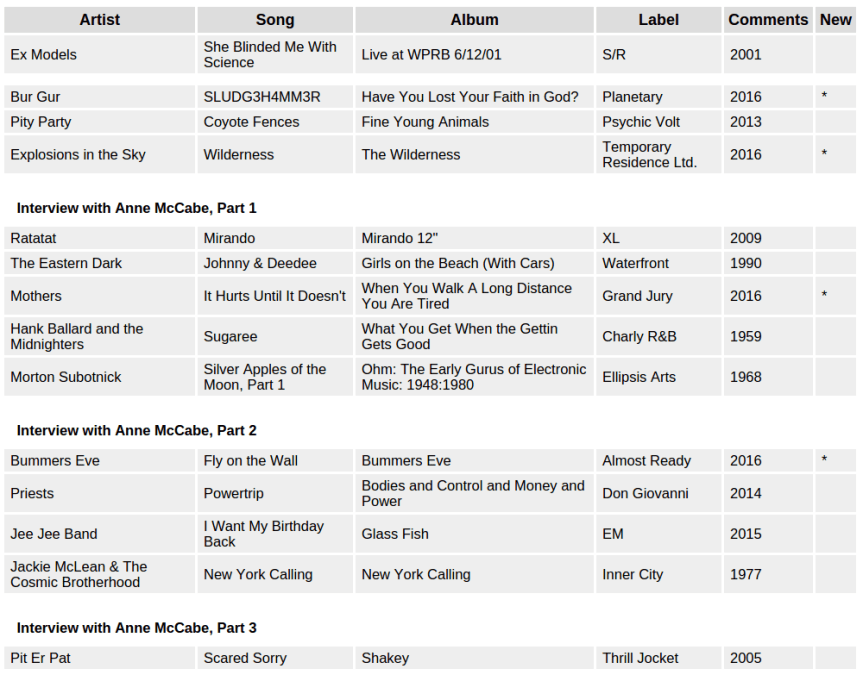
A full playlist can be found here and on WPRB.com. Thanks for listening!

041216_playlist

3/29/16 Show feat. Christin Monroe on enzyme factories + boat news and science for science’s sake

3dEnzymeImage

Featured image: a 3D illustration of an enzyme. Since enzymes have a rich structure like the molecule in this image, they are tuned to perform specific reactions inside the body. (From Argonne National Laboratory).

This week, we invited Christin Monroe, a fifth-year graduate student in the Department of Chemistry at Princeton University, to come in and speak with us about enzyme production. Christin uses a variety of organisms, from E. coli to yeast, as factories for enzymes–3D molecules that perform specific chemical reactions, like hemoglobin carrying oxygen through your veins.

As a student in Professor Grove’s group, Christin first teaches a colony of bacteria to produce the enzyme in question. Basically, this involves getting a strand of DNA from an organism that produces an enzyme naturally, and stuffing this inside the creatures in a Petri dish (of course, it’s harder than it sounds!). Then, if the host understands its genetic instructions, it mass-produces the enzyme so that Christin can harvest it and purify it enough for further analysis.

That next step could involve all sorts of applications. Maybe the isolated enzyme is critical for a certain medicine to work in the human body, so its reactions with a particular drug are analyzed to minimize side effects. Or, the enzyme could digest some contaminants in our drinking water (as tested in Belgium), cleaning it for us and then decaying away. After all, enzymes are naturally biodegradable, so they perform much better and cleaner than the synthetic alternatives that chemists might produce inorganically.

Sometimes, the reaction between and enzyme and another chemical happens in stages, and these intermediate byproducts are crucial to understand. Maybe they cause unintended side-effects from drugs, or maybe they signify other chemical uses for the enzyme aside from the obvious. In any case, researchers need to look inside the quick reaction: so they might “freeze” the reactions to view these byproducts. Or, they might keep a careful eye on the reaction’s progress with diagnostics like spectroscopy, which watches the color of light emitted from a chemical to identify its changes in time.

Christin is more than a chemist–she has also organized several outreach programs here at Princeton. One of them, a series of lectures and career-services mentoring events throughout August 2016, is happening in partnership with the American Chemical Society, and will feature a public talk by Bassam Shakhashiri. Check it out: there’s more information on this page’s second story.

After the interview, Brian and Stevie moved on to the very serious topic of Arctic ice melting, which is so concrete that a cruise liner will be able to pass through the Arctic Ocean this August. This has never been possible for such a big ship before, so it goes toboaty.pngshow how quickly our ice caps are disintegrating (and allowing for morally questionable commercial ventures to jump in and take advantage of the new open seas). Afterwards, we discussed the not-so-serious naming of the new British Antarctic Survey ship, which will take on the name (thanks to the Internet) Boaty McBoatface.

Lastly, we ask a broad question: should science be done for application’s sake, or for nothing but curiosity? Most science questions originate when a researcher finds something interesting and wants to find out more, but generally they get funded when the researcher connects the question to an application in engineering that might benefit society. But research for its own sake can produce spin-off technologies that were never expected, and also provides the chance for revolutionary results instead of incremental progress. Plus, humans are curious: shouldn’t we satisfy the urge to know more, especially if it leads to scientific truths unbiased by the economic forces around us?

As always, you can find the playlist for the show on WPRB.com, or below.

032916_playlist.png


3/15/16 Show feat. Justin Ripley on anti-gravity and cosmology + organ donors & AI’s AlphaGo win

2000px-Casimir_plates.svg

Image: Casimir plates, which attract each other just because of standing waves that exist in vacuum between them. Just one of many crazy effects predicted with math!

This week on These Vibes, we hosted Justin Ripley, a second-year graduate student in the Princeton Department of Physics, for an interview about his work in theoretical cosmology. The discussion dug into the deep philosophical side of physics, probing ideas like how time began and what clumps of dark matter might look like.

Justin is a cosmologist, which means he studies events that occur on the grandest scales of our universe. He’s driven by a search for fundamental laws: what did the universe look like when it was the size of a basketball? What can those processes tell us about the rules underlying our present-day reality? When you look at space around us through this lens, the stars and planets become fossils–and cosmology is excavating these remains of the Big Bang for deep clues about the nature of physics.

One notion Justin brought up is the idea of anti-gravity. Unlike the attractive force that keeps us on Earth and our solar system in alignment, this repulsive force can happen when you consider negative energy states, an idea which is hard to visualize in practice but which can be expressed in mathematical models. It’s examining these equations that Justin hopes can lead to new developments in cosmology. If the models line up with experimental evidence (like Stevie’s cosmic microwave background, or LIGO’s recently-discovered gravity waves), then we can push the laws of physics into new territory.

After many questions from listeners, we moved on to dark matter and the ways in which it might clump together. Like we discussed last week, dark matter has to exist, because we can indirectly measure its mass–but it’s invisible and doesn’t interact with anything (except gravitationally). Scientists like Lisa Randall at Harvard point out that dark matter could form planets and galaxies of its own, clumping together (check out the N-body simulation below!) just like the matter that makes us and our Earth. Experiments like Gaia are examining the motion of astral bodies, trying to detect changes in their paths that might indicate clumps of dark matter nearby.

After Justin’s interview, Stevie came on the mic to talk about this exciting new study that might allow universal organ transplants. Just as some peoples’ blood types aren’t compatible with others, organ donations tend to be limited by the need to find a perfect match. That’s why family members might be the first to give up a kidney for their relative: because their genes match so well, there’s a better chance the donated organ won’t be rejected by the recipient’s immune system. This new technique, called desensitization, could allow even an incompatible organ to remain successfully in its new body after the transplant. Even though the technique is new and (presently) expensive, it’s worked in many patients and has the potential to revolutionize the way we organize transplants.

To end the show, Justin and Brian talked about Google’s AlphaGo computer and its 4-1 win against Go grandmaster Lee Sedol over the past week. This is a historic win for artificial intelligence, since Go is known to require a lot of intuition: it’s a game that humans are good at and computers have a hard time learning. DeepMind’s team overcame this obstacle with neural networking (as discussed in this past interview), which allowed the computer to learn the game and tune its strategies over time.

The playlist can be found here on WPRB.com.

031516_playlist