5/17/16 Show feat. Prof Julianne Dalcanton on New Souped-up Satellites + Science Writer Lizzie Wade

Credits for the featured image, above: NASA, ESA, J. Dalcanton, B.F. Williams, and L.C. Johnson (University of Washington), the PHAT team, and R. Gendler

In this installment of These Vibes, Astrophysics Professor Julianne Dalcanton (U. of Washington) joined us in the studio to talk about space telescopes – specifically two she’s
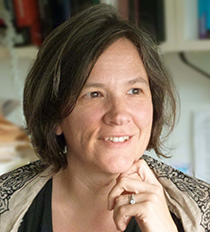
Julianne-Dalcanton_2101
Julianne Dalcanton, professor of astrophysics at the University of Washington

most psyched for: the just-proposed High-Definition Space Telescope, which would be “like the Hubble Space Telescope on steroids” (expected launch in ~2030) and the gorgeous feat of engineering that is the James Webb Space Telescope, to be launched in just a few years. We also got in to other exciting things like galaxies and exoplanets a bit.

Additionally, we talked about PHAT (actual acronym – I didn’t make this up), the Panachromatic Hubble Andromeda Treasury. For a period of time, Professor Dalcanton and some colleagues dominate the Hubble Space Telescope taking image after detailed image of our nearest galaxy, Andromeda. What came together was the most detailed images ever taken (for example, the featured image above), and they’re stunning:

Here’s another cool video for you. We discussed how the James Webb Space Telescope is going to essentially unfold after it’s launched, since it’s so large no existing shuttle can carry it to space. Here’s a really neat animation of how it’s supposed to go down.

And the aforementioned James Webb Space Telescope “selphie”:

JWST selphie
SHINY. 

Towards the end, we discussed life on other planets and how hard it is to look at the endless stars in the Andromeda Galaxy – only one of the countless galaxies in our universe – and not believe there’s more life-forms out there.

Later in the show (about an hour and 20 minutes in), Latin America correspondent for Science Magazine, Lizzie Wade, called in to the studio from Mexico City. We discussed her

LizzieWade
Lizzie Wade, Latin America correspondent for Science and freelance journalist, often writing for Wired

recent piece in Wired on how “Being Bilingual Changes the Architecture of Your Brain.” Lizzie discussed her own experiences becoming proficient in Spanish, as well as current science on the topic. She even touched a little bit on the ongoing debate on this topic (is bilingualism good for you? or neutral (neither good nor bad)?) as well as a bit of the shoddy history.

Last for the show, Wade told us a bit about two of her recent pieces on upheavals in the field of geology and some new findings on ancient stone tools in the Americas.

MUCH MOAR to see here:


playlist 5-17-16.png

5/10/16 Show feat. Ecologist Justine Atkins on antelope decisions and protected areas + chaos

gorongosaAntelope

Featured photo: A herd of sable antelopes graze in Gorongosa National Park, Mozambique. Credit to Michael Paredes.

For this week’s show, Justine Atkins, a graduate student in the Department of Ecology and Evolutionary Biology at Princeton, came in and told us all about animal decision making and the (lack of) science behind protected areas for conservation.

justine4-1
Justine Atkins in the field.

First, we went over Justine’s current research: she wants to make a computer model that predicts animal behavior given particular constraints. For example, what would a herd of antelope decide to do if we build a fence across their grazing lands? Or if we take land they use as a resource for farming or urbanization? Of course, understanding an antelope’s state of mind in order to predict such things is no easy task.

The initial step is to evaluate what factors influence antelopes to make various decisions in the first place. Might a skinnier antelope take more risks to eat in a bountiful field, even if there might be predators around? To get real data that might answer questions like this, researchers like Justine have to sedate wild animals and collar them with GPS transponders (a full-time job, until all thirty antelope are monitored and back with their herd!). Noting which animals are pregnant, or old or young, or skinny or well-fed, can give insight when Justine downloads their traveling paths and looks for patterns.

In the end, this massive amount of data (months of location data for 10-20 animals) will feed back into Justine’s code. Her simulation has a number of variables to consider that might affect each animal’s next move: hunger, danger, memory of the area, pregnancy… Until the simulation can be checked against real data, it’s hard to know how an antelope will weigh these considerations. But once the variables are weighted properly and the simulation can reproduce real transportation patterns from the wild, Justine can use the simulation to predict the antelopes’ response to future situations.

All of this goes hand in hand with conservation efforts. A researcher looking to protect endangered species might want to establish new protected areas, and should have an idea how the animals will react to such changes in their environment. Justine also has an interest in the science behind protected areas, particularly for evaluating their effectiveness. How do we know that a new national park has really helped the biodiversity within? Measuring its success is a difficult problem, especially since there are lots of fluctuations in nature that might confuse the study. Plus, in science we usually use control groups, so that a parcel of land that had protection should be compared against a similar parcel that was left in its original state. This type of research is rarely done in designating new protected areas.

costa rica laselva.jpg
La Selva station in Costa Rica.

Justine went into detail with this problem of impact evaluation for protected areas in a blog post on Highwire Earth (which comes up a lot on our show!). She brought up a few examples of well-researched protected areas, like La Selva in Costa Rica. There, the scientists put numbers to the state of each acre of rainforest they protected: some untouched, some reduced to farmland a hundred years ago, some just returned to forest within the last decade. Comparisons between these areas can lead to insight on re-development of forest after humans have intervened. Similarly, the savanna biosphere in Gorongosa National Park in Mozambique, where Justine carries out her data-taking on wild antelope populations, is recovering from a period of rampant poaching during a recent civil war. Ecologists there have the opportunity to study animal bounce-back after such a shock.

After the interview, Stevie brought up a viral GIF of Jose Ramirez running to second base. On his way, he loses his helmet, kicks it wildly as he runs, and it flies off-screen–only to come back and hit him in the head as he slides into the base. WIRED and These Vibes are here to tell you that physics didn’t break to turn Jose’s helmet into a boomerang. The effect is a trick of conserved momentum and of a panning camera. Since Jose was running when he kicked the helmet, it actually went straight up in his frame of reference, but kept moving forward at the same speed as the baseball player’s sprint. And the helmet appears to dip backward because the camera is moving sideways fast enough to trick you. In the end, it’s a bit of slapstick that actually makes physical sense.

doublePendulum
Double-pendulum simulation, showing unpredictable chaotic behavior.

We closed out the show with a quick discussion of chaos theory. In physics, chaos means something specific: two systems begin in almost the same scenario, but after a while they look totally different. This happens in the weather, since a Tuesday that turns into a Saturday thunderstorm isn’t much different at all from a Tuesday followed by a sunny weekend. Tiny fluctuations in the atmosphere end up foiling our weather prediction: it turns out we can’t do better than about a week out, even if we knew the temperature and pressure all over the globe. Other chaotic systems include three bodies in space or a double pendulum. This is a fascinating topic that we only just started to dig in to, so keep looking if you’re interested!

As always, the playlist is here or at WPRB.

051016_playlist.png

5/3/16 Show feat. Cosmologist Colin Hill on the Universe as a Laboratory + Learning’s Physical Effect on the Brain

Featured image is of the Atacama Cosmology Telescope (of which Colin Hill is a collaborator) in the Atacama desert in Chile. Image credit: NASA

In this installment of These Vibes, cosmologist, musician and ex-WPRB DJ Colin Hill came in to the studio to chat with us about the cosmic microwave background (aka “the CMB”), using the early universe as a laboratory to probe fundamental physics, dark matter, and his Brooklyn-based band Memorial Gore.

colinhillColin walked us through his life as a theoretical astrophysicist that “lives close to the data,” and what that means. He explained how the Sunyaev-Zeldovich effect blurs the cosmic microwave background, and how that tells us about the matter distribution in the universe.
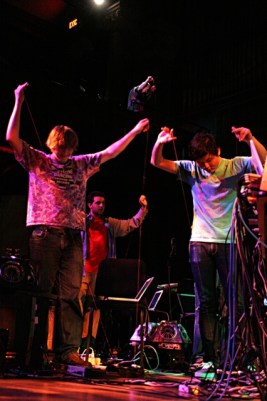

In part 2 of our interview we discussed what gravitational waves from the very early universe would do to the CMB: if theories are true, the gravitational waves would have imprinted a swirly polarization pattern in the radiation. Cosmologists are currently looking for this pattern (called “B-modes”), but there’s a big challenge. Dust – tiny particulates of carbon and silicon – in our galaxy can mimic this B-mode signal.  Continue reading “5/3/16 Show feat. Cosmologist Colin Hill on the Universe as a Laboratory + Learning’s Physical Effect on the Brain”

4/26/16 Show: Jeff Snyder on electronic music and instrument design + tornadoes and dengue

Featured video: The Princeton Laptop Orchestra (PLOrk) performs a piece “Skipstep” at a live concert in Spring 2014, featuring guest Sam Hillmer on saxophone.

This week’s show featured Jeff Snyder, Associate Research Scholar of Electronic Music at Princeton University. Jeff’s many roles in the local music scene gave us a lot of topics to discuss: directing the Princeton Laptop Orchestra (PLOrk, see video above!), keeping high-level electronic music composition at Princeton alive, and designing new and flexible instruments for Jeff’s own use and for consumers.

To start, PLOrk is an ensemble started by Dan Trueman, a professor of music, and Perry Cook, a professor of computer science. But instead of playing physical instruments, the group explores the conundrum of interfacing with electronics to make 1) innovative musical compositions that are 2) entertaining to watch live.

laptoporchestra2_ars
PLOrk performing, courtesy ArsTechnica.

To this effect, the orchestra makes music not only with laptops, but also with video game
controllers and algorithmic motion sensors to stretch the limits of their concert experience. Jeff brought up the example of making music with your eyebrow, which is possible with a little programming and a decent camera. PLOrk also interplays with more traditional instrumentalists, processing their sounds in real time. As the ensemble’s director, Jeff leads a diverse group of students (from math, neuroscience, finance…) through the process of programming software, writing pieces, and ultimately performing their works live.

Jeff’s further role as a faculty member at Princeton is to ensure that electronic music composition remains strong in academia. He points out the challenge of making a computer expressive: the composer has to “design in” the freedom and flexibility that physical instruments have naturally. A violinist can pull subtle emotions through their strings with changes in posture and technique, while a musician on a synthesizer has a relatively limited range of expression. Creating innovative interfaces between musician and instrument is thus a huge part of the writing process.

owenlake-headshot
Jeff as Owen Lake.

Aside from academic responsibilities, Jeff plays in many musical groups (many of which you can hear on the show recording!). His duo exclusiveOr just features Jeff on an analog synthesizer and Sam Pluta on a computer. The team emphasizes the interplay of raw and processed sounds in their pieces, since Sam can only modify sounds from Jeff’s synthesizer and Jeff can’t modify any of his parts himself. Not one to be limited by genre or style, Jeff also plays in the experimental trio The Miz’ries and the electro-country group Owen Lake and the Tragic Loves. If you aren’t impressed yet, Jeff is co-founder of the Carrier Records music label, which has been releasing experimental work since 2009.


Lastly, the innovative performance of electronic music wouldn’t be possible without new instruments that bring versatility and expression to the world of synthesized tones. That’s why Jeff founded electronic-instrument company Synderphonics, an offshoot of Jeff’s desire to make new instruments for his own use. The company’s first and main product, the Manta, is an open-ended programmable keypad that reacts to sensitive changes in touch. In an age when everyone wants a sandbox to build their own unique soundspace, the Manta is ideal: a musician can tune its keys to respond to touch in an unlimited number of ways. But Jeff’s philosophy is different–the goal is to design an instrument that’s immediately recognizable, like the ghostly tone of the theremin decades ago. Whether or not that will fly in our era of customizability remains to be seen.

After the interview, I commemorate the fifth year since the Tuscaloosa-Birmingham

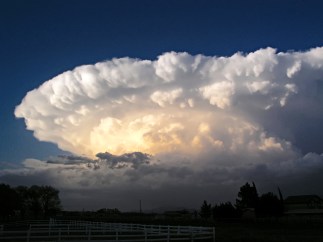
Chaparral_Supercell_2
Supercell storm, courtesy Wikimedia.

tornado of 2011 with a short piece about tornado formation. Just like instabilities can occur in plasmas when we try to contain fusion reactions, strange arrangements of fronts in the atmosphere can lead to instabilities in wind patterns during severe weather events. In tornadoes, a cold and dry front high in the sky covers a hot humid layer of air near the ground, and between them a vortex of shifting winds begins to form. When this vortex becomes vertical because of heating, it can form a supercell thunderstorm and becomes a prime environment for tornadoes to form. So stay safe out there: tornado season is well underway for much of the US.

Stevie then closed out our show with news about dengue fever. Now that Stevie has gone through dengue during her time in Indonesia, she runs a huge risk if she gets the disease a second time. It turns out there are four strains (“serotypes”) of dengue, and getting a new strain when you’ve already had one of them is bad news. Your body’s immune system wipes out a lot of the new virus because it’s similar to the old one, but the strains are different enough that some cells sneak below the radar and do a lot of damage. In fact, catching dengue again can be fatal. So it’s a big deal that a new vaccine is doing well in trials, fighting all the serotypes particularly well in humans. Let’s hope it works and becomes widely available, because 400 million people a year suffer through dengue fever.

As always, the playlist can be found below or at WPRB.com.

Screenshot from 2016-04-27 20-25-39

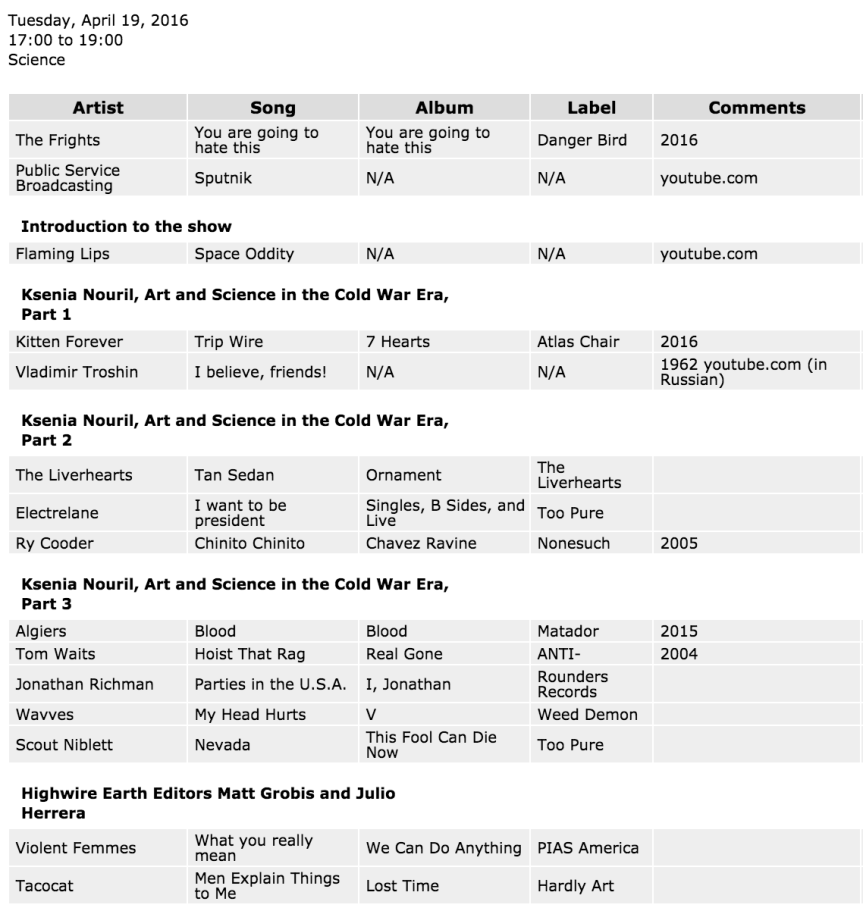
4/19/16 Show feat. Ksenia Nouril on art and science during the Cold War, plus the editors of Highwire Earth

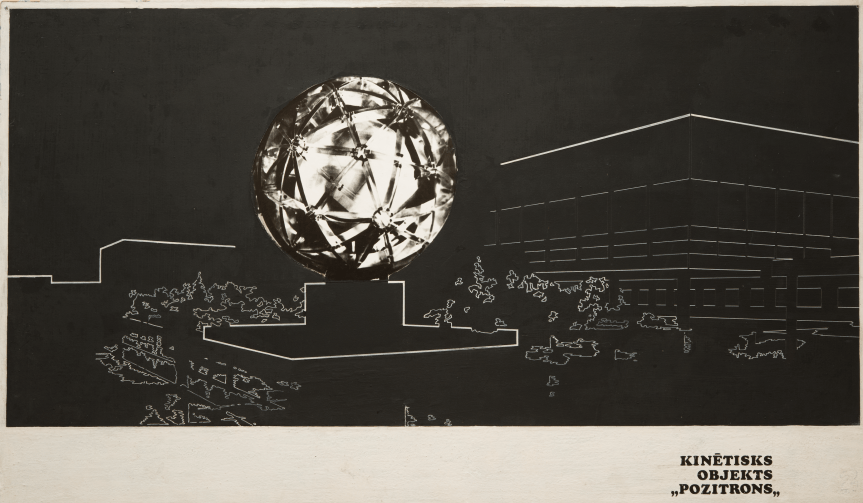
Featured Image: Valdis Celms. View of Positron, 1977. Ink and collaged photograph mounted on fiberboard. Zimmerli Art Museum, Norton and Nancy Dodge Collection of Nonconformist Art from the Soviet Union. © 2016 Artists Rights Society (ARS), New York / AKKA-LAA, Latvia. Photo Peter Jacobs

Last Tuesday was a wonderful, packed show. First we spoke to Ksenia Nouril, doctoral candidate in art history at Rutgers, New Brunswick, C-MAP Fellow at the Museum Of Modern Art in New York City, and Dodge Fellow at the Zimmerli Art Museum, also at Rutgers University.

Screen Shot 2016-04-20 at 9.41.20 PM
Ksenia Nouril. Credit: Sohl Lee

Furthermore, Ksenia is the curator of an excellent exhibit at the Zimmerli Art Museum that explores this topic, entitled Dreamworlds and Catastrophes, that will be up until July 31st, 2016 (free entry, information for visitors).

Throughout the first hour of the show Ksenia spoke to us on the intersections of art and science in Cold War Era Soviet Russia.

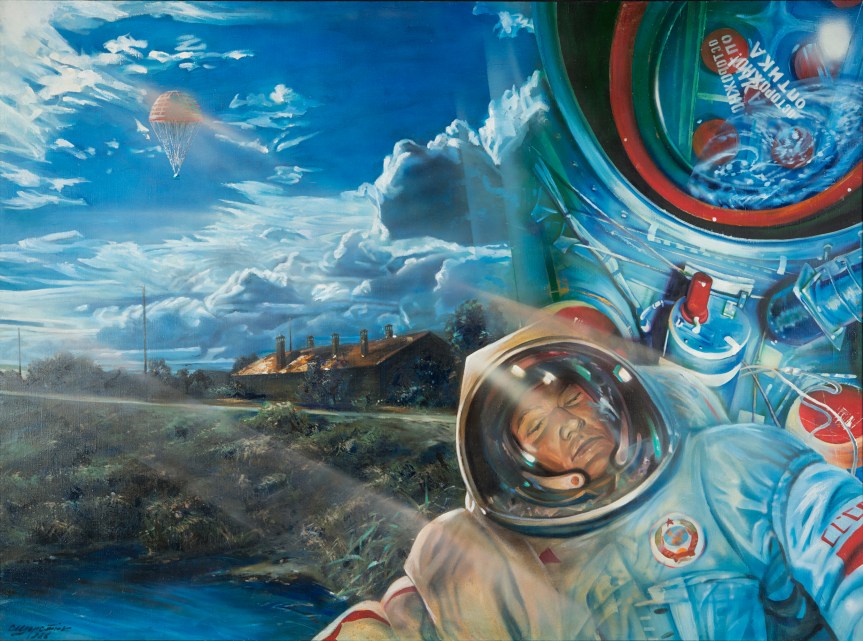
We discussed specific pieces like the Positron (featured image), and The Cosmonaut’s Dream.

Sherstiuk 1991
Sergei Sherstiuk (Russian, 1951-1998), The Cosmonaut’s Dream1986. Oil on canvas. Collection Zimmerli Art Museum at Rutgers. Norton and Nancy Dodge Collection of Nonconformist Art from the Soviet Union. Photo by Peter Jacobs 2014
Nussberg 2003
Lev Nussberg (Russian, born in Uzbekistan, 1937), Natalia Prokuratova (Russian, 1948). Altar for the Temple of the Spirit (Sketch for the creation of an altar at the Institute of Kinetics), 1969-70. Tempera and photocollage on paper. Gift of Dieter and Jutta Steiner. Collection Zimmerli Art Museum at Rutgers. Norton and Nancy Dodge Collection of Nonconformist Art from the Soviet Union. Photo by Jack Abraham 2006

Further, Ksenia played and translated “I believe, friends!” by Vladimir Troshin (1962). In the video below he’s marching around Moscow, rousing listeners to exalt in the glory of the space race. Check it out:

Towards the end of the show Stevie spoke with the editors of the blog Highwire Earth, Julio Herrera Estrada (Co-Founder and Editor-in-Chief, doctoral candidate in the Environmental Engineering and Water Resources Program) and Matt Grobis (Co-Founder and Managing Editor, doctoral candidate in Ecology and Evolutionary Biology)**, which posts articles from Princeton researchers who’s work focuses on balancing human development and sustainability. From prison reform to sustainable land use, there’s a lot of interesting stuff already up on the site. We hope this will be only the beginning of an ongoing partnership between These Vibes and Highwire Earth.

**Two other founders and editorial staff members, Arvind Ravikumar (Co-Founder and Associate Editor) and Greta Shum (Co-Founder and Communications Director), were not in the studio due to space and availability.


Screen Shot 2016-04-20 at 9.52.45 PM

4/12/16 Show on Cell Walls and Antibiotics Feat. Anne McCabe

goldNanoparticleBilayer.jpg

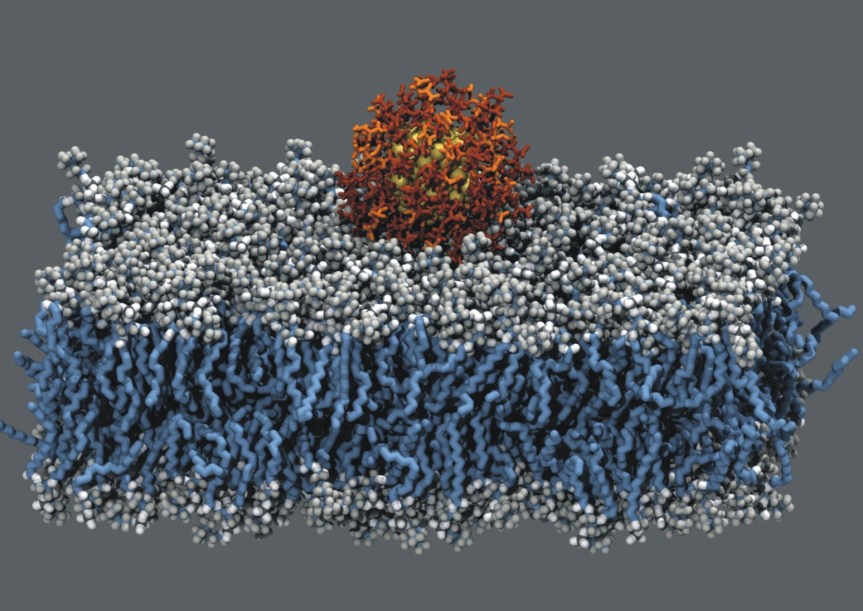
Featured Image: A visualization of a gold nanoparticle impinging on a cell wall, made of two layers of fatty molecules that repel water on both sides and keep a bacterial organism safe from the outside world. (courtesy S. Nielsen, UT Dallas)

This week, we interviewed PhD candidate Anne McCabe about bacterial cell walls and antibiotics! Anne works in the Department of Molecular Biology’s Silhavy Lab here at Princeton to decode how bacteria build protective cell walls around themselves. Understanding the genetics behind this construction could allow us to crack it, opening the pathway towards new antibiotics to stop diseases.RGS---Anne-McCabe-x250

A cell needs to isolate itself from the outside world somehow, and an easy way to do that is with fatty molecules that repel water on one side. Still, a cell needs to eat and exchange material with the outside world, so it has proteins embedded in the cell wall that intelligently sift particles from outside to inside and vice versa.

Anne deciphers the behavior of these protein ports through the wall by messing with the genetic codes of bacteria. She can introduce mutations in E. Coli’s genome that weaken its cell wall, making the bacteria weak to external dangers like antibiotics. As generations of bacteria suffer through the antibiotic onslaught, a few develop new mutations that help them survive, allowing Anne to track which proteins are defending the bacteria from our medicines.

Deconstructing bacterial defense is a complicated process, because a lot of cell wall proteins act together to protect bacteria from our attacks. But we need to figure it out–as antibiotics are overused in our society, many bacteria are slowly developing resistance to our medicines. If we want to protect ourselves against infections and disease, we need to discover new types of antibiotics and stay a step ahead of bacterial evolution. Anne’s research is a key approach to find more venues for productive medicines, but there’s a lot of options that deserve investigation: some come from soil microbes, others from the backs of sloths.

10850114_771171536263567_946927321817388830_nFinally, Anne is the recent chair of the Princeton Graduate Molbio Outreach Program, a huge organization of graduate students that arrange outreach in schools and at public events around the community. They have programs for children and adults, and aim for long-term collaborations between researchers and students. Look them up!
In the last few minutes of our broadcast, Stevie came on with two exciting stories of new science out this week. First, the company SpaceX has landed a space-going rocket on a barge in the Atlantic, finally successful after two previous attempts. This achievement means that the rocket gets recycled for another trip into orbit, dramatically lowering the cost of space flight for its next payload. It’s big news for a company that strives to make rocketeering economical.

We closed the show with a word about sonar: it’s being used for archaeology! A 200-foot object has been located with sonar off the coast of North Carolina, and there’s a good chance it’s the long-lost Agnes E. Fry shipwreck from the Civil War. The water is too dark and murky for surveying divers to see, so they’re taking images with sonar and mapping out the structure of the ship.

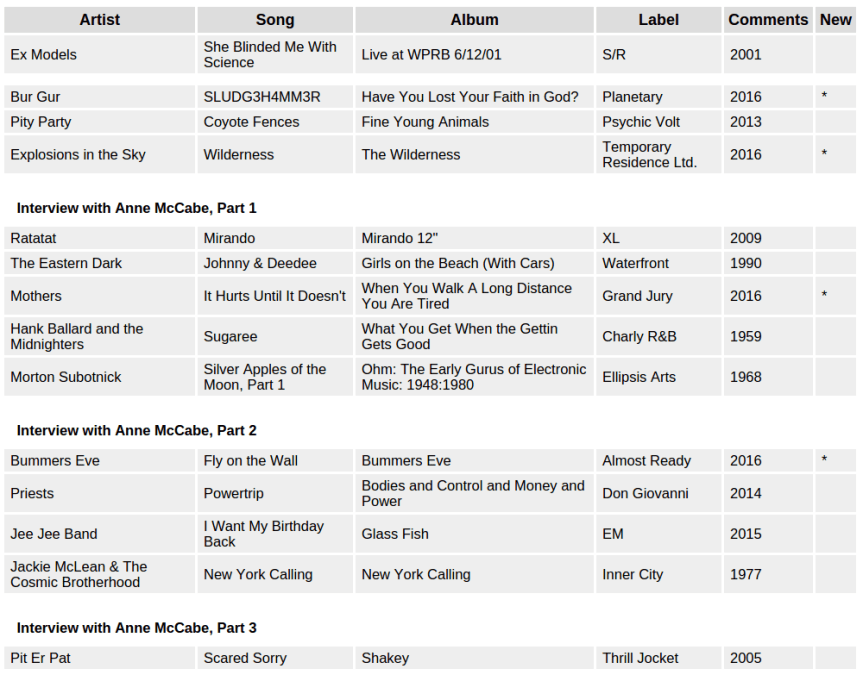
A full playlist can be found here and on WPRB.com. Thanks for listening!

041216_playlist

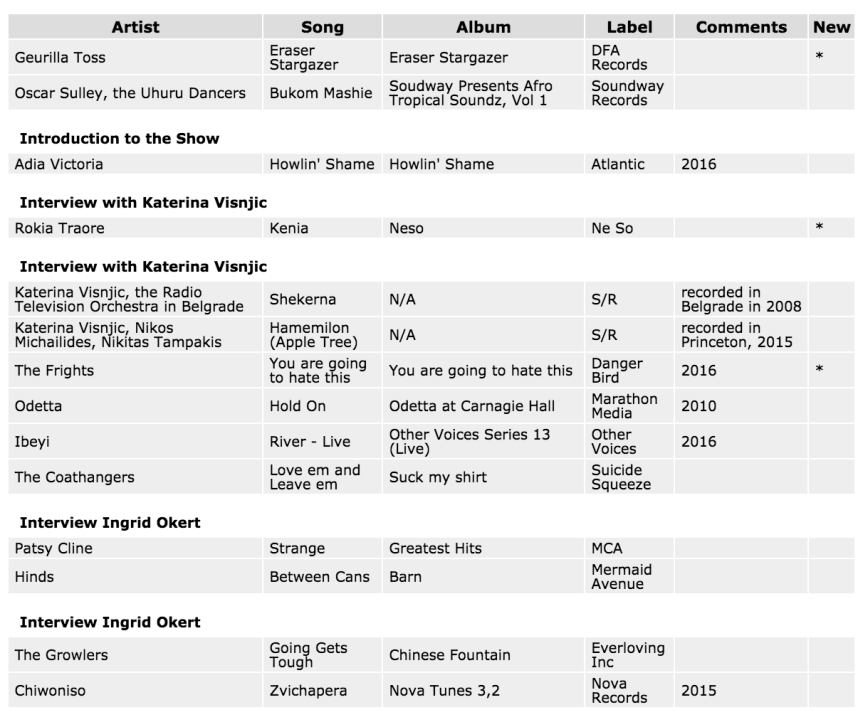
4/5/16 Show with Katerina Visnjic and Ingrid Ockert on Science Education Foundations and TV

In one of my favorite shows thus far, I discussed science education with one who practices it, and one who researches and documents the history of it. First, I spoke with Dr. Katerina Visnjic, senior lecturer in physics at Princeton University, and Ingrid Ockert, doctoral researcher in the history of science department. Ingrid’s research focuses on educational science television in the last century.

KatVisnjic
Dr. Katerina Visnjic
IngridOckert
Ingrid Ockert

With Dr. Visnjic we went in to the philosophy of teaching and various methods, both successful and not so much. We spoke about preparing for a physics education and what it means to see the world more scientifically – and more. Kat referenced and recommended the book The Art of Changing the Brain: Enriching the Practice of Teaching by Exploring the Biology of Learningby James Zull.


Dovetailing our conversation with Dr. Visnjic, Ingrid and I went in to her research on science educational television in the last century, beginning with the first program, the Johns Hopkins Science Review which aired from 1948 to 1955. Here’s a clip that aired in March 20th, 1951.

We discussed Watch Mr. Wizard! at length, like this clip from 1954:

Ingrid then took us through the years of science television and how they changed up to Carl Sagan’s Cosmos and today. Among several suggestions, she recommends Emily Graslie’s The Brain Scoop:


And so much music!

Screen Shot 2016-04-08 at 11.33.41 AM

3/29/16 Show feat. Christin Monroe on enzyme factories + boat news and science for science’s sake

3dEnzymeImage

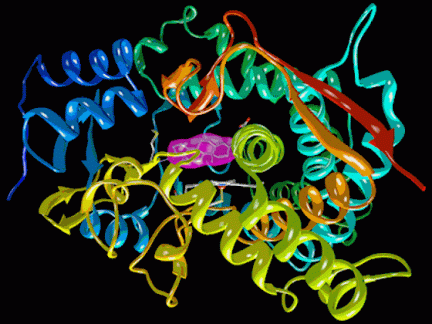
Featured image: a 3D illustration of an enzyme. Since enzymes have a rich structure like the molecule in this image, they are tuned to perform specific reactions inside the body. (From Argonne National Laboratory).

This week, we invited Christin Monroe, a fifth-year graduate student in the Department of Chemistry at Princeton University, to come in and speak with us about enzyme production. Christin uses a variety of organisms, from E. coli to yeast, as factories for enzymes–3D molecules that perform specific chemical reactions, like hemoglobin carrying oxygen through your veins.

As a student in Professor Grove’s group, Christin first teaches a colony of bacteria to produce the enzyme in question. Basically, this involves getting a strand of DNA from an organism that produces an enzyme naturally, and stuffing this inside the creatures in a Petri dish (of course, it’s harder than it sounds!). Then, if the host understands its genetic instructions, it mass-produces the enzyme so that Christin can harvest it and purify it enough for further analysis.

That next step could involve all sorts of applications. Maybe the isolated enzyme is critical for a certain medicine to work in the human body, so its reactions with a particular drug are analyzed to minimize side effects. Or, the enzyme could digest some contaminants in our drinking water (as tested in Belgium), cleaning it for us and then decaying away. After all, enzymes are naturally biodegradable, so they perform much better and cleaner than the synthetic alternatives that chemists might produce inorganically.

Sometimes, the reaction between and enzyme and another chemical happens in stages, and these intermediate byproducts are crucial to understand. Maybe they cause unintended side-effects from drugs, or maybe they signify other chemical uses for the enzyme aside from the obvious. In any case, researchers need to look inside the quick reaction: so they might “freeze” the reactions to view these byproducts. Or, they might keep a careful eye on the reaction’s progress with diagnostics like spectroscopy, which watches the color of light emitted from a chemical to identify its changes in time.

Christin is more than a chemist–she has also organized several outreach programs here at Princeton. One of them, a series of lectures and career-services mentoring events throughout August 2016, is happening in partnership with the American Chemical Society, and will feature a public talk by Bassam Shakhashiri. Check it out: there’s more information on this page’s second story.

After the interview, Brian and Stevie moved on to the very serious topic of Arctic ice melting, which is so concrete that a cruise liner will be able to pass through the Arctic Ocean this August. This has never been possible for such a big ship before, so it goes toboaty.pngshow how quickly our ice caps are disintegrating (and allowing for morally questionable commercial ventures to jump in and take advantage of the new open seas). Afterwards, we discussed the not-so-serious naming of the new British Antarctic Survey ship, which will take on the name (thanks to the Internet) Boaty McBoatface.

Lastly, we ask a broad question: should science be done for application’s sake, or for nothing but curiosity? Most science questions originate when a researcher finds something interesting and wants to find out more, but generally they get funded when the researcher connects the question to an application in engineering that might benefit society. But research for its own sake can produce spin-off technologies that were never expected, and also provides the chance for revolutionary results instead of incremental progress. Plus, humans are curious: shouldn’t we satisfy the urge to know more, especially if it leads to scientific truths unbiased by the economic forces around us?

As always, you can find the playlist for the show on WPRB.com, or below.

032916_playlist.png


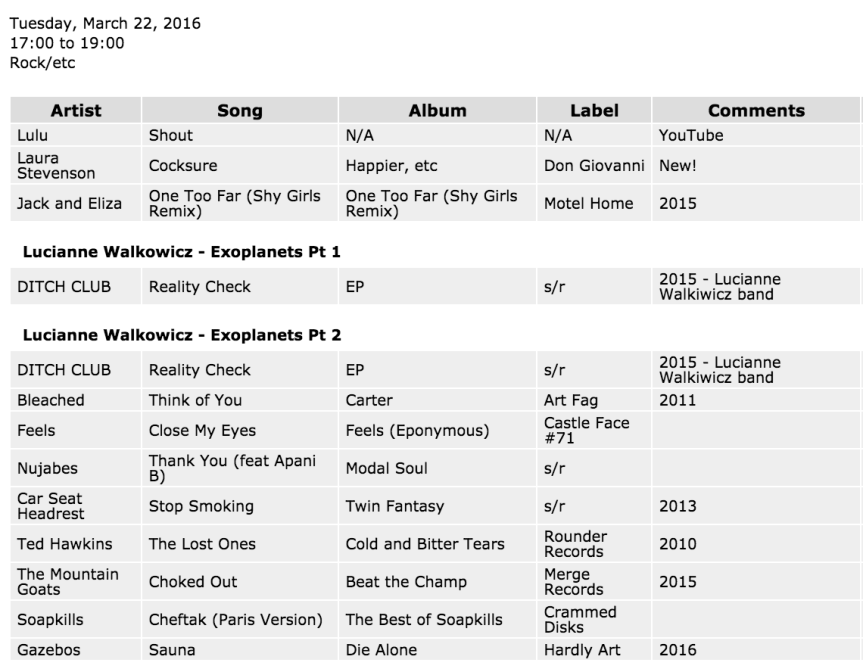
3/22/16 Show feat. Lucianne Walkowicz on exoplanets, Brian on fusion rockets, and muchos music

For this show I decided to replay an interview recorded last December 2015 with the extremely intelligent and talented Lucianne Walkowicz. For LOTS of extra information on the interview, links to her TED talks, and information on her band DITCH CLUB, check out the original post on the interview. (Don’t be shy!) We talked about the Kepler telescope and how it finds exoplanets, tardigrades, and why some people think one star observed by Kepler (“Tabby’s star”) could be an alien megastructure – no joke.

Additionally, Brian and I chatted for a while (around 1.5 hours in) about the prospect of fusion rockets, and in particular developing them to shoot down apocalypse-inducing asteroids. Here’s a press release from NASA on developing fusion rockets.


Screen Shot 2016-03-25 at 4.16.43 PM

3/15/16 Show feat. Justin Ripley on anti-gravity and cosmology + organ donors & AI’s AlphaGo win

2000px-Casimir_plates.svg

Image: Casimir plates, which attract each other just because of standing waves that exist in vacuum between them. Just one of many crazy effects predicted with math!

This week on These Vibes, we hosted Justin Ripley, a second-year graduate student in the Princeton Department of Physics, for an interview about his work in theoretical cosmology. The discussion dug into the deep philosophical side of physics, probing ideas like how time began and what clumps of dark matter might look like.

Justin is a cosmologist, which means he studies events that occur on the grandest scales of our universe. He’s driven by a search for fundamental laws: what did the universe look like when it was the size of a basketball? What can those processes tell us about the rules underlying our present-day reality? When you look at space around us through this lens, the stars and planets become fossils–and cosmology is excavating these remains of the Big Bang for deep clues about the nature of physics.

One notion Justin brought up is the idea of anti-gravity. Unlike the attractive force that keeps us on Earth and our solar system in alignment, this repulsive force can happen when you consider negative energy states, an idea which is hard to visualize in practice but which can be expressed in mathematical models. It’s examining these equations that Justin hopes can lead to new developments in cosmology. If the models line up with experimental evidence (like Stevie’s cosmic microwave background, or LIGO’s recently-discovered gravity waves), then we can push the laws of physics into new territory.

After many questions from listeners, we moved on to dark matter and the ways in which it might clump together. Like we discussed last week, dark matter has to exist, because we can indirectly measure its mass–but it’s invisible and doesn’t interact with anything (except gravitationally). Scientists like Lisa Randall at Harvard point out that dark matter could form planets and galaxies of its own, clumping together (check out the N-body simulation below!) just like the matter that makes us and our Earth. Experiments like Gaia are examining the motion of astral bodies, trying to detect changes in their paths that might indicate clumps of dark matter nearby.

After Justin’s interview, Stevie came on the mic to talk about this exciting new study that might allow universal organ transplants. Just as some peoples’ blood types aren’t compatible with others, organ donations tend to be limited by the need to find a perfect match. That’s why family members might be the first to give up a kidney for their relative: because their genes match so well, there’s a better chance the donated organ won’t be rejected by the recipient’s immune system. This new technique, called desensitization, could allow even an incompatible organ to remain successfully in its new body after the transplant. Even though the technique is new and (presently) expensive, it’s worked in many patients and has the potential to revolutionize the way we organize transplants.

To end the show, Justin and Brian talked about Google’s AlphaGo computer and its 4-1 win against Go grandmaster Lee Sedol over the past week. This is a historic win for artificial intelligence, since Go is known to require a lot of intuition: it’s a game that humans are good at and computers have a hard time learning. DeepMind’s team overcame this obstacle with neural networking (as discussed in this past interview), which allowed the computer to learn the game and tune its strategies over time.

The playlist can be found here on WPRB.com.

031516_playlist