Credits for the featured image, above: NASA, ESA, J. Dalcanton, B.F. Williams, and L.C. Johnson (University of Washington), the PHAT team, and R. Gendler
In this installment of These Vibes, Astrophysics Professor Julianne Dalcanton (U. of Washington) joined us in the studio to talk about space telescopes – specifically two she’s
Julianne Dalcanton, professor of astrophysics at the University of Washington
most psyched for: the just-proposed High-Definition Space Telescope, which would be “like the Hubble Space Telescope on steroids” (expected launch in ~2030) and the gorgeous feat of engineering that is the James Webb Space Telescope, to be launched in just a few years. We also got in to other exciting things like galaxies and exoplanets a bit.
Additionally, we talked about PHAT (actual acronym – I didn’t make this up), the Panachromatic Hubble Andromeda Treasury. For a period of time, Professor Dalcanton and some colleagues dominate the Hubble Space Telescope taking image after detailed image of our nearest galaxy, Andromeda. What came together was the most detailed images ever taken (for example, the featured image above), and they’re stunning:
Here’s another cool video for you. We discussed how the James Webb Space Telescope is going to essentially unfold after it’s launched, since it’s so large no existing shuttle can carry it to space. Here’s a really neat animation of how it’s supposed to go down.
Towards the end, we discussed life on other planets and how hard it is to look at the endless stars in the Andromeda Galaxy – only one of the countless galaxies in our universe – and not believe there’s more life-forms out there.
Later in the show (about an hour and 20 minutes in), Latin America correspondent for Science Magazine, Lizzie Wade, called in to the studio from Mexico City. We discussed her
Lizzie Wade, Latin America correspondent for Science and freelance journalist, often writing for Wired
I would be extremely remiss if I didn’t mention that Julianne Dalcanton is also a major contributor to the excellent Discover Magazine blog Cosmic Variance. I had a whole slew of questions about her posts on CV that we sadly didn’t have time for. *Sigh.*
Julianne Dalcanton was a WPRB DJ when she was at Princeton in the 90s, and some of the archives of her co-hosted show, The Three Bad Sisters (though there was two of them… this fact I love), are still online.
And then there’s this written up piece on an old WPRB show called Spotlight that was run by Corey, Julianne’s co-host. Julianne is wonderfully mentioned in this piece as “another female DJ (whose name I forget).”
AND definitely check out Lizzie Wade’s two very recent pieces on
Featured image is of the Atacama Cosmology Telescope (of which Colin Hill is a collaborator) in the Atacama desert in Chile. Image credit: NASA
In this installment of These Vibes, cosmologist, musician and ex-WPRB DJ Colin Hill came in to the studio to chat with us about the cosmic microwave background (aka “the CMB”), using the early universe as a laboratory to probe fundamental physics, dark matter, and his Brooklyn-based band Memorial Gore.
Colin walked us through his life as a theoretical astrophysicist that “lives close to the data,” and what that means. He explained how the Sunyaev-Zeldovich effect blurs the cosmic microwave background, and how that tells us about the matter distribution in the universe.
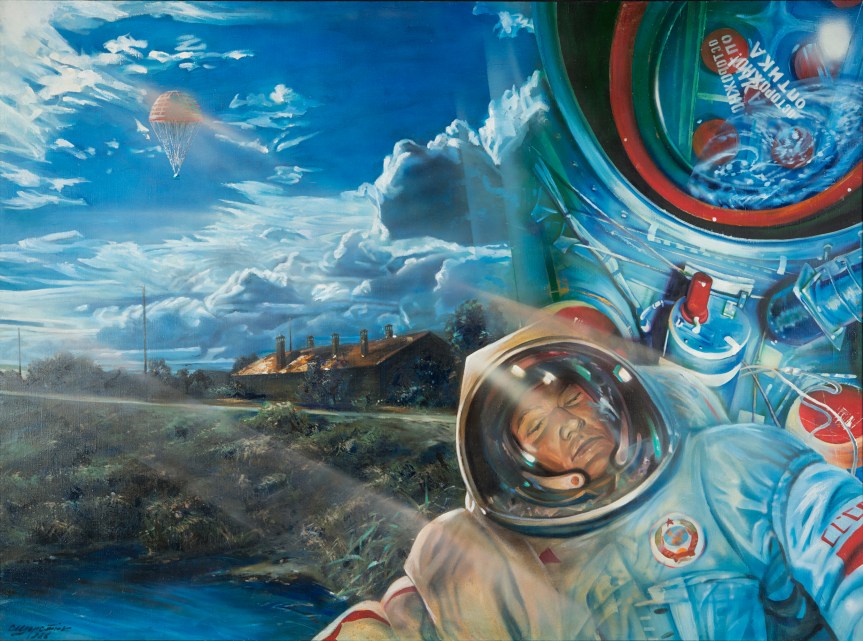
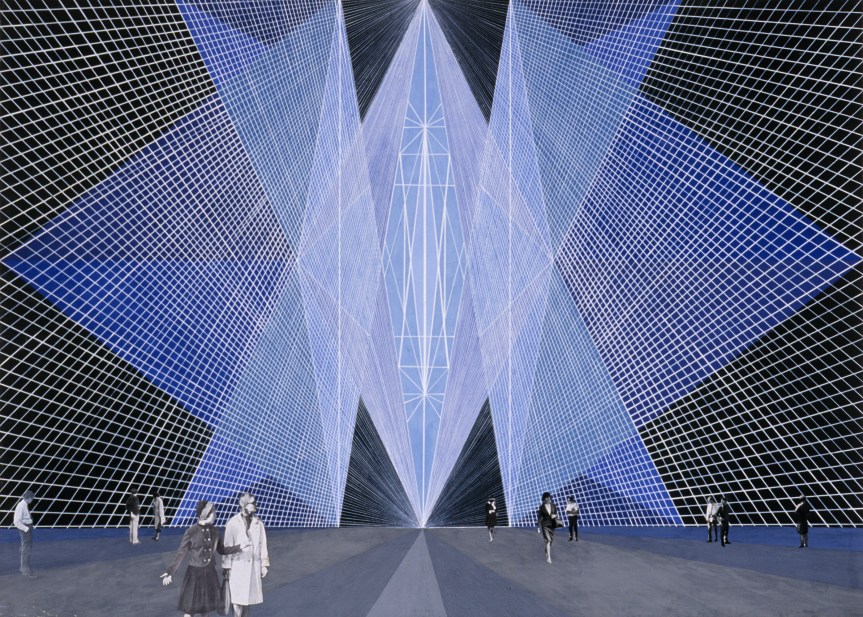
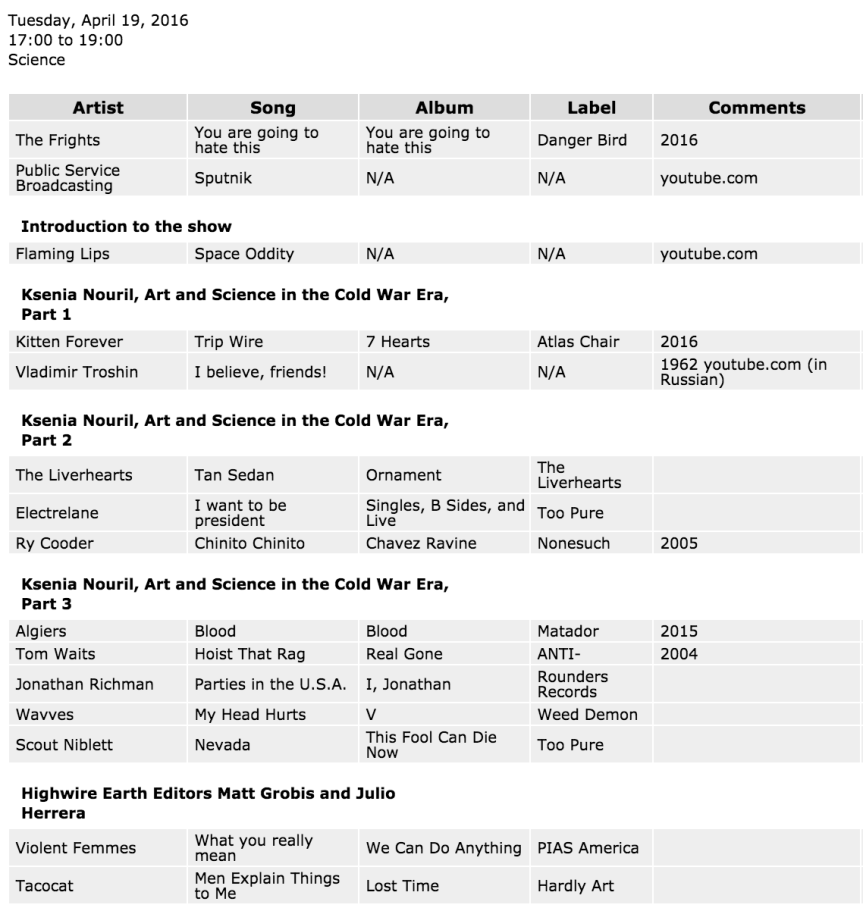
Last Tuesday was a wonderful, packed show. First we spoke to Ksenia Nouril, doctoral candidate in art history at Rutgers, New Brunswick, C-MAP Fellow at the Museum Of Modern Art in New York City, and Dodge Fellow at the Zimmerli Art Museum, also at Rutgers University.
Throughout the first hour of the show Ksenia spoke to us on the intersections of art and science in Cold War Era Soviet Russia.
We discussed specific pieces like the Positron (featured image), and The Cosmonaut’s Dream.
Sergei Sherstiuk (Russian, 1951-1998), The Cosmonaut’s Dream, 1986. Oil on canvas. Collection Zimmerli Art Museum at Rutgers. Norton and Nancy Dodge Collection of Nonconformist Art from the Soviet Union. Photo by Peter Jacobs 2014Lev Nussberg (Russian, born in Uzbekistan, 1937), Natalia Prokuratova (Russian, 1948). Altar for the Temple of the Spirit (Sketch for the creation of an altar at the Institute of Kinetics), 1969-70. Tempera and photocollage on paper. Gift of Dieter and Jutta Steiner. Collection Zimmerli Art Museum at Rutgers. Norton and Nancy Dodge Collection of Nonconformist Art from the Soviet Union. Photo by Jack Abraham 2006
Further, Ksenia played and translated “I believe, friends!” by Vladimir Troshin (1962). In the video below he’s marching around Moscow, rousing listeners to exalt in the glory of the space race. Check it out:
Towards the end of the show Stevie spoke with the editors of the blog Highwire Earth,Julio Herrera Estrada (Co-Founder and Editor-in-Chief, doctoral candidate in the Environmental Engineering and Water Resources Program) and Matt Grobis (Co-Founder and Managing Editor, doctoral candidate in Ecology and Evolutionary Biology)**, which posts articles from Princeton researchers who’s work focuses on balancing human development and sustainability. From prison reform to sustainable land use, there’s a lot of interesting stuff already up on the site. We hope this will be only the beginning of an ongoing partnership between These Vibes and Highwire Earth.
**Two other founders and editorial staff members, Arvind Ravikumar (Co-Founder and Associate Editor) and Greta Shum (Co-Founder and Communications Director), were not in the studio due to space and availability.
In one of my favorite shows thus far, I discussed science education with one who practices it, and one who researches and documents the history of it. First, I spoke with Dr. Katerina Visnjic, senior lecturer in physics at Princeton University, and Ingrid Ockert, doctoral researcher in the history of science department. Ingrid’s research focuses on educational science television in the last century.
Dovetailing our conversation with Dr. Visnjic, Ingrid and I went in to her research on science educational television in the last century, beginning with the first program, the Johns Hopkins Science Review which aired from 1948 to 1955. Here’s a clip that aired in March 20th, 1951.
We discussed Watch Mr. Wizard! at length, like this clip from 1954:
Ingrid then took us through the years of science television and how they changed up to Carl Sagan’s Cosmos and today. Among several suggestions, she recommends Emily Graslie’s The Brain Scoop:
Additionally, Brian and I chatted for a while (around 1.5 hours in) about the prospect of fusion rockets, and in particular developing them to shoot down apocalypse-inducing asteroids. Here’s a press release from NASA on developing fusion rockets.
Featured image is from NASA. See below for explanation and credits.
It was a bit of a chaotic show in the studio. Just before start, we were told that our show would be interrupted a half hour in by basketball. Plans were thrown out and the drawing board went up. Blessedly, the sports only hijacked our live-stream. The day turned in to a beautiful show of music, with a great discussion on dark matter just before the end (around 1.5 hours in). The planned airing of an interview on exoplanets with astronomer and TED fellow Lucianne Walkowicz has been postponed.
The featured image for this post is from NASA. It’s the famed bullet cluster we mentioned so many times on the show! Two galaxies clusters collided, producing the image. Hot gas from normal matter colliding and interacting is in pink, and dark matter is in blue. You can see the dark matter just flew right past everything, maintaining its spherical shape.
This composite image shows the galaxy cluster 1E 0657-56, also known as the “bullet cluster.” This cluster was formed after the collision of two large clusters of galaxies, the most energetic event known in the universe since the Big Bang. Hot gas detected by Chandra in X-rays is seen as two pink clumps in the image and contains most of the “normal,” or baryonic, matter in the two clusters. The bullet-shaped clump on the right is the hot gas from one cluster, which passed through the hot gas from the other larger cluster during the collision. An optical image from Magellan and the Hubble Space Telescope shows the galaxies in orange and white. The blue areas in this image show where astronomers find most of the mass in the clusters. The concentration of mass is determined using the effect of so-called gravitational lensing, where light from the distant objects is distorted by intervening matter. Most of the matter in the clusters (blue) is clearly separate from the normal matter (pink), giving direct evidence that nearly all of the matter in the clusters is dark. The animation below shows an artist’s representation of the huge collision in the bullet cluster. Hot gas, containing most of the normal matter in the cluster, is shown in red and dark matter is in blue. During the collision the hot gas in each cluster is slowed and distorted by a drag force, similar to air resistance. In contrast, the dark matter is not slowed by the impact, because it does not interact directly with itself or the gas except through gravity, and separates from the normal matter.
In the last half hour of the show Brian and I, and our friend and fellow DJ Tristan, spoke about dark matter for a while. Honestly, the wikipedia page for dark matter is great if you’re looking for more information on the topic.
Photo credit where credit is due: X-ray: NASA/CXC/CfA/M.Markevitch et al.; Optical: NASA/STScI; Magellan/U.Arizona/D.Clowe et al.; Lensing Map: NASA/STScI; ESO WFI; Magellan/U.Arizona/D.Clowe et al.
Playlist:
Check out the band, Gulps! They’re a new, totally rockin’ local New Jersey band that’s playing a lot of shows.
Featured image above is from an article from 2013 where a group at Berkeley is working to make windows even smarter, in a different way.
In this special show for WPRB’s all-vinyl week, Brian covers the tunes and Stevie speaks to our guests, Princeton graduate researchers Nick Davy and Melda Sezen. It was beautiful chaos in the studio.
Nick and Melda work on Smart Windows, under Professor Lynn Loo in Chemical and Biological Engineering. “Smart Windows” refers to glass that can change colors (darken) when a current is applied. This happens due to the electrochromic (electro=electrical responding, chromic=color) material polyaniline. Polyaniline is magical. It dissolves in water, and is just green when no current is applied (see image), but when connected to an energy source, like a battery or a solar cell, it can be tuned to be varying shades of blue, and even transparent. Nick and Melda’s collaboration
Poly-aniline.
works to improve this technology by introducing organic* solar cells as an extra varnish on the windows, producing both the energy needed to change the color of the glass and hopefully some excess to power your home, etc.
So, in the show we in to the nitty gritty of how smart glass works, and how Nick and Melda are fabricating and improving the technology. We then dive in to other applications of organic solar cells and polyaniline, for example wearable technology.
If you’re looking for something about smart windows that’s little higher level, take a look here.
At the very end of the show, Brian jumps on the mic to give us a little history of vinyl, including cylinder vinyl, and how LPs are made!
*In chemistry speak, “organic” = carbon based. In this case, think “plastic.”
Featured image is an artist’s conception of gravitational waves from a binary system. From LIGO.org.
Image with the recording is of the inside of the Tate Britain museum in London.
Dr. Lora Angelova at her old office at the University College London.
The main portion of this show is an interview with Dr. Lora Angelova – a chemist and researcher at the Tate Britain in London, England. What this means is, she uses chemistry, material sciences, physics, art history – and whatever else she needs – all towards the effort of conserving art. Currently, her research focuses on developing methods of surface cleaning artworks. Throughout our interview she takes us through some of the work involved to keep a piece of art in a state as close to its original as possible, and how much of an effort that takes. It’s truly a labor of love.
In the interview we discussed her work with NanoRestART, and micro-emulsions. Lora explained micelles, and that lead us to how soap works. Then we spoke a little on the surface of our cells – as it’s a similar concept.
From sustainablescientist.net.
Simplified cell-membrane. See how it’s a double layer of the micelle?
After the interview, I spoke for a while about gravitational waves. Here’s approximately what I said on them:
If I were a betting woman, I’d say that you’re about to hear a lot in the news about these entities called “gravitational waves.” That is, if you keep up with science and tech news.
On Thursday, the LIGO experiment is having a press conference. BUT it’s been rumored for months that they might have seen something in their instrument. LIGO stands for Laser Interferometer Gravitational-wave Observatory. And what they search for is, you guessed it, gravitational waves.
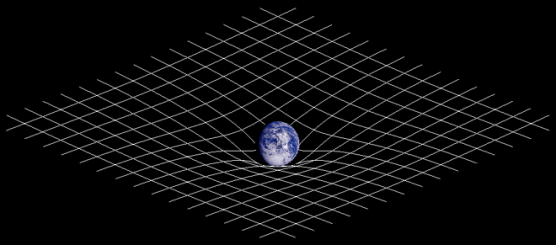
From general relativity we know that gravity – the force that makes apples fall and keeps us here on Earth, and maintains the Earth orbiting the Sun – isn’t like the other forces. The other three forces: the electromagnetic, strong, and weak forces – all operate via particle interactions. So if two objects are attracted or repelled due to the electromagnetic force, this comes about because of particle exchange. But when two objects are gravitationally attracted to each other, this comes about due to the fact that massive objects actually warp the spacetime around them. Like when you sit on your bed with lots of stuff on it and everything falls in to you. Alternatively, think of a rubber sheet pulled taught with a bowling ball set on it. The bowling ball warps the sheet, causing any marbles
Einstein ring image taken by the Hubble Telescope.
you throw on to the sheet to fall in to the ball. This is how gravity works.
And, in our sky, we can see gravity do this due to its effect on light. Light always takes the shortest path through spacetime, so if spacetime curves due to some massive object, then the light will curve. This effect creates these fascinating images on the sky called Einstein rings – these are absolutely gorgeous and dramatic and totally incredible. You can see one of these to the right of this page, but google for images. There’s many.
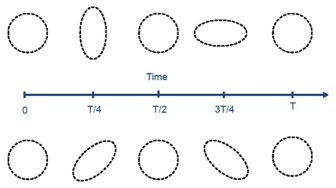
So what’s a gravitational wave? Well, if gravity is curvature of spacetime, then a gravitational wave is an oscillation in spacetime. Think of it like a stretching and compressing of a small bit of space – first vertically stretched and horizontally compressed, then horizontally stretched and vertically compressed, and again and again, back and forth – but that stretching and compressing action is traveling, at the speed of light, away from its source.
The LIGO instrument uses this property – and lasers – to try to measure gravitational waves. Essentially, they have VERY very precise lasers aimed across a distance, and if this light from the laser is stretched or compressed just a little tiny bit, then LIGO will pick it up. And if that stretching and compressing has the right signature, then it could be a gravitational wave.
From LIGO at Caltech website.
A good next question is, where does the gravitational wave come from? What’s the source? Well, a gravitational wave is theorized to radiate out from just about any massive, moving source. So this could be, for example, two neutron stars spinning around each other at fantastic speeds, colliding black holes. Or you, driving in your car.
A key thing to note is that gravity is SO MUCH weaker than any of the other forces. This is why a magnet that you hold in your hand could attract a paperclip via the electromagnetic force, but could never really attract anything gravitationally. If you’re in to numbers, gravity is about 30 orders of magnitude – that’s a 10 with 30 zeros after it – weaker than the electromagnetic force.
And this is why LIGO is looking to observe gravitational waves from two neutron stars spinning around each other at fantastic speeds, but isn’t worried about picking up the waves from you driving in your car. And this is also why it’s so hard – and why it’s never been done before. But LIGO has been diligent…and there have been rumors of discovery for weeks now. So…watch this space.
And just so you know – gravitational waves have never been directly observed before, but
Figure showing how gravitational waves radiate from a binary pulsar system, like the Hulse-Taylor system. From http://resources.edb.gov.hk
it’s on very very strong theoretical footing. First off, they come out of General Relativity, which has been tested time and time again. And second, they have been measured indirectly.
Here’s what we’ve seen. As a system – like binary neutron stars or black holes – radiate gravitational waves, they lose energy… this will cause the objects to spiral in towards each other and eventually collide. And this has been observed! Cue the Hulse-Taylor pulsar.
In the Hulse-Taylor system a…
…decrease of the orbital period [was observed] as the two stars spiral together. Although the measured shift is only 40 seconds over 30 years, it has been very accurately measured and agrees precisely with the predictions from Einstein’s theory of General Relativity. The observation is regarded as indirect proof of the existence of gravitational waves. Indeed, the Hulse-Tayor pulsar is deemed so significant that in 1993 its discoverers were awarded the Nobel prize for their work.
So, we are pretty sure they exist. And if we are able to observe gravitational waves directly from sources like black holes and dark matter, that would be totally revolutionary for astrophysics! It would show us the universe us in a whole, brand new way.
And with that, we’re all pretty pumped to hear what LIGO has to say on Thursday. And sometime soon I’ll try to get someone from the collaboration in here to talk about it.
Feature image: Behold! The cosmic microwave background. It was emitted just after the universe was one big plasma. Credit: Planck HFI telescope.
Welcome to the new and improved These Vibes Are Too Cosmic. Brian Kraus and Stevie christen their new time slot of 5-7pm on Tuesdays. We introduce the new format for the show – we’re switching off taking the helm each week (next week Stevie, the week after that Brian, and so on) serving up steaming offerings of science and music.
But this week, in this new show we’re so pumped about, we decided to introduce our listeners to….ourselves. We play music we love, interview each other on our respective research fields, and take questions from listeners.
Plasma physics (Brian): I work on plasmas, which are basically electrified gases. Imagine the process of melting a solid, and then boiling a liquid: in both cases, the atoms in the material are more and more free to move around as they gain energy. In a plasma, the electrons around the atoms have enough energy to escape the atomic nucleus, and what you’re left with is a gas of charged particles: negative electrons zooming around the heavier positive ions. You’d know a plasma if you saw one: they glow, like the plasma ball to the right or the lightning during a rainstorm.
A toy plasma ball – touch it, and one of the filaments runs to your finger (courtesy of Wikipedia).
The applications of plasma are numerous – from lightbulbs to space propulsion – but the most famous reason to study plasmas is to make fusion energy. This is the nuclear process where small atoms collide together to form bigger ones, which results in a huge energy gain for fused particles. Fusion energy could become a safe source of power, driving electrical grids with energy from seawater. The main issue is plasma containment, which means we have to keep the hot plasma (often at 10 million degrees C) from melting the walls of the container we keep it in. The most common device for magnetically confining a plasma is called a tokamak, which is basically a donut that keeps particles spinning around on a racetrack as they heat up.
MAST tokamak, a plasma containment device (courtesy of CCFE).
My own work concerns measuring properties of plasmas with probes. Since the plasma is an electrified gas, it can conduct currents and respond to voltages – which are very easy to tap into by sticking a metal wire in the middle of the plasma! By varying the bias on the metal probe (putting stronger or weaker batteries on it), I can push or pull on the electrons in the plasma. Through this general method, we can deduce the plasma’s temperature and density at many points, so we have a good map of what it’s actually doing.
You can learn a lot more about plasmas, and my work studying them, by listening to an older show where Stevie interviews me about all of this in greater detail.
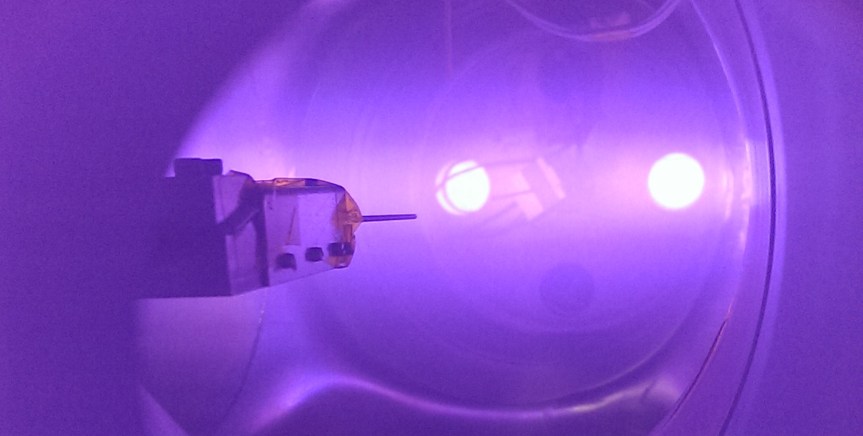
A xenon plasma that I study with the probe assembly to the left. You can see the plasma beam – the bright part in the middle – streaming toward the probe, which we use to measure properties like density and temperature.
Observational Cosmology (Stevie): I work on the SPIDER instrument, a telescope with the aim to measure the polarization in the cosmic microwave background radiation (CMB, the featured image up top). The CMB is, believe it or not, microwave radiation that bathes our entire universe. Not only is this radiation the oldest in our universe, it serves as a snapshot of our universe at that time it was emitted – over 14 billion years ago. Since it’s discovery in the 1960s (a great story unto itself), we’ve learned the CMB (like our universe) is almost entirely homogeneous and isotropic, but with tiny variations that map to density perturbations in
Bill Jones, PI of SPIDER, working on the instrument in Antarctica.
our early universe. These perturbations were the seeds of all the astrophysical structures we see around us today. Currently, the cosmic background radiation is our richest source of information on the evolution and large scale structure of our universe.
At only 2.7 degrees Kelvin, this radiation is difficult to measure, but not impossible. It is still just light with a defined energy ( = wavelength) and polarization. Through decades of effort scientists have carefully mapped the temperature of the CMB. Now, the forefront of observational cosmology is to map the polarization. Incredibly, the patterns in the polarization of the CMB have the capacity to
SPIDER, during its first flight in January 2015, hanging below a giant weather balloon above Antarctica.
tell us about our universe back before the CMB was even emitted, pushing our understanding of our universe back to a time just moments after the Big Bang.
The SPIDER collaboration manages this task by cooling polarization-sensitive detectors to
less than a degree above absolute zero, and then sending them to the edge of space for a 20 day flight in weather balloon above Antarctica. SPIDER’s first flight was last January (2015). The flight was successful. We’re currently analyzing our rich new data set and preparing for a second flight in the next few years. As a grad student on this project, I’m pretty psyched.
Our bodies are made up of hundreds of different types of cells, each with their own specific task. They react to all sorts of internal and internal stimuli as they go about their business. Sometimes they’re instructed to move left/right, reproduce, kill themselves, etc. If this all goes haywire (think, cancer), and oh man are there so many ways it could, it can profoundly affect our lives, or end them.
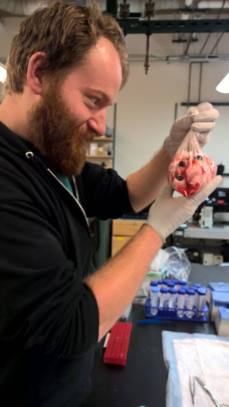
Anthony Berger. He looks maniacal, but these eyes are all for important scientific research.
In this interview I discuss cellular decision making and biomedical engineering with Anthony Berger, PhD student at the University of Wisconsin, Madison. Tony’s work focuses on how cells respond to the structural properties of their environment – i.e. whether the tissue around them is stiff, stretchy, soft, etc. Specifically, Tony studies how tissue stiffness and fiber architecture affects the development of vasculature (blood veins) within the tissue. To accomplish this, he designs materials that can flex to allow for changes in the rigidity of a material without changing the density of that material (a very important point in the design).
All of my designs have been based around natural materials — I generally take some sort of form of collagen (gelatin in most cases) and chemically alter it to be less flexible. We then embedd nodules of vascular cells within the tissue and observe how the cells invade into the material and develop a system of vessels.
I liken it to an office building with people working in it. The building is the tissue and the people are the cells doing all the work. Drugs and chemical growth factors/hormones are like emails to the people telling them to do specific things. Changes in different physical aspects of the tissue would be like changing certain aspects of the building — if the floors were made out of trampolines, work efficiency would probably be much different than if they were concrete. The point is the cells are generally what do everything in your body and a lot of focus is put on them, but the physical environment, often overlooked as something that is just there, has the potential to influence a cell’s behavior.
As an example, Tony guides us through how this relates to breast cancer. Note: the stiff lump a woman may feel in her breast isn’t actually the cancer, rather an area of stiff tissue that creates a preferred environment for breast cancer to take root. Scientists aren’t sure exactly why, hence research. Take a listen!
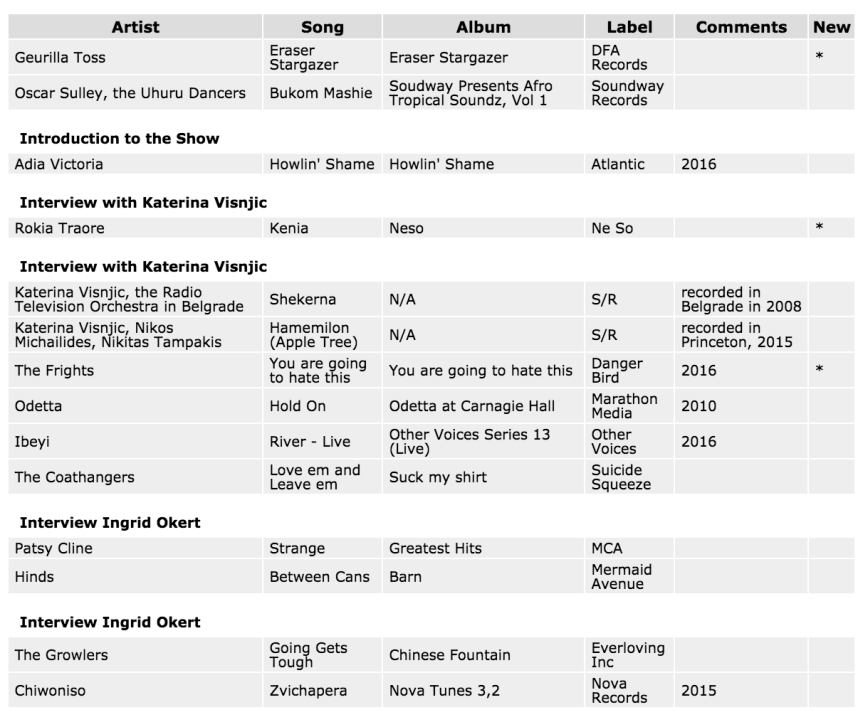
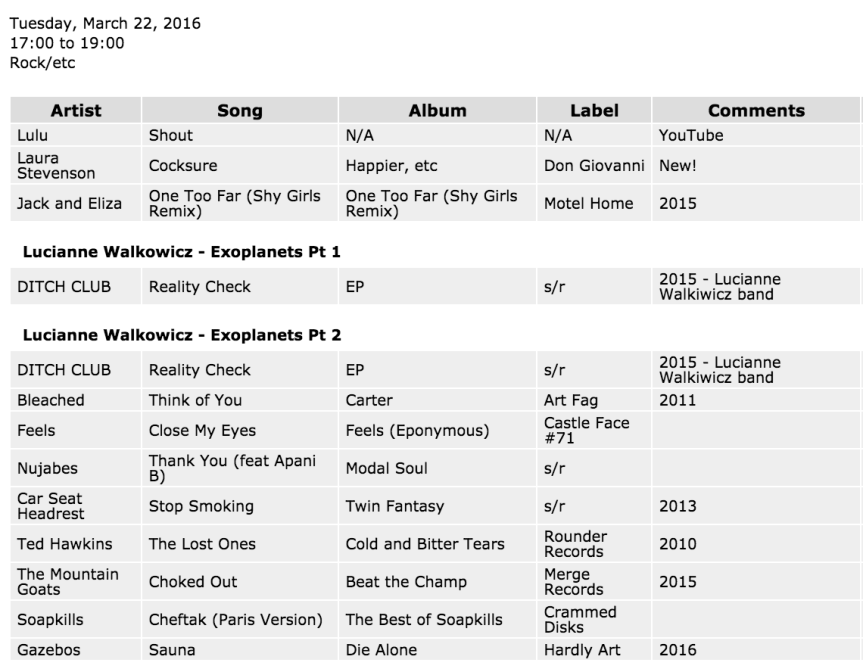
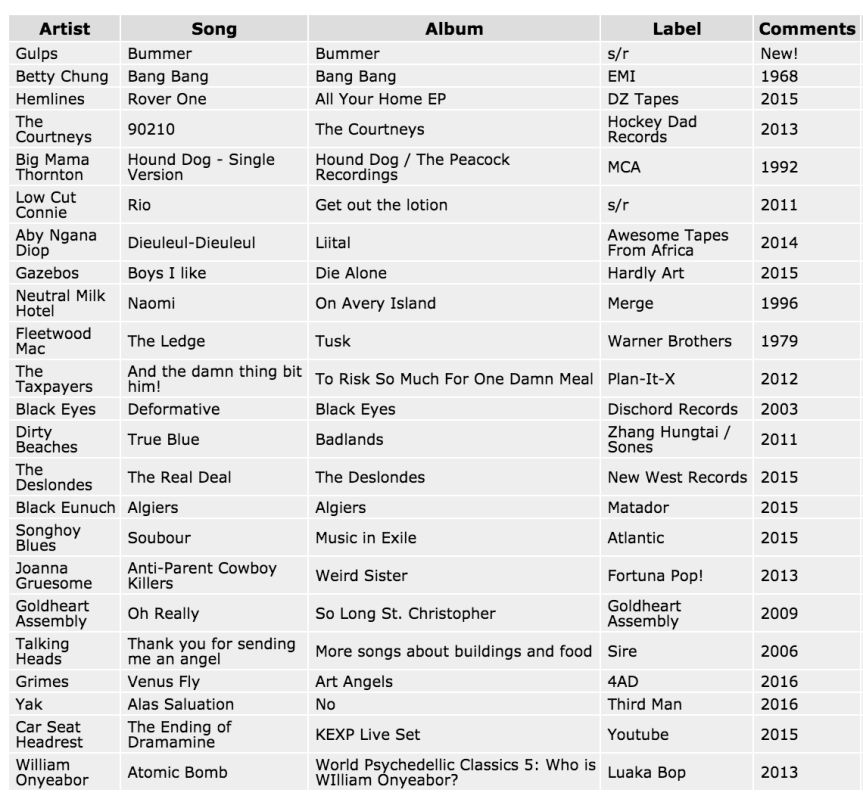
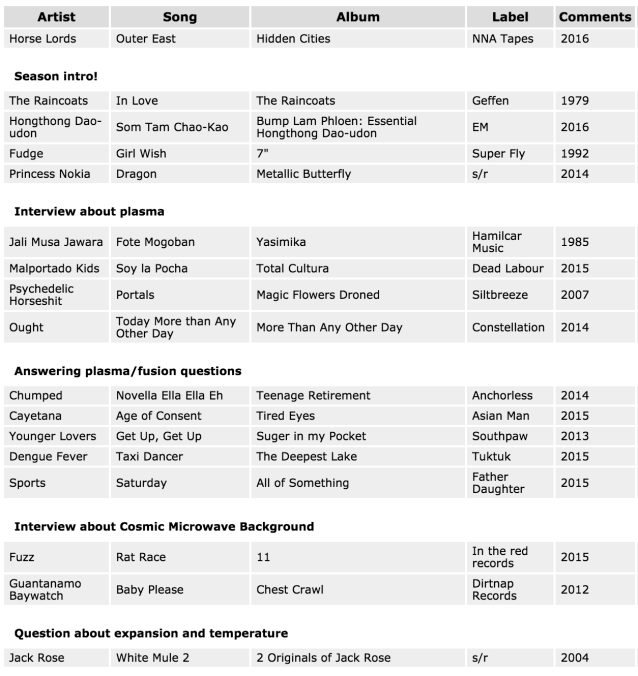
Playlist:
Artist
Song
Album
Label
Iggy Pop
The Passenger
Lust for Life
Virgin
Introduction to the show
First Aid Kit
Winter is all over you
The Big Black and the Blue
Jagadamba
Anthony Berger interview, Pt. 1
Biomed Engineering and Cellular Decision Making
Tacocat
I hate the weekend
Lost Time
s/r
Anthony Berger interview, Pt. 2
Biomed Engineering and Cellular Decision Making
Protomartyr
What the wall said
Under the color of official right
Hardly art
Mourn
Your brain is made of candy
Mourn
Captured tracks
Chastity Belt
IDC
Time to go home
Hardly Art
Hop Along
Waitress
Painted Shut
Saddle Creek
Paul Simon (General MD Shirinda, The Gaza Sisters)
I know what I know
Graceland
Sony
Anthony Berger interview, Pt. 3
Discussing the music
Bad Brains
I against I
I against I
s/r
Shilpa Ray
Johnny Thunders Fantasy Space Camp
Last Year’s Savage
Northern Spy
Girl Band
In Plastic
Holding Hands With Jamie
Rough Trade
Sylvan Esso
Come down
Syvan Esso
Partisan Records
Daddy Issues
Shitty World
Can We Still Hang
Infinity Cat
Bob Dylan
Pledging My Time – Take 1 (3/8/1966)
Bob Dylan, the cutting edge sampler 1965-1966 (Bootleg Series Vol 12)





 Colin walked us through his life as a theoretical astrophysicist that “lives close to the data,” and what that means. He explained how the Sunyaev-Zeldovich effect blurs the cosmic microwave background, and how that tells us about the matter distribution in the universe.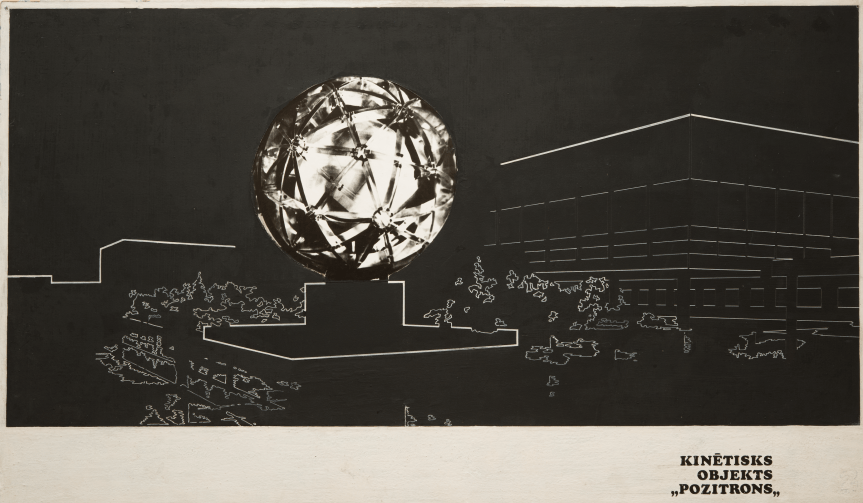






 In this special show for WPRB’s all-vinyl week, Brian covers the tunes and Stevie speaks to our guests, Princeton graduate researchers Nick Davy and Melda Sezen. It was beautiful chaos in the studio.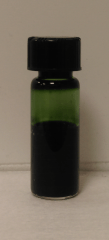
 are fabricating and improving the technology. We then dive in to other applications of organic solar cells and polyaniline, for example wearable technology.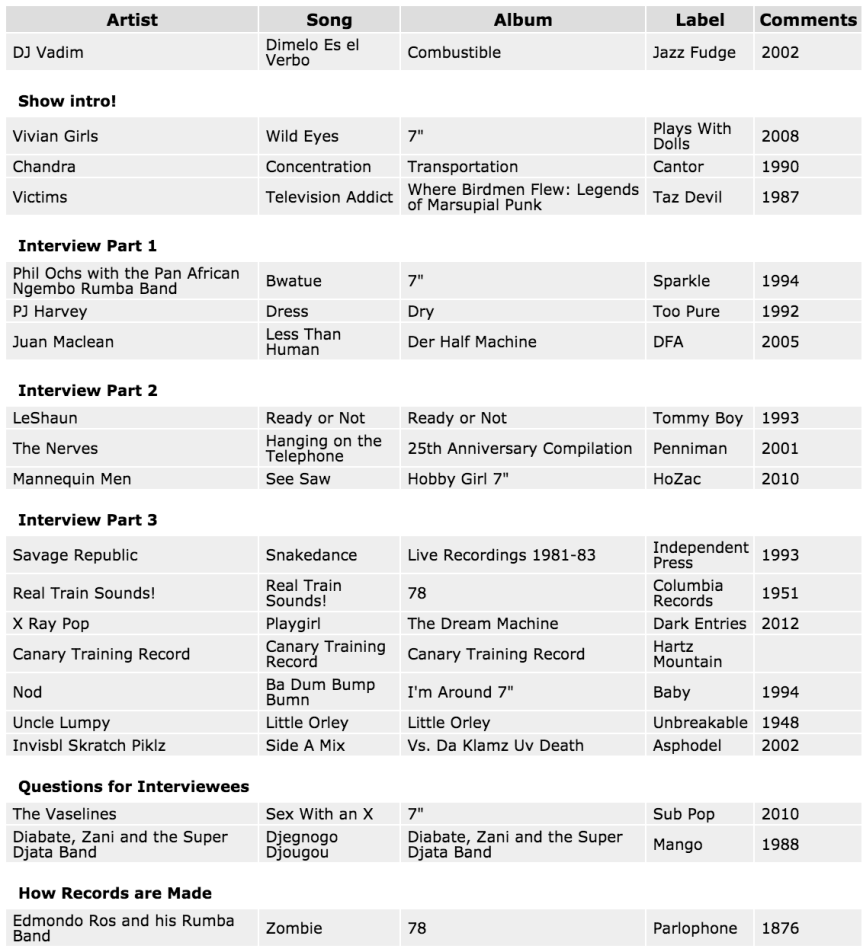


 force, this comes about because of particle exchange. But when two objects are gravitationally attracted to each other, this comes about due to the fact that massive objects actually warp the spacetime around them. Like when you sit on your bed with lots of stuff on it and everything falls in to you. Alternatively, think of a rubber sheet pulled taught with a bowling ball set on it. The bowling ball warps the sheet, causing any marbles
 gravitational wave is an oscillation in spacetime. Think of it like a stretching and compressing of a small bit of space – first vertically stretched and horizontally compressed, then horizontally stretched and vertically compressed, and again and again, back and forth – but that stretching and compressing action is traveling, at the speed of light, away from its source.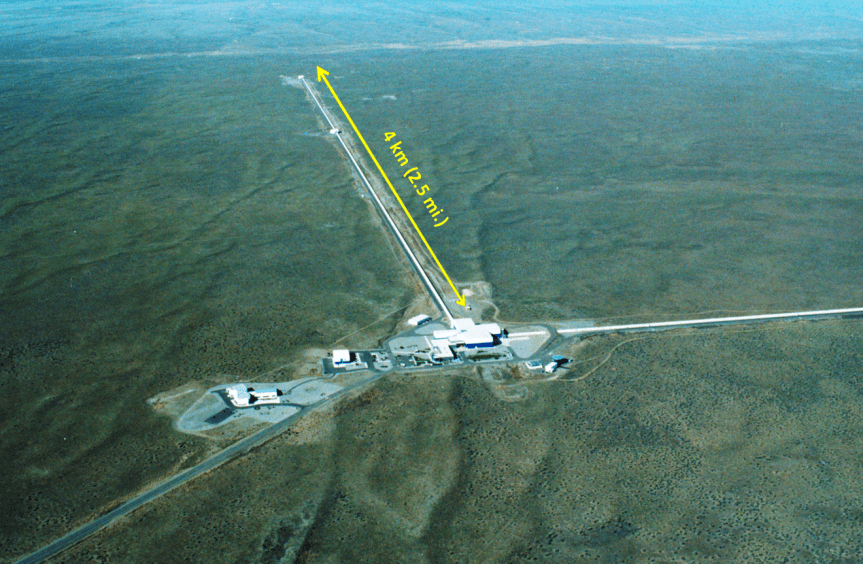





 These Vibes Are Too Cosmic