3/28/17 Show feat. Stephen Pacala on measuring the impact of climate change

syria_drought

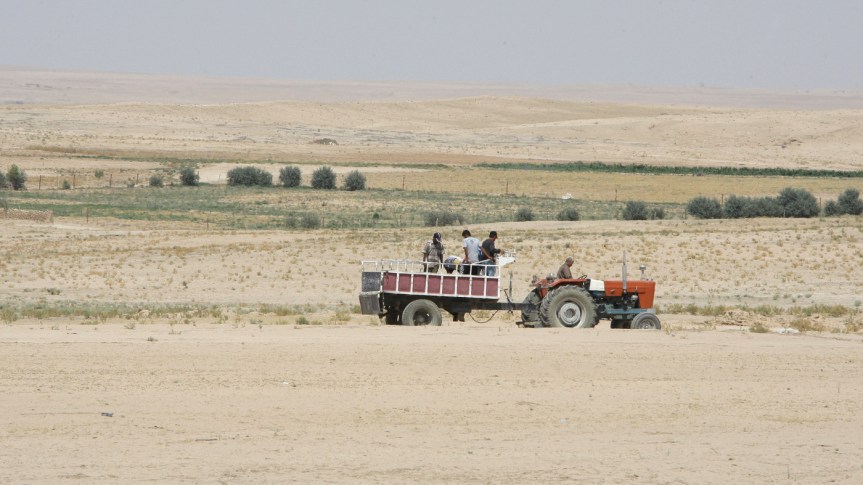
Featured image: A recent drought in Syria is one of the factors that prompted mass migration to cities and eventual civil war–and researchers are implicating man-made climate change as causing it. (Courtesy NPR)

Very unfortunately, the show tonight was not recorded due to technical difficulties at WPRB. Sorry about that! 

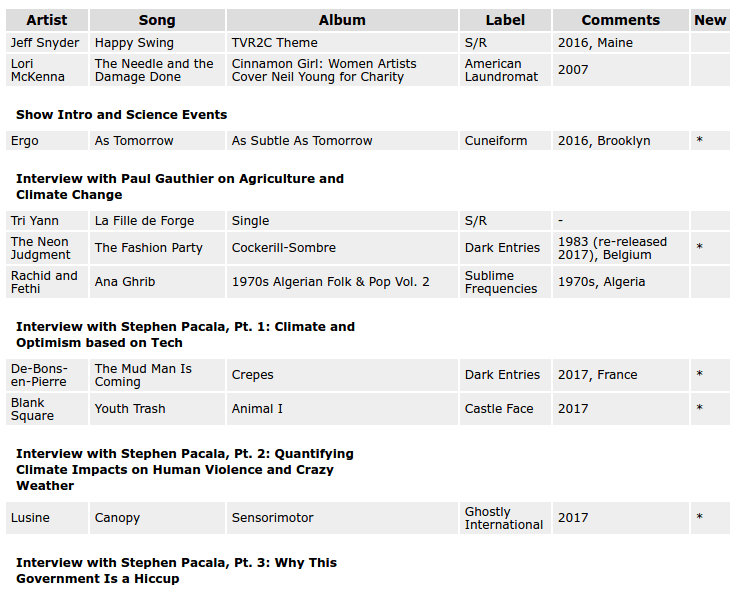
Today we hone in on climate change by talking with Dr. Stephen Pacala of Princeton’s Department of Ecology and Evolutionary Biology. Dr. Pacala’s new class on the Environmental Nexus investigates the worldwide interplay between agriculture, biodiversity, and climate, so we’ll speak about how these systems feed into each other. What do our coupled studies of the market and worldwide climate tell us about enacting environmental policies today? As Dr. Pacala informs us, we have the technology today to avoid many of the worst consequences of increased carbon dioxide in the atmosphere–it’s only a matter of doing the hard work of applying this technology to our agriculture, electricity grid, and so on. As he claims, humanity is trending towards solving these problems, present politics in the US aside.

Further, we spoke at length about how scientists quantify the impact of climate change. How can we know whether fossil fuel emissions are really at fault for causing the death of  the Great Barrier Reef, or for the recent flooding of Louisiana? Scientists can now pinpoint the change in risk of extreme weather due to human-introduced pollution, and the results are startling. Even more, we can now say that humans have caused instances of climate change in Africa, which in turn have made conflicts more likely. Studies like this rely on statistical methods, which they use to show impressively disastrous links between pollution and human life.

Before Dr. Pacala joined us, I brought on former guest Dr. Paul Gauthier to talk about the interplay between plants and our atmosphere. Can more carbon dioxide help plants grow? Is faster food always better? And above all, how do we manage a growing population with a food supply in danger?

The full playlist is available on WPRB.com or below.
tvr2c_playlist_032817

3/21/17 Show: Sabine Kastner and Michael Lemonick in The Science of Memory

LonniSue

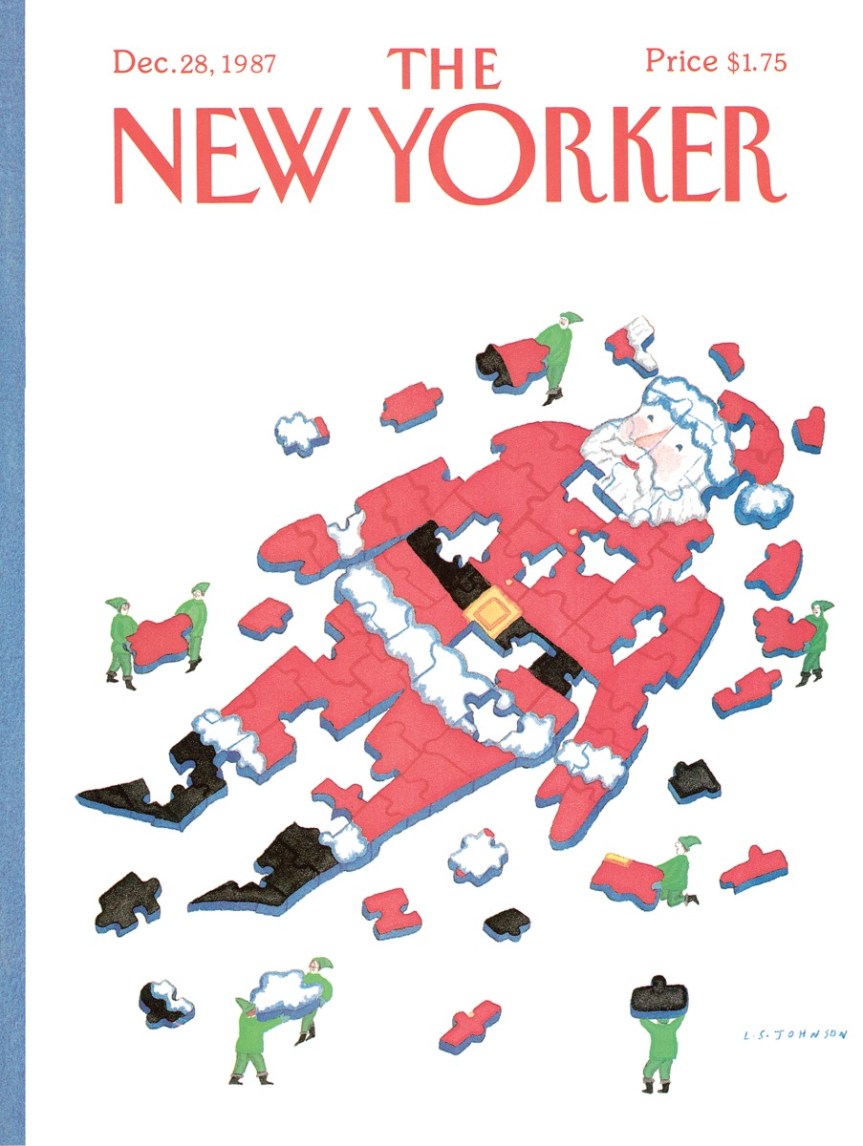
Featured image: A New Yorker cover from 1987 by Lonni Sue Johnson, artist and pilot who later became the amnesiac inspiration of Mike Lemonick’s The Perpetual Now.

Tonight, we’re finally airing the entirety of The Science of Memory, the live show that we put on with the Council of Science and Technology in February. We brought Mike Lemonick (Scientific American editor) and Sabine Kastner (Princeton neuroscientist) on stage to discuss the science of memory, amnesia, and how our brains learn. You’ll hear how Lonni Sue Johnson, a Princeton artist and airplane pilot, lost her ability to form new memories, and how her personality is intact despite being lost in the present. Alongside the science, the Princeton Laptop Orchestra played three original pieces, from an extended version of our theme song to one that translates neuron signals into noise. We had so much fun putting this show together for a live studio audience, so we hope you’ll enjoy the full performance broadcast!

liveEventPhoto.png
Neural event art for The Science of Memory, done expertly by Drew Wallace.

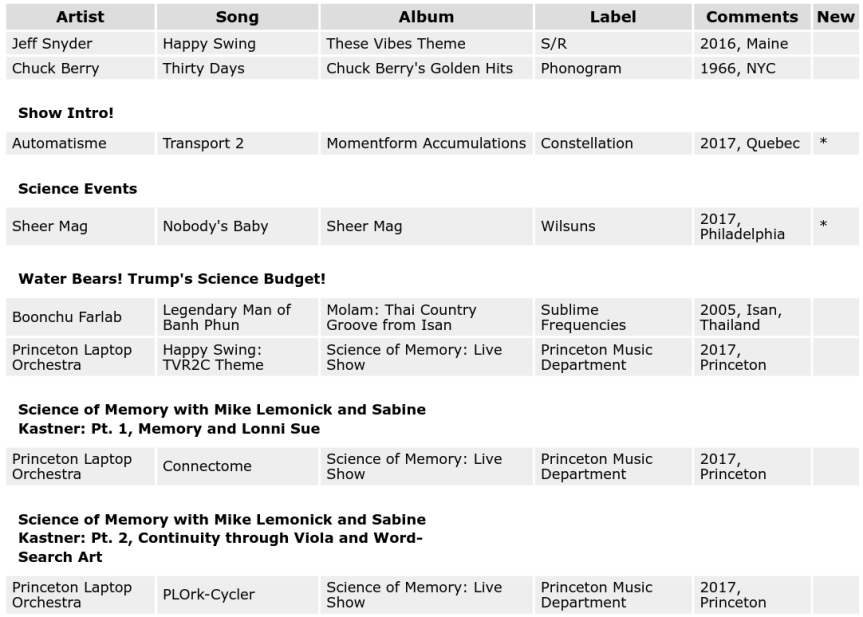
In addition to the recording, we start off the show with science events and:

The full playlist can be found on WPRB.com or below.

TVR2C_playlist_032117.png

2/28/17 Show feat. Jill Knapp on the Prison Teaching Initiative

prisonteaching_sanquentin

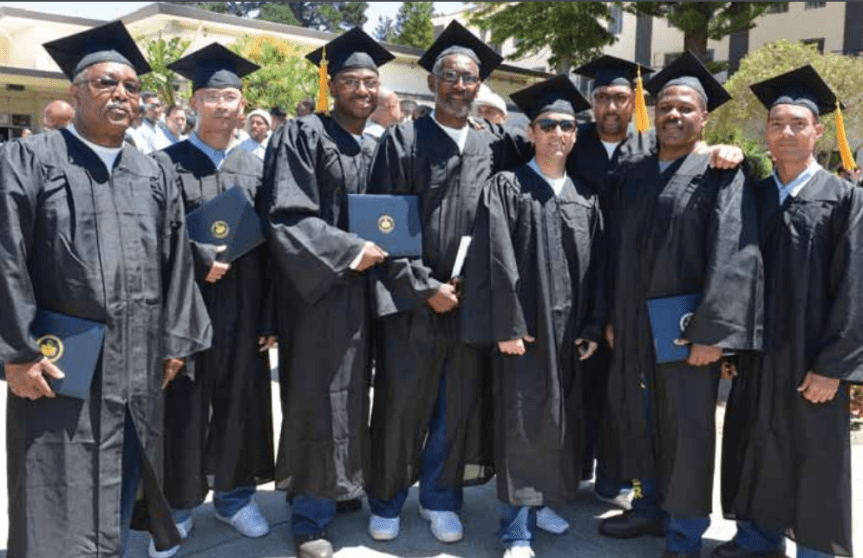
Featured image: A 2015 graduating class of inmates from San Quentin, California, thanks to the Prison University Project (which inspired PTI Princeton).

In today’s packed show, we start off fifteen minutes in with regular guest and History of Science expert Ingrid Ockert. Her review of Peter Kuznick’s Beyond the Laboratory covered scientists-turned-activists from the 1930s, who rose to protest the corporate causes of the Great Depression and the growth of Nazi Germany.

Next, 45 minutes in, we welcome Jill Knapp, Professor of Astrophysics and co-founder of the Princeton Teaching Initiative. Jill tells her story as an advocate for New Jersey inmates, and how she leads a cohort of volunteers that design curricula and teach college courses in local prisons. Eventually, we turn to the overarching issues: how can education help break the cycle of mass incarceration in America?

Where there’s time, we fill you in on local science events, exoplanet news, and why light bends around heavy objects. Thanks for listening!

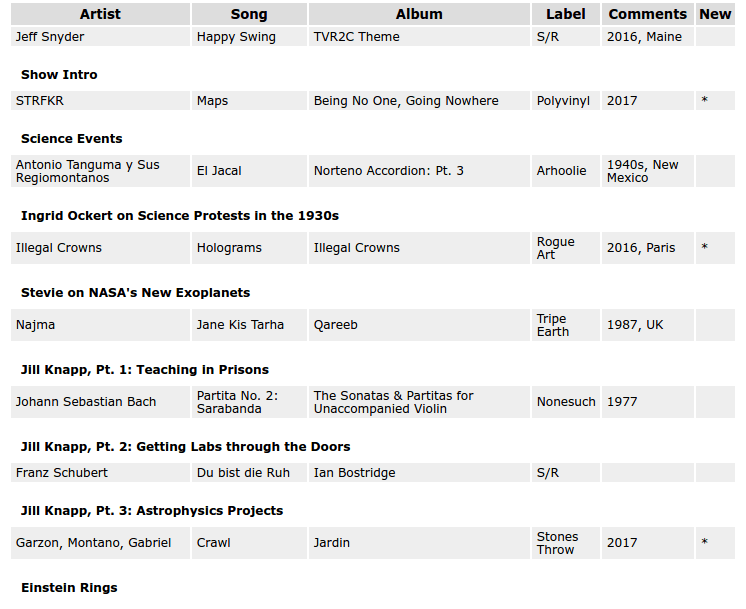
The playlist can be found on WPRB.com or below.

tvr2c_playlist_022817

2/14/17 Show feat. Kaz Uyehara on tree competition and flammability

forestfire

Featured image: A forest fire burns in the Big Cyprus National Preserve, a disturbance which some trees have been shoring up against for their whole lives. (Courtesy NPS and Christopher Derman)

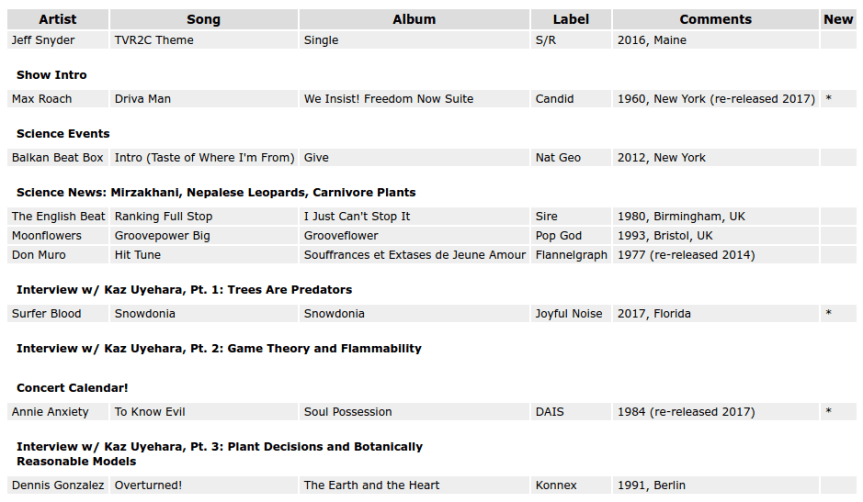
This week, our show features Kaz Uyehara of Princeton’s Ecology and Evolutionary Biology Department. As an expert on plant modeling, Kaz has studied why some forests are especially flammable (like the Pine Barrens near Atlantic City). What evolutionary benefit does a tree gain from being easy to burn? How can we model such a self-destructive trait with game theory?

Kaz also investigates the computerization of plant growth, building trees of all ages into simulations used for long-term climate studies. Are there overarching rules that regulate how plants grow larger and taller, and can we codify them into mathematics that make botanical sense? Writing these into a model would allow us to understand why trees are different shapes and have different behaviors.

nrs-2010-001The interview starts 45 minutes into the show, but the introduction has science events, English Beat tickets, and more.
Check out these extras below:

As always, the playlist for the show is on WPRB.com or below.

tvr2c_playlist_021417

1/31/17 Show feat. Patrick Phillips on his novel Blood at the Root: A Racial Cleansing in America

blogphillips1.jpg

Featured image: A photo from the Atlanta Constitution, showing three National Guardsmen defending six black prisoners, whose tale forms the core of Blood at the Root (Patrick’s research began with this photo).

This week’s show starts with Drew University professor and author Patrick Phillips, taking a deep look at his new book Blood at the Root. The novel covers the expulsion of all black residents from Forsyth County, Georgia, which began in violence in 1912 and lasted up through the 1980s. In his expansive historical research, Patrick talks with the descendants of whites and blacks who participated in the evictions, and his book analyzes the deep societal divide that still hangs over modern America. How did this twisted series of events happen, and what can its still-lingering consequences tell us about race in the USA?

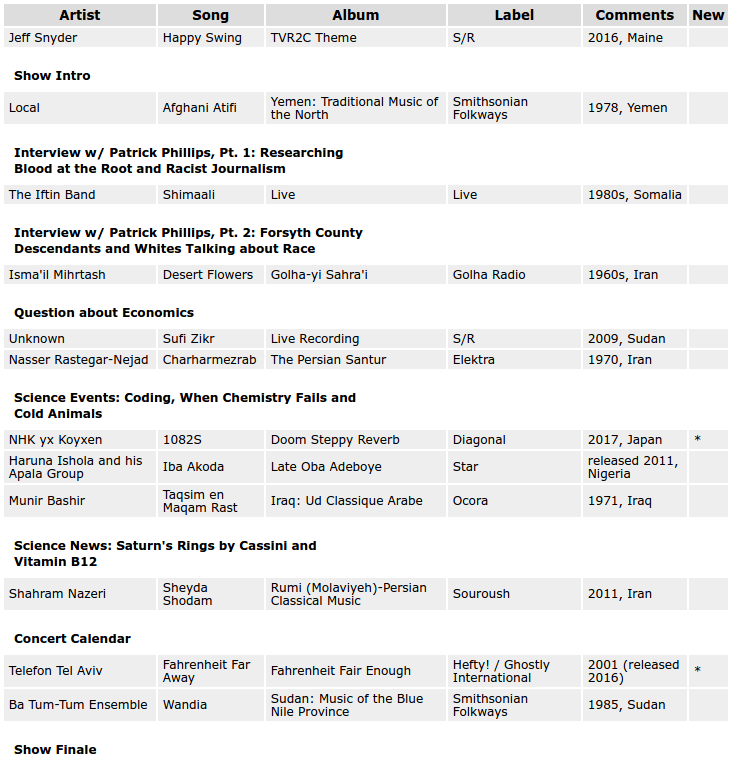
Otherwise, the show features exclusively Islamic music, and shares science news (from Saturn to pond goop in Washington) and local science events as always.

Specially recommended extra content:

cassini.jpg

The playlist can be found online at WPRB.com or below.

tvr2c_playlist_013117.png

1/24/17 Show feat. Mallika Randeria on imaging electrons and quantum behavior

mallika_electronripples_crop

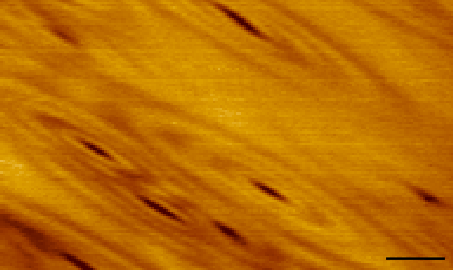
Featured image: Ripples of electron waves, imaged by Mallika in the Yadzani Lab on a bismuth crystal. (see the scientific paper here)

In today’s show we speak with doctoral researcher Mallika Randeria on her work in the Yazdani lab at Princeton University. As she explains in the interview, her research

bismuth
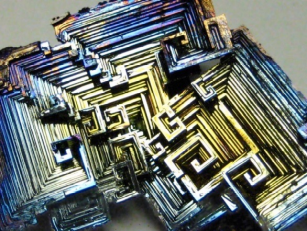
A bismuth crystal, as seen in intense detail above.

explores the quantum behavior of electrons in a magnetic field. In fact, she uses a powerful scanning-tunneling microscope to actually image the electrons! Last year her group became the first to ever accomplished this and they got some astounding and (almost) unexpected results! Tune in to the show if you want to learn about the weird quantum behavior of electrons and what they actually look like up close when they’re exhibiting quantum effects, how a scanning-tunneling microscope works (and about the one here at Princeton), and some of Mallika’s other research imagining the phenomenon of superconductivity.

groupphoto-1150
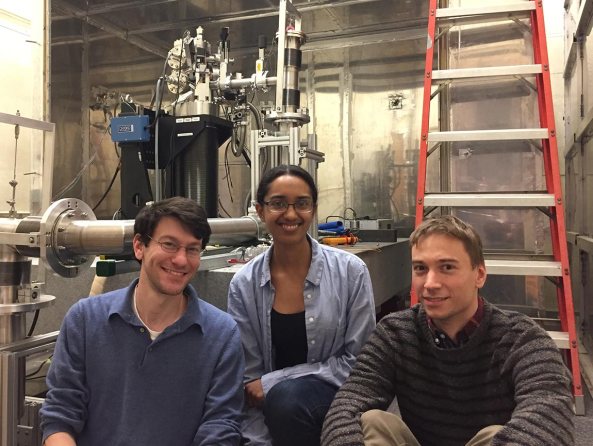
Mallika and cohort in the Yadzani lab with their vibration-proof scanning tunneling microscope.
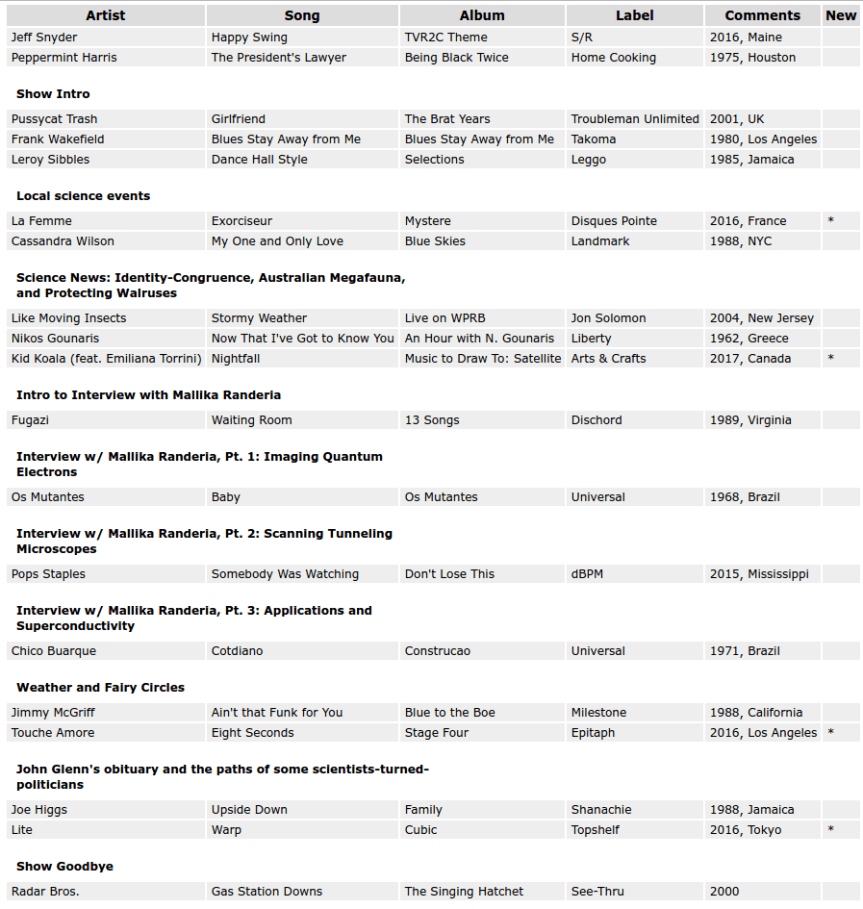
Later in the show, Brian overviews some notable examples of scientists who became politicians. Though they’re few and far between, they include names like the late John Glenn, German leader Angela Merkel, and Illinois senator Bob Foster. As always, we pepper the show with science news, events (featuring Science on Saturdays and the Princeton Public Library), and music from all over the world.

Get your fill of extras below:

  • Facts matter to people, as long as the facts fit into their preferred idea about the world–as shown in a new psychological metastudy.
  • Mallika’s research was featured in this popular science article: read to learn what a quantum Hall liquid is!
  • Australia used to be covered with giant mammals, but new fungus fossils indicate that humans are the culprits of their mass extinction.
  • The AAAS puts out a weekly overview of science news, including this bit about protecting walruses.

The playlist can be found on WPRB.com or below.

tvr2c_playlist_012417.png

1/17/17 Show feat. Mark Miller on wind turbines and scaled fluid dynamics + Lian Zhu on curiosity

Wind-turbine-simulator-siting-software-img31.png

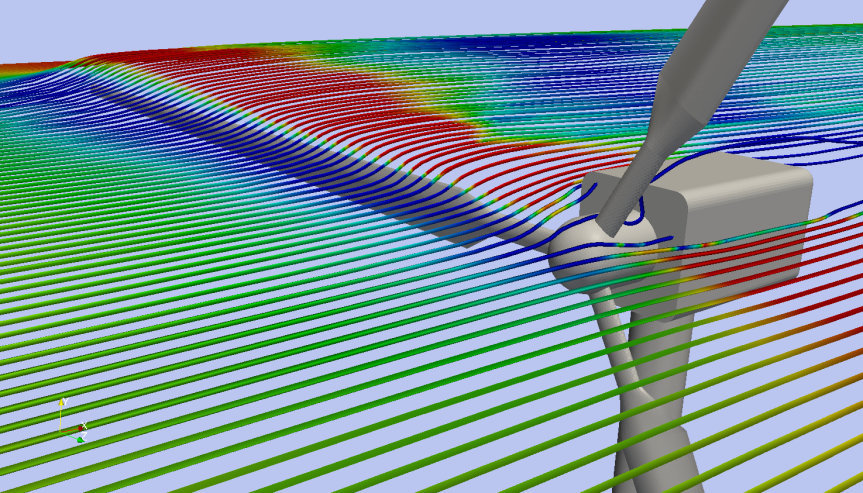
Featured image: Wind turbines mess with air flow, but the process can only be modeled in sophisticated labs or in computer codes like this Purdue University software.

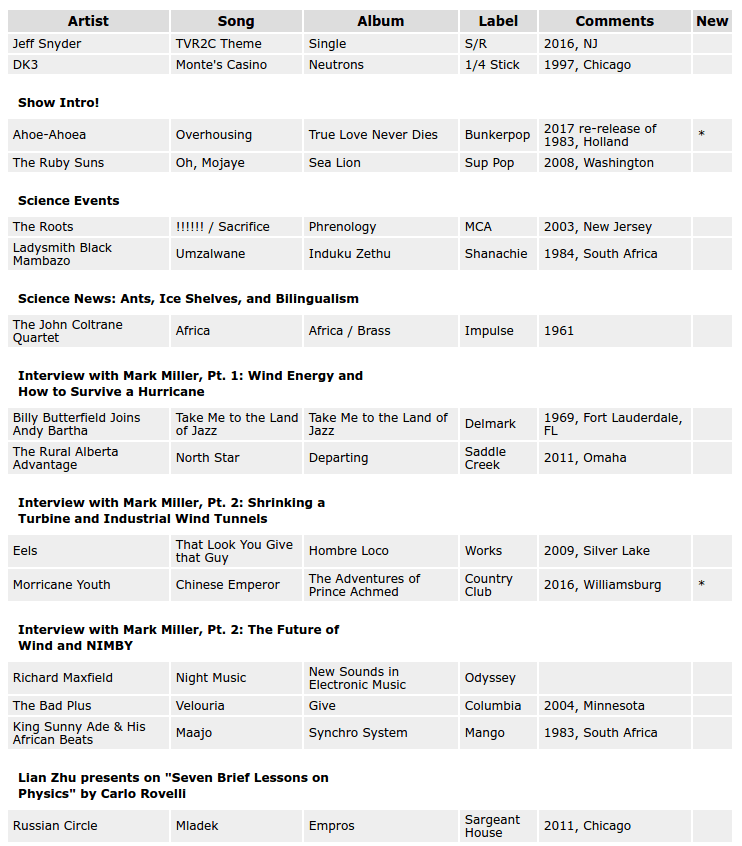
We welcome Mark Miller, a PhD candidate in Prof. Hultmark’s Gas Dynamics Lab, who knows all about the aerodynamics of wind turbines. Wind energy is a crucial component of the future’s energy landscape, but learning how to optimize their engineering is a work in progress. How should a windmill farm be laid out to maximize each turbine’s output? How can scientists model the air flow around windmills in lab-sized models? And finally, how does wind energy fit into the grid?

Before Mark’s interview an hour in, listen for science news about ant laziness to polar ice shelves melting. Later in the show, former guest Lian Zhu returns to dive into the philosophy of curiosity (detailed in Carlo Rovelli’s new book, Seven Brief Lessons on Physics).

Resources to enjoy:

The playlist for the show can be found on WPRB.com or below.

TVR2C_playlist_011717.png

1/3/17 Show feat. Jacob Schwartz on nuclear waste and sending warnings to future civilizations

nuclearwarningsouthafrica

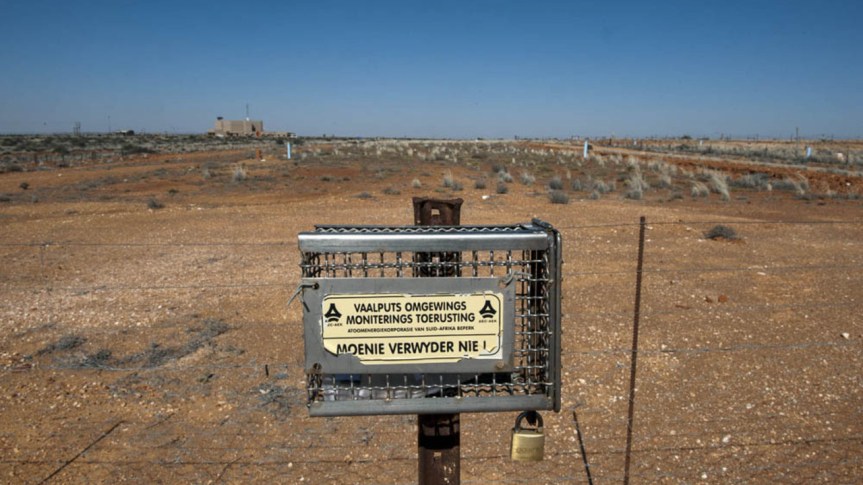
Featured image: The Vaalputs nuclear waste site in South Africa, guarded (for the present) with fences and signposts. Can this strategy ward off the next 10,000 years of civilization? (Courtesy Mail & Guardian)

This week features Jacob Schwartz, a PhD candidate in plasma physics here at Princeton, who brings us a deep concern: what should we do with our nuclear waste? Fission plants produce radioactive byproducts over time, and these concoctions will be dangerous to life for millennia. At the WIPP facility in New Mexico, scientists are testing many methods for safe storage of radioactive materials. Even more intriguingly, reports from WIPP contemplate strategies for warding off future civilizations, communicating across the centuries that an area is unhealthy to inhabit. How can we send messages on the timescales of the pyramids? How far do duty or ethics push us to confine our nuclear waste?

Elsewhere in the show, we cover the geology of northern Iraq and the dangers it poses to a dam near Mosul. Plus, look forward to a scientific 2017 with epigenetics, artificial intelligence and biometric identification. Throughout you can enjoy lots of jazz, blues, and music from Western Africa.

Resources to enjoy:

  • The full, 350-page Sandia report on waste storage at WIPP is easily accessible online.
  • The “Ten Thousand Years” episode of the 99% Invisible podcast covers the same topic of WIPP’s nuclear containment, but with relevant music!
  • Official reports on the Mosul dam’s condition are raising concerns that gypsum under a dam could endanger millions of people.
  • Artificial intelligence may boom in 2017, but it also poses risks we ought to be aware of.
  • The Long Now Foundation, which includes Amazon’s Jeff Bezos, is also interested in communicating with the future, but by means of building a durable mountaintop clock.
  • The Ray Cat Solution says that if we can’t convince people to avoid nuclear waste with signs, we could do it with mythology and genetically-engineered color-changing cats.
  • A documentary Into Eternity explains Finnish strategies on the waste storage problem, and another film Containment goes into much more detail about WIPP.

The playlist can be found on WPRB.com or below.

tvr2c_playlist_010317.png

12/20/16 Show feat. Matt Grobis on scientist-public relations + 2016 in review

billnye_msnbc_literal_140204

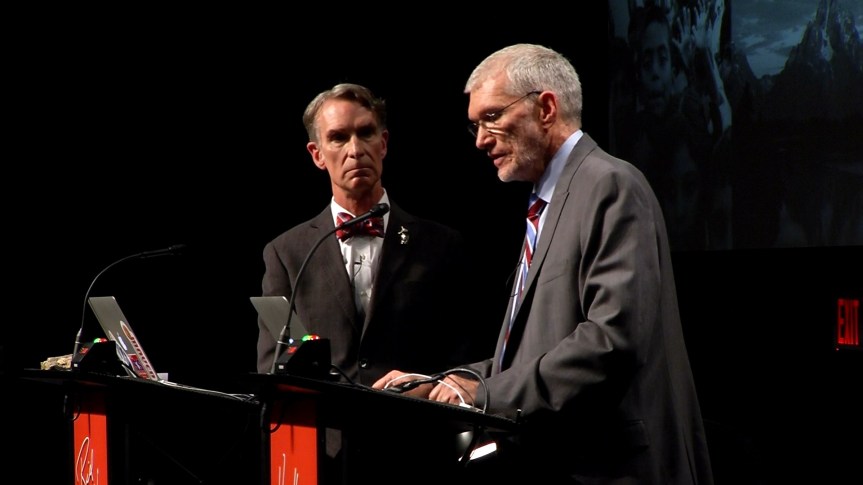
Featured image: Famed science advocate Bill Nye debates creationist Ken Ham on evolution in one of the most watched scientific debates in recent memory. (Courtesy NBC)

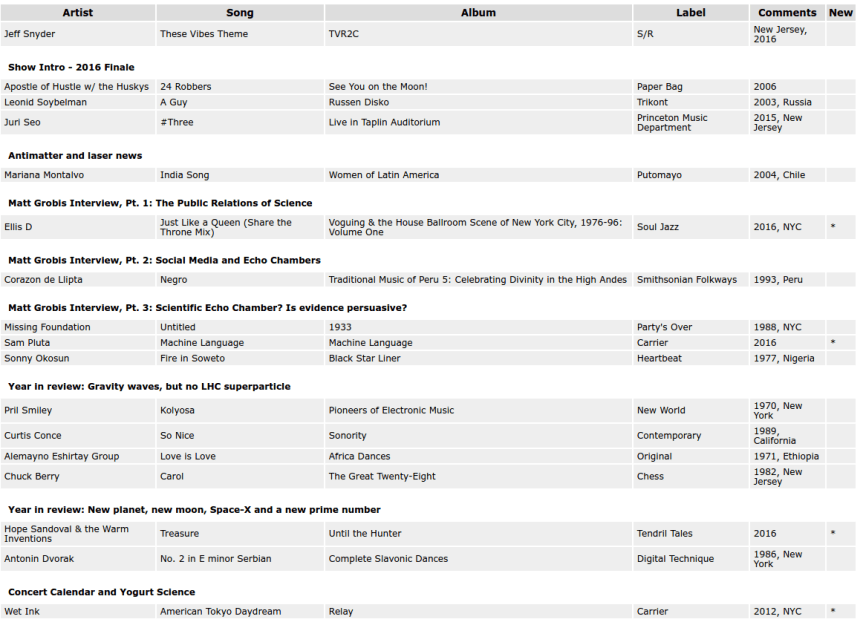
In this final show of the year, Matt Grobis (a regular guest and graduate student in EEB) comes on to talk through the urgent topic of public outreach by scientists. In a media landscape where evidence doesn’t always count, how can scientists defend their research to taxpayers and the government? Can we accurately gauge public understanding of science, and whether the public is divided over our research? Finally, we contemplate echo chambers in society and the accusation that the scientific community itself is an echo chamber.

On top of that, listen for yogurt science, holiday/science events, and an overview of some of this year’s biggest discoveries: from gravity waves to the superparticle that wasn’t, to new prime numbers, planets and moons.

Thanks for listening to These Vibes Are Too Cosmic all through 2016! It’s our goal to keep up the quality science news and entertainment through the exciting discoveries of 2017. Never hesitate to contact us with show ideas if you have them!

For further information:

The playlist for the show is online at WPRB.com or below.

tvr2c_playlist122016


12/6/16 Show feat. Yann Koby on trade economics and the US election + Ingrid on trusting scientists

ChinaShipping2-772536.jpg

Featured image: a cargo ship, ferrying a pile of our everyday goods across the Pacific Ocean. Increases in ship traffic attracted the attention of Eric Stone, photographer.

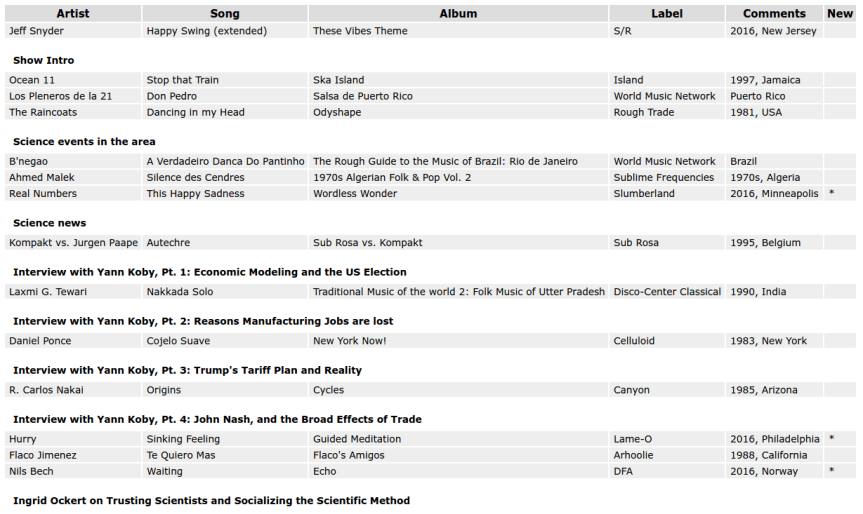
This week, Yann Koby of Princeton’s Department of Economics comes on the air, focusing on the economics of the US manufacturing sector. We examine economic modeling and prediction, especially concerning the flow of jobs in and out of the US due to trade with other countries. How do trade policies between large nations affect the structure of our economy? How does job availability in the US affect politics? Specifically, Yann theorized about the recent election: Trump bet his candidacy on the connection between globalization and jobs. Was he right that increased trade put Americans out of work? What effects on the US and world economy might we expect out of the upcoming administration? Listen in to the interview (starting an hour in to the recording) to find out!

Later in the show, regular guest Ingrid Ockert reviews a lecture series by Naomi Oreskes on scientists as Merchants of Doubt. When have scientists peddled misinformation, and when should we trust them?

Other relevant info and background:

  • Yann Koby maintains a blog, visible here (some articles are in English!).
  • Solar panels have broken even, making as much energy as it’s cost to produce them for decades.
  • We’ve long theorized about dark matter, but have never seen it. Some suspect it might not exist at all – hear Stevie’s careful analysis in the show.
  • Genetic engineering is making plants grow faster – demonstrated in tobacco but useful for fighting worldwide hunger.

The full playlist is online at WPRB.com or below.

tvr2c_playlist_120616.png